
Number sequences and regularities hold a special place in the history of mathematics. For a long time, mathematicians have observed series of values to understand the rule connecting them. This search for patterns has contributed to the development of arithmetic, algebra, and subsequently, many tools used to study phenomena that evolve according to a precise logic.
The value of these challenges lies not only in calculations. They primarily teach us to observe, compare, and hypothesize. This ability to recognize a rule is now found in computer science, data analysis, the sciences, and in many situations where understanding how one value is derived from another is essential.
“Mathematics is the art of giving the same name to different things.” — Henri Poincaré
This quote aptly reflects today’s challenge: behind several seemingly different equalities may lie a single common rule.
When faced with such a challenge, it is common to immediately seek a complicated operation. However, the initial values often provide valuable clues. By carefully comparing each line, one can sometimes uncover a very simple relationship that applies universally. It’s a good habit to observe multiple examples before deciding which rule to apply.
What This Challenge Allows You to Work On:
- Observation of numbers;
- Searching for regularities;
- Logical reasoning;
- Formulating a rule;
- Verifying a hypothesis;
- Mental calculation;
- Speed and concentration.
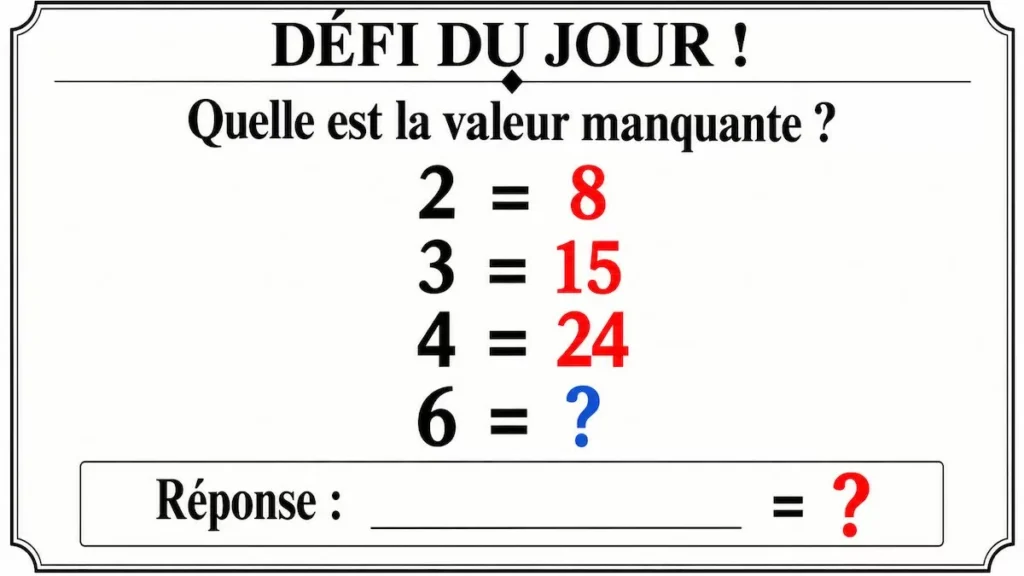
DAILY CHALLENGE!
What is the missing value?
The same rule should allow you to find the first three equalities.
You have 10 seconds to discover it.
The Countdown Begins
10…
9…
8…
7…
6…
5…
4…
3…
2…
1…
Time’s up!
What Your Performance Can Reveal
If you found the answer quickly and correctly, you have excellent logic and good analytical skills.
If you found the answer after some thought, you are able to structure your reasoning and check your steps.
And if your answer was incorrect or you didn’t find it, no worries; this type of exercise is perfect for improving method and precision.
Detailed Solution We Found (Not Necessarily the Only One, Sometimes Even the Correct One)
Let’s observe the first equalities.
For 2, we have:
2 × 4 = 8
For 3:
3 × 5 = 15
For 4:
4 × 6 = 24
We notice that the second factor is always 2 more than the first number.
Therefore, the rule can be expressed as:
n × (n + 2)
Let’s verify:
2 × (2 + 2) = 8
3 × (3 + 2) = 15
4 × (4 + 2) = 24
The rule works well for all the proposed lines.
For 6, we apply the same rule:
6 × (6 + 2)
6 × 8 = 48
Answer: 48
Conclusion
This challenge illustrates that a sequence of numbers can conceal a very simple rule. Here, it was necessary to notice that each number was multiplied by the number located two units further: 2 by 4, 3 by 5, 4 by 6, and thus 6 by 8.
The key point was not to calculate quickly, but to identify a regularity and then verify that it holds true for all the given equalities.
If you found 48 before the countdown ended, well done! And if you imagined another rule, that too is an interesting aspect of this type of puzzle: with only a few examples, several rules can sometimes be devised. Here, 48 corresponds to the simple regularity expected by the challenge.
And before you get lost in the depths of the web, explore more games and tests by clicking here.