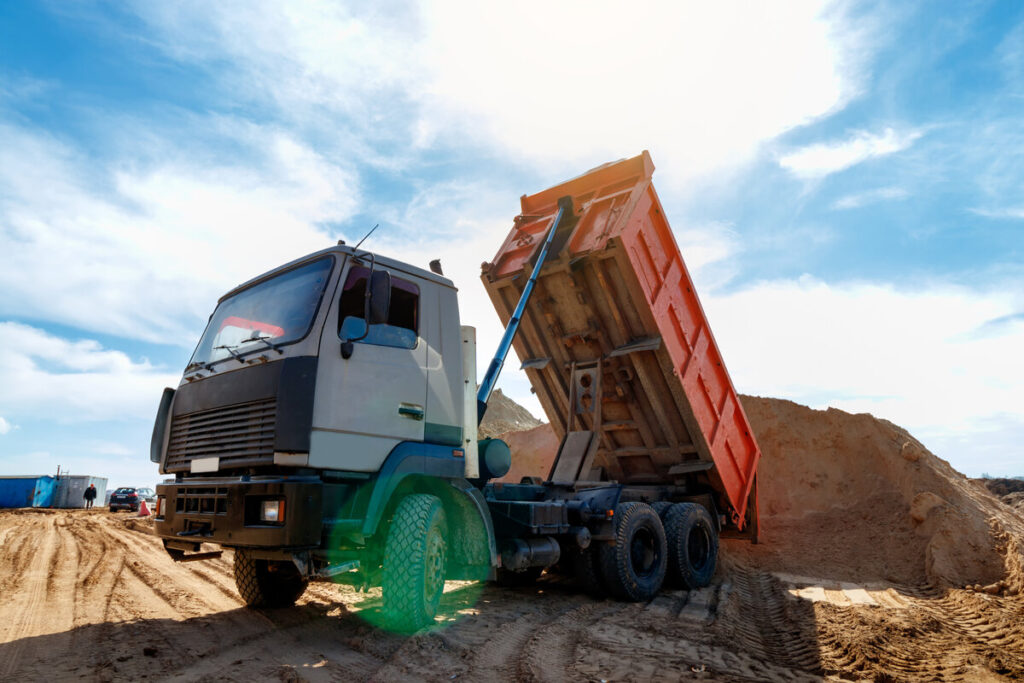
A supplier quotes you a price “per brass” of sand, and your engineer gave you the quantity in cubic metres. Before you pay, three numbers are all you need to check whether the truck at your gate carries what is on the bill.
Brass is a traditional unit that is still everywhere in the Indian construction industry. It sounds technical, but it is just a round number of feet. The only trap is that the same word is used for two different things, one for loose material and one for work done on a surface.
Number 1: one brass of material is 100 cubic feet
When you buy sand, gravel or rubble by the brass, you are buying a volume. One brass equals exactly 100 cubic feet of loose material. So the formula is simple: multiply length, width and height in feet, then divide by 100.
Brass = length (ft) × width (ft) × height (ft) ÷ 100
Here is a real example. A tipper arrives and you measure the load in its body: 12 ft long, 6 ft wide and 1 ft 6 in deep. First turn the inches into feet: 6 inches is half a foot, so the depth is 1.5 ft (not 1.6, a very common slip). Then:
- 12 × 6 × 1.5 = 108 cubic feet
- 108 ÷ 100 = 1.08 brass
If the bill says 1.5 brass, you are paying for 0.42 brass, or 42 cubic feet, that never reached your site. At a made-up price of ₹5,000 per brass (just to show the math), that gap is worth ₹2,100 on a single load.
Number 2: one brass is about 2.83 cubic metres
Drawings and estimates prepared by engineers are often in metric units, while sand suppliers in many places still talk in brass. The bridge between the two is 1 brass ≈ 2.83 cubic metres (100 cubic feet, with 1 foot = 0.3048 metres).
- Metres to brass: divide by 2.83. If your estimate says you need 5 m³ of sand, that is 5 ÷ 2.83 ≈ 1.77 brass.
- Brass to metres: multiply by 2.83. An order of 3 brass is 3 × 2.83 ≈ 8.49 m³.
The mistake to avoid here is measuring a heap in metres and still dividing by 100. That shortcut only works when every dimension is in feet.
Number 3: one brass of work is 100 square feet
Here is where people get confused. For jobs measured on a surface, such as plastering, painting, brickwork or tiling, a brass means 100 square feet of area, not a volume. Contractors may quote labour “per brass” in this sense.
Say you need plaster on two walls, each 24 ft long and 10 ft high:
- One wall: 24 × 10 = 240 square feet
- Two walls: 480 square feet
- 480 ÷ 100 = 4.8 brass of plaster work
Those 4.8 brass describe the wall area. They tell you nothing directly about how many brass of sand the plaster mix will use, so never compare the two numbers on a quote as if they were the same unit.
The same 100 square feet has another name abroad: in North American construction it is called a square, and roofers measure a roof in square feet before converting it to squares.
Common mistakes when buying by the brass
- Mixing up area and volume. Always ask whether a “brass” on a quote is material (cubic feet) or work (square feet).
- Converting inches badly. 3 inches is 0.25 ft, 6 inches is 0.5 ft, 9 inches is 0.75 ft. Divide inches by 12, never by 10.
- Comparing prices from far away. Aggregate is heavy and cheap, and moving it more than about 40 km by truck is generally not economical, which is why quarries are local and a price per brass can differ a lot from one area to the next.
Check your numbers in seconds
If you would rather not do the multiplication by hand, the brass volume calculator takes length, width and height in feet, inches, metres or other units and gives the result in brass. For plastering, painting or tiling jobs, use the brass area calculator instead.