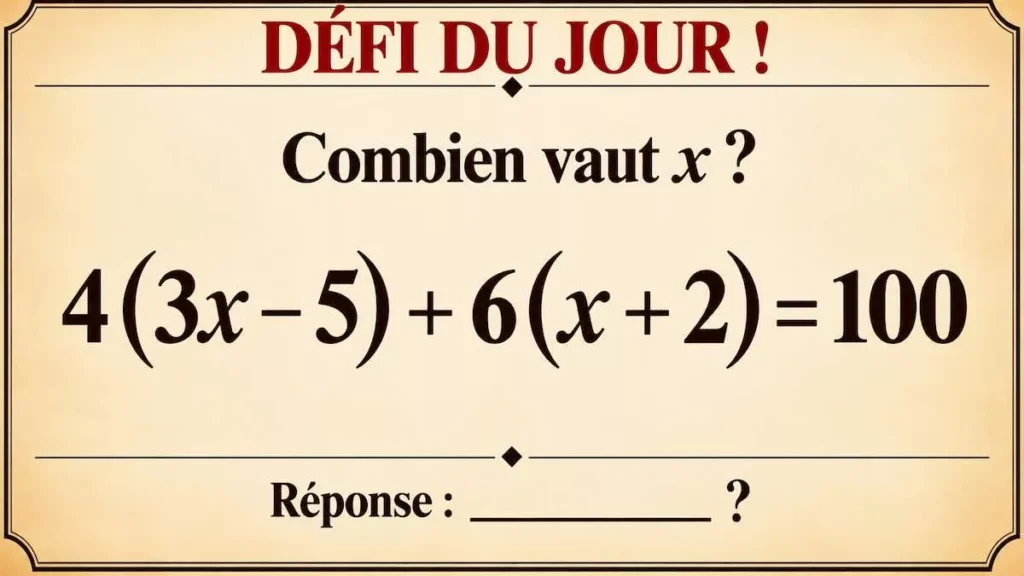
Imagine a somewhat strange story: a mathematician enters a room and discovers an equation written on a board, but no one knows who left it there. Two parentheses, several numbers, and a mysterious letter seem to form a secret message. Intrigued, he decides to solve this riddle, convinced that a particular rule lies hidden behind all these symbols. Moments later, he realizes that the true secret is not in the numbers themselves, but in the way they are organized. This little imaginary story perfectly illustrates what makes mathematics so exciting. For centuries, mathematics has allowed us to understand phenomena that once seemed inexplicable, such as the movement of planets or the propagation of light. Today, equations are used to build satellites, program computers, forecast certain weather phenomena, and design medical technologies. Behind these extraordinary achievements often lie rules that we learn from the early years of algebra.
We sometimes remember those exercises where we encounter an equation filled with parentheses and numbers that seem to mix in all directions. It can feel like we need to perform a multitude of calculations to find the answer. However, as soon as we apply the right rules and move step by step, everything becomes much clearer. This is how we discover that mathematics is not just about numbers, but also a wonderful school of logic and reasoning.
Quote of the Day
“The essence of mathematics is freedom.” Georg Cantor
Mathematics allows us to explore different methods for solving the same problem. It encourages us to search, to experiment, and to develop our reasoning. Each equation then becomes an opportunity to discover a new way of thinking.
What This Challenge Helps Develop:
This challenge reinforces mastery of distributivity, an essential rule for solving equations containing parentheses. It also trains us to group like terms, perform calculations accurately, and isolate a variable. These skills form important foundations for progressing in algebra. It also enhances concentration, quick thinking, and the ability to organize the different steps of reasoning. When we learn to solve an equation methodically, we develop habits that are useful in many everyday situations. The goal is not only to find a number but to understand why that number is the correct answer.
Challenge Presentation
Today, I present you with an equation that seems complicated but hides an accessible solution for anyone familiar with the right rules. You will need to expand two parentheses, simplify the calculations, and discover the value of x. Be careful, every sign counts, and a small mistake can completely change the result.
Here is your equation:
What is the value of x?
You have only 50 seconds to find the correct answer. Pay close attention to the numbers in front of the parentheses and think about how to simplify this equation. Get ready to test your logic and calculation speed.
The Countdown Begins
50…
40…
30…
25…
20…
15…
10…
5…
4…
3…
2…
1…
Time’s up!
What Your Performance May Reveal
If you found the result quickly and correctly, you have excellent logic and analytical skills.
If you found the result after some thought, you know how to structure your reasoning and check your steps.
And if your result was incorrect or not found, no worries; this type of exercise is perfect for improving method and precision.
Detailed Solution We Found (not necessarily the only or even the correct one)
The time is now up, and it’s time to discover how to solve this equation. The main difficulty lies in the two parentheses, which can easily cause errors if calculated too quickly. But by correctly using distributivity, we will progressively simplify our equation until we find the value of x.
First Step: Observe Our Equation.
We have:
Our goal is to isolate the letter x to find its value. Before doing that, we need to eliminate the parentheses by multiplying each inner term by the number in front. This operation is called distributivity.
Second Step: Expand the First Parenthesis.
Let’s start with:
4(3x − 5)
We multiply 4 by each of the two terms:
4 × 3x = 12x
4 × (−5) = −20
We thus obtain:
4(3x − 5) = 12x − 20
The first parenthesis is now expanded. We can move on to the next one.
Third Step: Expand the Second Parenthesis.
We have:
6(x + 2)
Let’s apply the same method:
6 × x = 6x
6 × 2 = 12
We obtain:
6(x + 2) = 6x + 12
We now know the results of both expansions. We just need to combine them in our initial equation.
Fourth Step: Group Like Terms.
Our equation becomes:
12x − 20 + 6x + 12 = 100
First, let’s group the terms containing x:
12x + 6x = 18x
Next, let’s group the numbers:
−20 + 12 = −8
We thus obtain:
18x − 8 = 100
Our equation is now much simpler. We just need to isolate the variable.
Fifth Step: Find the Value of x.
Starting from:
18x − 8 = 100
Let’s add 8 to both sides of the equation:
18x = 100 + 8
Which gives:
18x = 108
Now, let’s divide both sides by 18:
x = 108 ÷ 18
We obtain:
x = 6