Imagine a mathematician who decides to measure the distance between two houses. Instead of taking out a tape measure and walking around the neighborhood, he grabs a sheet of paper, draws a few lines, and calmly announces the result. His neighbor, astonished, asks him, “How can you know this distance without moving?” The mathematician replies with a smile, “Thanks to geometry, my legs can rest while my brain does the work!” This little story perfectly illustrates one of the great strengths of mathematics: it allows us to solve problems without needing to measure everything directly. Since ancient times, mathematicians have developed methods to calculate distances, construct buildings, and understand the shapes around us. Even today, this knowledge is essential for designing bridges, guiding airplanes, creating maps, and launching satellites into space.
Sometimes, there are geometry problems that seem particularly complicated. We see several segments drawn in different directions, and we need to determine a distance that is not indicated anywhere. Initially, one might be tempted to add up all the lengths, only to realize that the true secret lies in carefully observing the horizontal and vertical directions. This is how we discover that in geometry, good reasoning can be much more effective than a long series of calculations.
Quote of the Day
“There is no royal road to geometry.” Euclid
This famous quote reminds us that mathematics requires attention, method, and perseverance. There are not always magical shortcuts to find a solution. But when we understand the right properties, even an impressive problem becomes much more accessible.
What This Challenge Allows You to Work On:
This challenge is an excellent exercise for developing geometric reasoning and the ability to analyze a figure. It specifically allows you to work on:
- Observing horizontal and vertical segments.
- Recognizing right angles and right triangles.
- Using the Pythagorean theorem.
- The ability to break down a complex figure into simpler elements.
- Concentration, logic, and accuracy in calculations.
These skills are useful far beyond school exercises. They are applied in architecture, construction, navigation, and many everyday situations.
Challenge Presentation
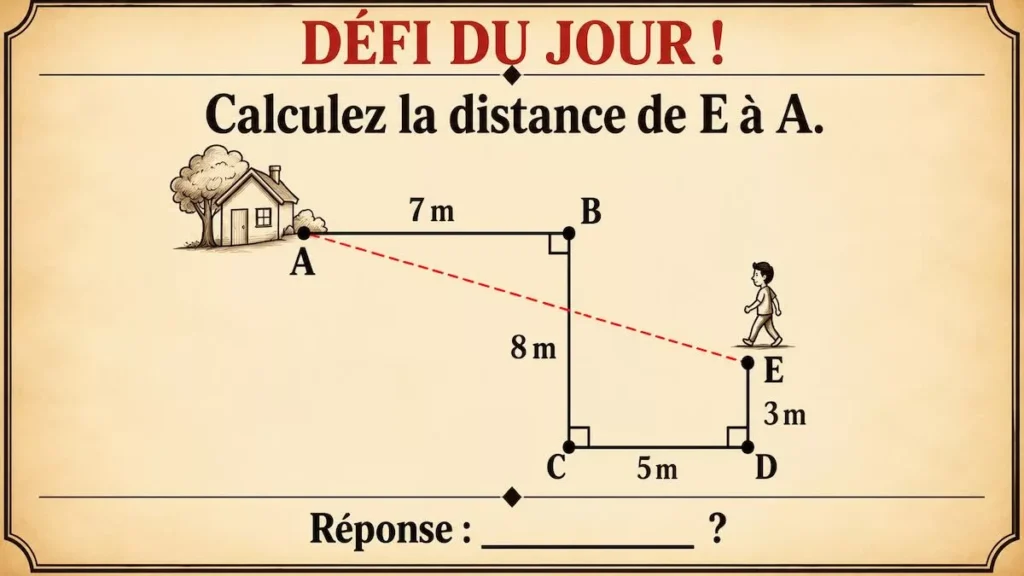
Today, I present to you a geometry challenge that may surprise you. In the image, we see a house located at point A and a person positioned at point E. Several segments connect points A, B, C, D, and E, with four measurements indicated.
Here is the information you have:
The angles marked in the figure are right angles.
Your mission: determine the direct distance between point A and point E.
Be careful, this is not about calculating the length of the path through all the points. We are looking for the straight-line distance, represented by the dashed red segment.
Do you think you can find the answer in just 50 seconds?
The Countdown Begins
50…
40…
30…
25…
20…
15…
10…
5…
4…
3…
2…
1…
Time’s up!
What Your Performance Can Reveal
If you found the result quickly and correctly, you have excellent logic and analytical skills.
If you found the result after some thought, you know how to structure your reasoning and check your steps.
And if your result was incorrect or you didn’t find it, no worries; this type of exercise is perfect for improving methodology and precision.
Detailed Solution We Found (Not Necessarily the Only One, Sometimes Even the Right One)
To solve this challenge, we must start by carefully observing the different directions. The figure contains horizontal and vertical segments that allow us to mentally construct a right triangle. The secret is to determine the two perpendicular sides of this triangle before applying a fundamental property of geometry.
First Step: Calculate the Horizontal Distance.
We note that segment AB measures 7 meters and segment CD measures 5 meters. These two segments are horizontal and oriented in the same direction. The total horizontal distance between A and E is therefore:
7 + 5 = 12 meters
We have now found the first side of our right triangle.
Second Step: Calculate the Height Difference.
Segment BC measures 8 meters and descends vertically from point B to point C. Meanwhile, segment DE measures 3 meters and ascends vertically from point D to point E. Therefore, the height difference between A and E is:
8 − 3 = 5 meters
Now we know the two perpendicular sides: 12 meters horizontally and 5 meters vertically.
Third Step: Apply the Pythagorean Theorem.
We can now envision a right triangle where the hypotenuse corresponds to the distance AE. The Pythagorean theorem tells us that the square of the hypotenuse is equal to the sum of the squares of the other two sides.
AE² = 12² + 5²
Let’s calculate the squares:
12² = 144
5² = 25
Now let’s add the results:
AE² = 144 + 25
AE² = 169
To find AE, we just need to calculate the square root of 169:
AE = √169
AE = 13 meters
Final Answer
The direct distance between point A and point E is 13 meters.
The secret to this challenge was not to add up all the visible lengths on the figure. First, we had to determine the horizontal displacement and the vertical displacement, and then use the Pythagorean theorem. This leads us to the famous right triangle with sides 5, 12, and 13.
Conclusion: Mathematics Teaches Us to See Differently
This challenge shows us that a seemingly complicated figure can hide a particularly elegant solution. A few segments, four measurements, and well-structured reasoning are all it takes to calculate a distance we didn’t know directly. It is precisely this ability to transform information into solutions that makes mathematics so exciting. Thanks to geometry, engineers can design sturdy structures, architects can calculate dimensions, and scientists can measure hard-to-reach distances. Each small exercise trains us to develop the same reflexes: observe, analyze, choose the right method, and verify the result.