Imagine a young girl who, despite difficulties and obstacles, refuses to give up her dream of becoming a mathematician. In a time when women rarely had access to scientific studies, she spends her evenings studying equations and solving problems that many consider impossible. This young girl is Sophie Germain, a French mathematician whose determination has made a mark in the history of science. Thanks to her courage and passion, she helped advance mathematics and paved the way for new generations of researchers.
Sophie Germain was particularly interested in number theory and complex mathematical problems. To gain recognition for her work in a scientific field largely reserved for men, she even used a male pseudonym in some of her correspondence. Her story reminds us that mathematics is not only about talent but also about perseverance, curiosity, and self-confidence. Behind every great discovery often lie years of patience and an extraordinary will to understand.
Today, mathematics is present in almost every aspect of our lives. It also teaches us to think methodically, recognize relationships, and solve seemingly complicated situations at first glance. Sometimes, a few geometric shapes are enough to reveal the power of mathematical reasoning.
Quote of the Day
“It is impossible to be a mathematician without having a poet’s soul.” — Sofia Kovalevskaïa
This quote reminds us that mathematics requires as much imagination as logic. To solve a problem, one must sometimes look at things differently and discover relationships that were not initially noticed. Creativity helps us find solutions while reasoning allows us to verify them. It’s this combination of imagination and rigor that makes mathematical challenges so exciting.
You don’t need to understand everything immediately to solve a problem. Sometimes, finding a first clue is enough to build your reasoning. Mathematics teaches us to transform a difficulty into several manageable steps. And that’s exactly what we’re going to do with today’s challenge.
What This Challenge Allows Us to Work On:
This challenge helps develop our observational skills and our ability to recognize relationships among several unknowns. It trains us to solve simple equations using addition, subtraction, and division. It also strengthens our logic, concentration, and ability to organize information in the correct order. Finally, it teaches us to verify each result before moving on to the next step.
Challenge Presentation
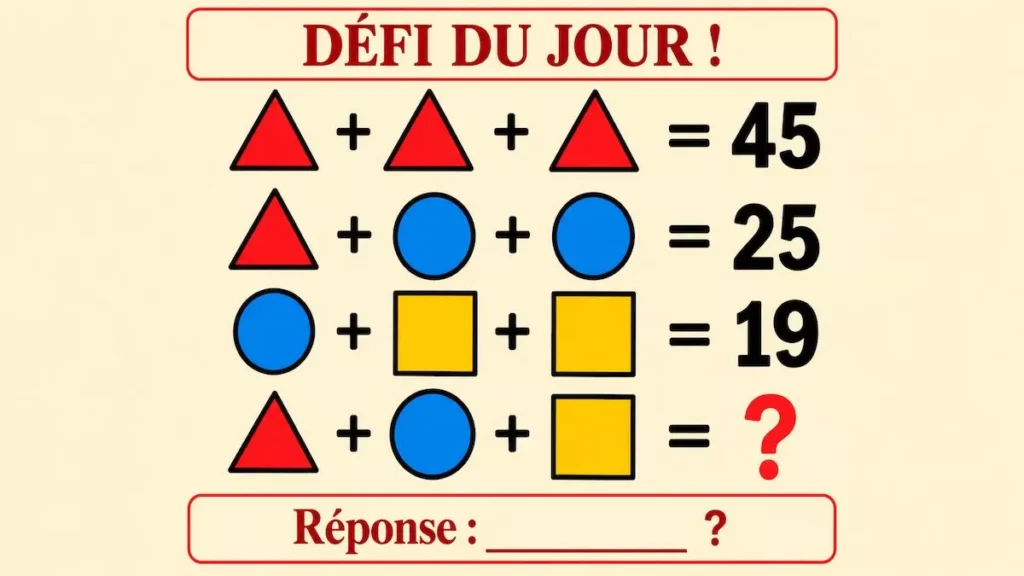
Today, we will solve a mathematical puzzle in which three geometric figures replace unknown numbers. We have a red triangle, a blue circle, and a yellow square, each with a specific value. Our mission is to discover these three values to calculate the result of the final equation.
Here is the information on the board:
Triangle + Circle + Square = ?
You have only 50 seconds to find the correct answer. Observe the first three equations carefully and decide where to start. Be careful; the secret is to solve the equations in the correct order!
The Countdown Begins
50…
40…
30…
25…
20…
15…
10…
5…
4…
3…
2…
1…
Time’s up!
What Your Performance Can Reveal
If you found the result quickly and correctly, you have excellent logic and analytical skills.
If you found the result after some thought, you know how to structure your reasoning and verify your steps.
And if the result was incorrect or not found, no worries, this type of exercise is perfect for improving method and precision.
Detailed Solution We Found (Not Necessarily the Only One, and Sometimes Even the Right One): Let’s Discover the Trap of This Equation
Step One: Find the Value of the Red Triangle
Let’s start by observing the first equation, which contains three identical red triangles. Since these three figures have the same value and their sum equals 45, we can easily determine the value of one triangle. We just need to divide the result by three.
Triangle + Triangle + Triangle = 45
We calculate:
45 ÷ 3 = 15
Thus, we find that:
Red Triangle = 15
This first piece of information is essential, as it will allow us to solve the second equation.
Step Two: Determine the Value of the Blue Circle
Now, let’s move to the second equation, which contains a red triangle and two blue circles. We already know the value of the triangle, which is 15. Therefore, we can replace this figure with its value to find out how much the two circles are worth together.
Triangle + Circle + Circle = 25
We replace the triangle with 15:
15 + Circle + Circle = 25
We subtract 15 from both sides:
Circle + Circle = 10
Since the two circles are identical, we divide 10 by 2:
10 ÷ 2 = 5
So we find that:
Blue Circle = 5
Now we know the value of two figures out of three.
Step Three: Discover the Value of the Yellow Square
We will now use the third equation, which contains a blue circle and two yellow squares. Since we know that the circle is worth 5, we can replace this figure with its value. This new information will allow us to calculate the value of one square.
Circle + Square + Square = 19
We replace the circle with 5:
5 + Square + Square = 19
We subtract 5 from both sides:
Square + Square = 14
Next, we divide 14 by 2:
14 ÷ 2 = 7
Thus, we find that:
Yellow Square = 7
The three figures have now revealed their values, and we can solve the final equation.
Step Four: Calculate the Final Result
We now arrive at the last equation of the challenge. It contains a red triangle, a blue circle, and a yellow square. Since we know the value of each of these figures, we simply need to add them together to get the answer.
Let’s recall the values found: