Thousands of years ago, long before the invention of calculators and computers, ancient civilizations were already trying to understand the mysteries of numbers. In Mesopotamia, the Babylonians used mathematics to measure land, organize trade, and observe celestial movements. They discovered that numbers could follow precise rules, and these rules allowed them to solve complex problems. Unbeknownst to them, they were laying the groundwork for a science that would transform our civilization.
Over the centuries, mathematics has enabled the construction of impressive monuments, the development of navigation, and the understanding of various natural phenomena. Today, it plays a crucial role in telecommunications, medicine, architecture, artificial intelligence, and even space exploration. However, its true value lies not just in calculations; it teaches us to observe, compare, and reason. Sometimes, a few numbers arranged in a certain order can lead us to discover an astonishing rule.
Quote of the Day
“Mathematics is the queen of sciences, and arithmetic is the queen of mathematics.” Carl Friedrich Gauss
This famous quote highlights the importance of numbers in understanding the world. Behind the most advanced technologies often lie relatively simple mathematical principles. Learning to recognize relationships between numbers helps develop a more structured and rigorous way of thinking. This is precisely what we will put into practice with our challenge of the day.
What This Challenge Allows You to Work On:
This challenge helps develop our observational skills and our ability to identify a logical sequence among several numbers. It trains us to use multiplication, addition, and squares of numbers to uncover a mathematical rule. It also enhances concentration, mental calculation, and reasoning speed. Finally, it teaches us to verify that a rule works across all equations before using it to find an unknown result.
Challenge Presentation
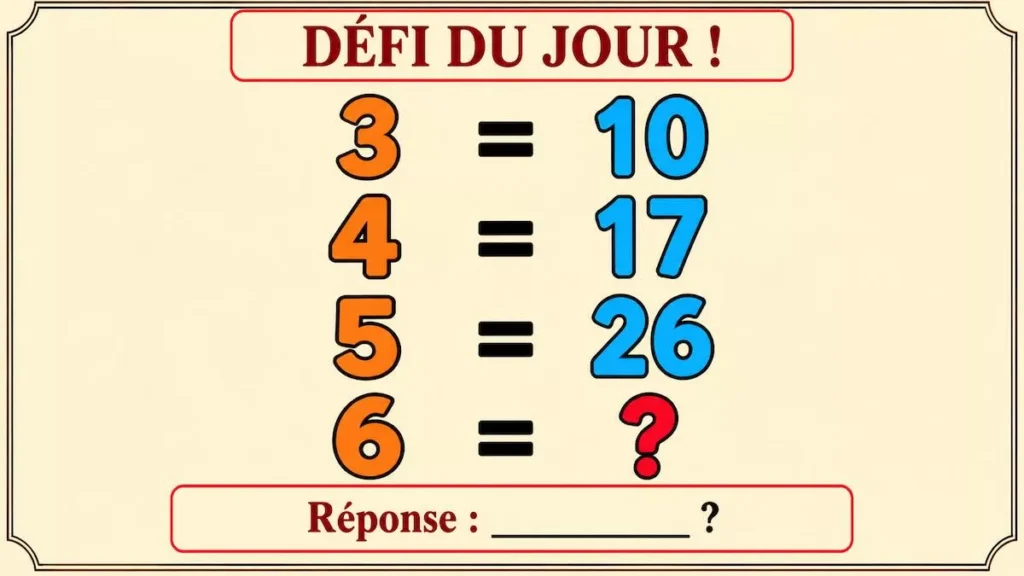
Today, we will explore a puzzle that seems very simple. However, the proposed equations do not correspond to the usual operations we use daily. Our mission is to carefully observe the numbers to understand the hidden rule behind these results.
Here is the information displayed on the board:
You must now find the number that replaces the question mark. Take your time to compare the first three equations and look for a common rule. Be careful; the secret does not simply involve adding the numbers on the left and right!
You have only 30 seconds to solve this puzzle. Try to find a method that works for the first three lines before calculating the fourth. Are you ready to take on this new mathematical challenge?
The Countdown Begins
30…
25…
20…
15…
10…
5…
4…
3…
2…
1…
Time’s Up!
What Your Performance Can Reveal
If you found the answer quickly and correctly, you have excellent logic and analytical skills.
If you found the answer after some reflection, you know how to structure your reasoning and verify your steps.
If your answer was incorrect or you couldn’t find it, no worries; this type of exercise is perfect for improving your method and accuracy.
Detailed Solution We Found (Not Necessarily the Only One, Sometimes Even the Right One)
Step One: Observe the Results
Let’s start by examining the first three equations to understand how the numbers are transformed. We see that 3 gives 10, 4 gives 17, and 5 gives 26. These results do not correspond to a simple addition of the same quantity. Therefore, we need to look for another mathematical relationship.
Now, let’s look at the differences between the successive results:
17 − 10 = 7
26 − 17 = 9
We notice that the first difference is equal to 7 and the second is equal to 9. These differences increase by 2, which gives us an interesting clue. This observation suggests that the results might be related to the squares of the numbers.
Step Two: Discover the Relationship with Squares
Now, let’s try calculating the square of each number on the left. The square of a number is obtained by multiplying that number by itself. We will then compare the results obtained with those displayed on the board.
For the number 3:
3 × 3 = 9
However, the board states:
3 = 10
We see that we just need to add 1 to the square of 3 to get 10.
3² + 1 = 9 + 1 = 10
This initial check seems promising, but we still need to confirm that the same rule works for the other numbers.
Step Three: Verify the Rule with Number 4
Now let’s move on to the second equation, which states that 4 corresponds to 17. If our hypothesis is correct, we must start by calculating the square of 4 and then add 1. Let’s verify if this operation indeed gives us the displayed result.
4 × 4 = 16
Next, we add 1:
16 + 1 = 17
Thus, we obtain:
4² + 1 = 17
The rule works perfectly for number 4. We now have two equations confirming our reasoning. However, one last verification remains before determining the missing number.
Step Four: Verify the Rule with Number 5
Now let’s look at the third equation, which tells us that 5 corresponds to 26. We will apply exactly the same method by calculating the square of 5 and then adding 1. If we find 26, our rule will be confirmed for all three examples on the board.
5 × 5 = 25
Next, we add 1:
25 + 1 = 26
Thus, we obtain:
5² + 1 = 26
All three equations adhere to the same rule. We can now assert that each number is transformed by calculating its square and then adding 1. This discovery allows us to solve the last line.
Step Five: Calculate the Value Corresponding to 6
Now we arrive at the last equation, which contains the question mark. Since we have discovered the common rule, we can simply apply it to number 6. Thus, we need to calculate the square of 6 and add 1 to the result.