Imagine a world where no one knows the order to perform calculations. Two people could arrive at different results from the same numbers simply because they began their operations in a different sequence. To prevent this confusion, mathematics is built on precise rules that enable everyone to follow the same reasoning. These rules, some of which are very simple, are the foundation of many scientific and technological discoveries today. Since ancient times, mathematics has accompanied the major advancements of humanity. It has allowed for the construction of impressive monuments, the understanding of planetary movements, and the development of instruments capable of accurately measuring time.
Today, mathematics plays a crucial role in computer programming, medicine, engineering, and space technologies. Behind these extraordinary achievements often lie fundamental operations that we learn in our early school years.
We remember those little math challenges that seemed easy. We would see a few additions, a multiplication, and a division, then rush to calculate from left to right without thinking further. But when we compared our answer to the solution, we discovered that a simple mistake in the order of operations could completely change the result. This is how we learned that in mathematics, speed never replaces rigor.
Quote of the Day
“Mathematics is the queen of sciences.” Carl Friedrich Gauss
This famous phrase attributed to mathematician Carl Friedrich Gauss emphasizes the fundamental role of mathematics in scientific knowledge. It allows us to describe phenomena, build models, and verify reasoning with precision. However, its true strength also lies in its ability to teach us to think methodically, even when faced with the simplest problems.
What This Challenge Helps Develop:
This challenge helps reinforce our mastery of operational priorities, particularly the use of parentheses, multiplication, and division. It trains us to identify which operations should be performed first and to adhere to the fundamental rules of calculation. It also enhances our ability to verify each step before moving on to the next. By completing this exercise, we improve our concentration, mental calculation, and reasoning speed. We learn to avoid mistakes caused by haste and to organize calculations in a logical order. These skills are valuable not only in school but also in managing a budget, solving everyday problems, and in many professional activities.
Challenge Presentation
Today, I present to you a math challenge that appears particularly simple but may surprise those who respond too quickly.
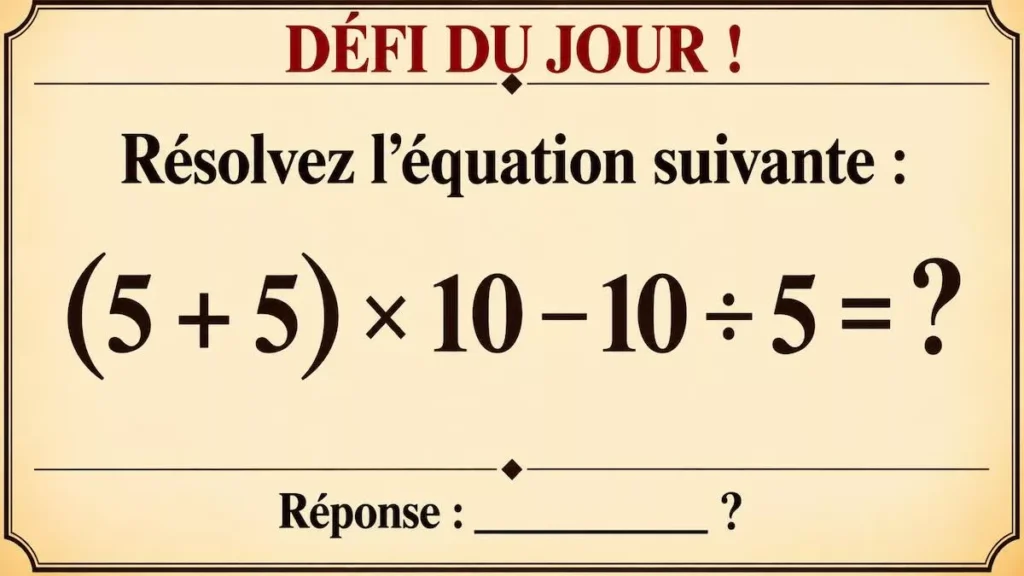
Here is the equation to solve:
Your mission is to find the exact result in just 30 seconds, without a calculator. Be careful, as you should not perform the operations simply in the order they appear. To succeed, you will need to remember the priority rules that allow you to correctly solve this type of calculation.
Can you find the correct answer before the timer runs out?
Take a close look at the equation and think about which operations you need to perform first. Take a few seconds to organize your reasoning before starting the calculations. The countdown starts now!
The Countdown Begins
30…
25…
20…
15…
10…
5…
4…
3…
2…
1…
Time’s up!
What Your Performance May Reveal
If you found the result quickly and correctly, you have excellent logic and analytical skills.
If you found the result after some reflection, you know how to structure your reasoning and verify your steps.
If the result was incorrect or not found, no worries; this type of exercise is perfect for improving method and accuracy.
Detailed Solution We Found (Not Necessarily the Only One, But Often the Correct One): Let’s Discover the Trap of This Equation
Time’s up, and now we will discover together the solution to this challenge. At first glance, this equation seems to pose no particular difficulty since all the numbers are small. However, it contains a classic trap: if we do not adhere to the operational priorities, we risk arriving at an incorrect answer.
First Step: Start with the Parentheses
The first rule to remember is that operations inside parentheses must be performed before the others. In our equation, we have an addition within parentheses: 5 + 5. Therefore, we must start with this operation.
Let’s calculate:
5 + 5 = 10
Our equation then becomes:
10 × 10 − 10 ÷ 5 = ?
We have removed the parentheses by replacing their content with the result of the addition. But be careful, as there are still several operations left, and we must continue to respect the rules of priority.
Second Step: Perform Multiplication and Division
After parentheses, multiplications and divisions take precedence over additions and subtractions. In our equation, we need to calculate 10 × 10 and 10 ÷ 5 before performing the subtraction. These two operations have the same level of priority and can be calculated separately here.
Let’s start with the multiplication:
10 × 10 = 100
Next, let’s calculate the division:
10 ÷ 5 = 2
By replacing these two operations with their results, we obtain:
100 − 2 = ?
We now have a much simpler equation to solve.
Third Step: Perform the Subtraction
Only one operation remains to be performed. Since the parentheses, multiplication, and division have already been dealt with, we can now perform the subtraction. This final step will allow us to find the definitive answer.
Let’s calculate:
100 − 2 = 98
The result is therefore 98.
Fourth Step: Understand the Trap
The main trap of this challenge is wanting to calculate all operations from left to right without considering their priority. Some people might perform subtraction before division and arrive at a different result. However, mathematical rules dictate that division must be done before subtraction.
So let’s remember the order to follow:
- Calculations inside parentheses.
- Multiplications and divisions, from left to right.
- Additions and subtractions, from left to right.
In our challenge, this order naturally leads us to the result 98. It is not the difficulty of the numbers that makes the problem interesting, but the necessity of following a rigorous method.
Fifth Step: Verify Our Result
Before definitively validating our answer, let’s revisit the initial equation. We will check each calculation to ensure that no errors have crept into our reasoning. This habit is particularly useful when we need to solve a math challenge quickly.
Starting equation: (