Imagine a young student who discovers a mysterious equation in an old mathematics book, one that no one has explained the solution to. Intrigued, he spends several minutes trying different numbers, unable to grasp the secret behind this equality. Then, by observing the terms closely, he realizes that a simple transformation could allow him to solve the entire problem. On that day, he understands that algebra is not just about calculations; it’s a remarkable adventure of logic and discovery. This story mirrors that of the French mathematician Évariste Galois, who, despite his tragically short life, profoundly transformed our understanding of equations.
At just twenty years old, he had already developed ideas that would become fundamental to modern algebra. His work helped explain why certain equations can be solved using formulas involving radicals, while others cannot. Even today, his discoveries play a significant role in mathematics.
Mathematics also accompanies us in many everyday situations, often without us realizing it. Algebra teaches us to represent an unknown quantity with a letter and to discover its value through structured reasoning. This is precisely the skill we will put to the test today.
Quote of the Day
“Mathematics is the queen of sciences, and arithmetic is the queen of mathematics.” — Carl Friedrich Gauss
This quote reminds us of the fundamental importance of numbers in understanding the world. Behind a seemingly complicated equation often lies a very simple idea. It just takes time to observe, reflect, and apply the right mathematical properties. Every problem solved becomes an opportunity to progress and boost our confidence.
What This Challenge Helps Develop:
This challenge serves as an excellent exercise to develop our logic and analytical skills. It invites us to recognize a quadratic equation and to use an appropriate solving method. It also enhances our mastery of factoring, mental calculation, and result verification. Lastly, it teaches us not to stop at the first solution found when an equation may have multiple solutions.
Challenge Presentation
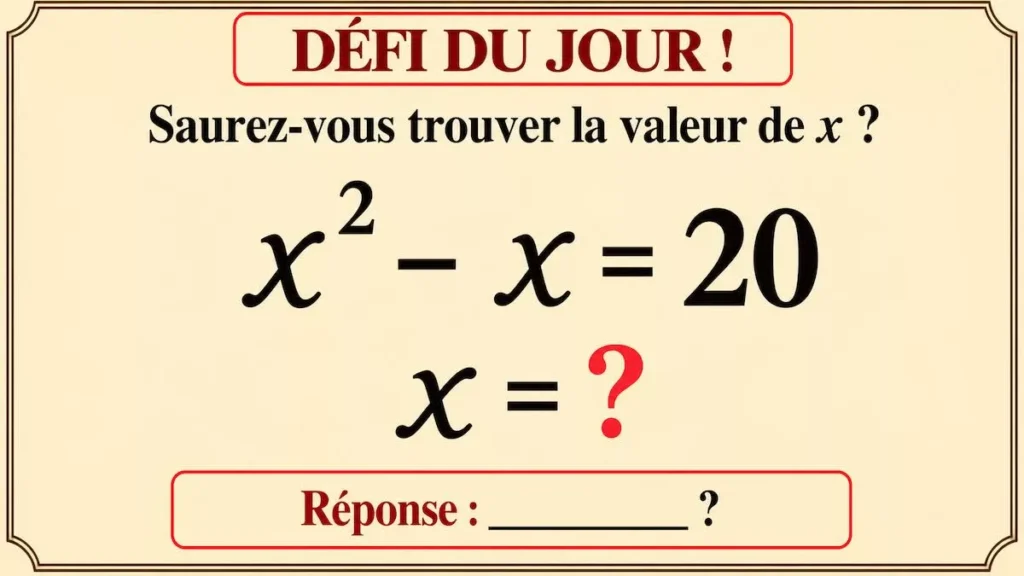
Today, we will solve an equation that appears simple but requires careful attention. Our goal is to determine all possible values of the letter x. To succeed, we need to observe the numbers, look for a factorization, and apply the properties of equations.
Here is today’s equation:
Can you find the values of x in just 40 seconds?
Take a moment to think before revealing the solution. Try to find two numbers whose product and sum allow for the equation to be factored. Be careful; this challenge might hide two answers!
The Countdown Begins
40…
30…
25…
20…
15…
10…
5…
4…
3…
2…
1…
Time’s up!
What Your Performance Can Reveal
If you found the result quickly and correctly, you have excellent logic and analytical skills.
If you found the result after some reflection, you know how to structure your reasoning and verify your steps.
And if your result was incorrect or not found, no worries; this type of exercise is perfect for improving your method and accuracy.
Detailed Solution We Found (Not Necessarily the Only One, Sometimes Even the Correct One): Let’s Discover the Trap of This Equation
First Step: Understand the Equation
We need to solve a quadratic equation since it contains an x² term. To begin, we will gather all terms on one side to obtain an equation equal to zero. This transformation will allow us to use a particularly effective method: factorization.
Our starting equation is:
x² − x = 20
We subtract 20 from both sides:
x² − x − 20 = 0
Second Step: Look for the Right Numbers
Now we need to find two numbers whose product equals −20 and whose sum equals −1. This search is essential because it will allow us to transform our equation into a product of two factors. Observing the possibilities, we see that the numbers −5 and 4 perfectly meet these conditions.
Let’s verify:
−5 × 4 = −20
−5 + 4 = −1
Thus, we have found the two necessary numbers for the factorization.
Third Step: Factor the Equation
With the two numbers found, we can rewrite our equation in a much simpler form. We obtain a product of two factors that must equal zero. This transformation is particularly interesting because it allows us to solve the equation without performing complicated calculations.
We write:
(x − 5)(x + 4) = 0
Now we will apply a fundamental property of algebra.
Fourth Step: Apply the Zero Product Rule
When a product of two factors equals zero, at least one of these factors must be zero. We can therefore solve two small equations separately. This method will allow us to discover all possible values of x.
First possibility:
x − 5 = 0
x = 5
Second possibility:
x + 4 = 0
x = −4
Thus, we obtain two possible solutions: 5 and −4.
Fifth Step: Verify Both Solutions
To be certain of our result, we will substitute x with each of the values found in the original equation. This verification is important because it confirms that our solutions respect the equality. We start with the first value.
For x = 5:
5² − 5 = 20
25 − 5 = 20
20 = 20
The first solution is correct.
For x = −4:
(−4)² − (−4) = 20
16 + 4 = 20
20 = 20
The second solution is also correct.
Final Answer: x = 5 or x = −4
The two solutions to this equation are 5 and −4.
The trap