The 20th century was marked by extraordinary mathematical advancements that profoundly transformed our understanding of the world. Among the most significant is the development of information theory by Claude Shannon in 1948, which established the mathematical foundations of modern digital communications. This discovery enhanced our ability to transmit, measure, and protect information. Even today, its principles play a vital role in computers, telecommunications, and scientific technologies. However, mathematics extends beyond major technological breakthroughs. It serves as an essential tool for studying nature, understanding ecosystems, and protecting animal species. Through equations, scientists can analyze animal movements, estimate population changes, and measure the effects of environmental shifts. Thus, mathematics contributes to wildlife preservation and biodiversity protection.
As mathematician Henri Poincaré said, “Mathematics is the art of giving the same name to different things.”
This quote reminds us that mathematics allows us to recognize common principles behind vastly different situations. The same rule can be applied to solve a calculation, interpret scientific data, or understand a natural phenomenon. However, one must know how to observe carefully and apply the correct methods.
What This Challenge Allows You to Work On:
This challenge helps reinforce mastery of operational priorities, particularly when multiple operations appear within the same equation. It also aids in understanding the role of parentheses, exponents, division, and addition. Furthermore, it develops concentration and the ability to verify each step of a calculation. These skills are crucial in scientific fields. An error in the order of operations can alter a result and lead to misinterpretation of data. For researchers studying animal populations or environmental changes, mathematical rigor is therefore essential.
Today’s Challenge
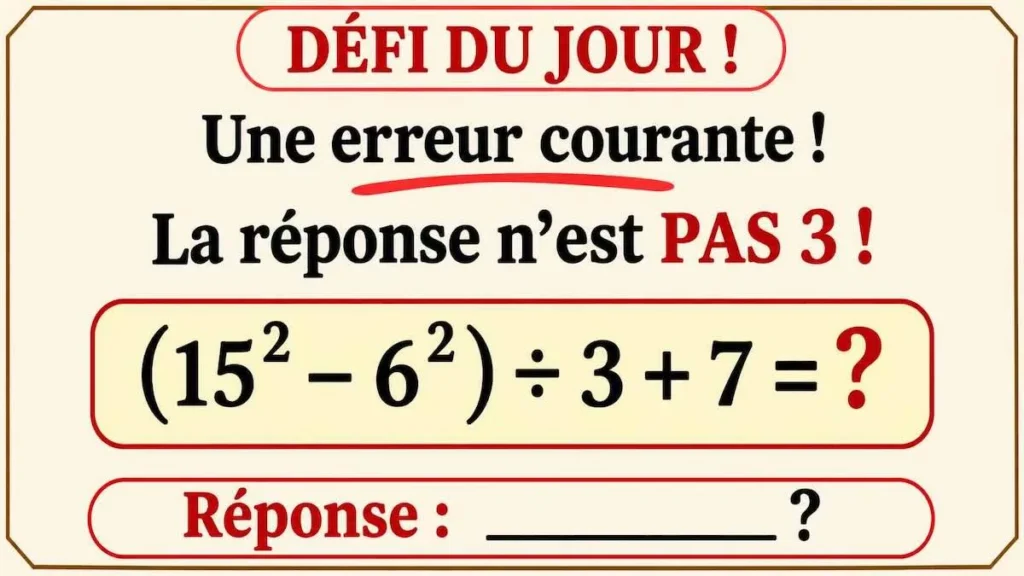
Today, I present you with an equation that seems simple but can lead to a common mistake. It contains several operations that need to be executed in the correct order to find the right answer. The trap lies in wanting to calculate too quickly without considering mathematical priorities.
Here is the equation to solve:
Note that the answer is not 3! To succeed in this challenge, pay close attention to the parentheses, exponents, and the operations that follow. You need to determine the order in which to perform the calculations to arrive at the correct result.
Take a moment to think and try to solve this equation without a calculator. The most important thing is not just to find a number but to understand why it is the correct answer. Are you ready to take on the challenge?
The Countdown Begins
30…
25…
20…
15…
10…
5…
4…
3…
2…
1…
Time’s Up!
What Your Performance Can Reveal
If you found the result quickly and correctly, you have excellent logic and analytical skills.
If you found the result after some thought, you know how to structure your reasoning and verify your steps.
And if you got an incorrect result or couldn’t find one, no worries; this type of exercise is perfect for improving your method and precision.
Detailed Solution We Found (Not Necessarily the Only One, Sometimes Even the Right One):
The Solution Explained Step by Step
To solve this equation correctly, we must adhere to the order of operations. Calculations within parentheses must be handled before those outside. Inside the parentheses, we must first calculate the exponents before performing the subtraction.
Let’s start with the square of 15. Squaring a number means multiplying it by itself. Thus, we get 15 × 15 = 225.
Next, let’s calculate the square of 6. By multiplying 6 by itself, we obtain 6 × 6 = 36. We now have both values necessary to perform the subtraction within the parentheses.
The equation now becomes:
(225 − 36) ÷ 3 + 7 = ?
Next, we perform the subtraction:
225 − 36 = 189
The equation simplifies to:
189 ÷ 3 + 7 = ?
At this stage, we have one division and one addition left. According to the order of operations, we must perform the division before the addition. Therefore, we start by dividing 189 by 3.
189 ÷ 3 = 63
Now, we just have one final operation to perform. We need to add 7 to the result obtained previously. This final step yields 63 + 7 = 70.
The Answer to the Challenge
The correct answer is 70.
We can verify the complete calculation:
(15² − 6²) ÷ 3 + 7
= (225 − 36) ÷ 3 + 7
= 189 ÷ 3 + 7
= 63 + 7
= 70
Thus, the result is indeed 70, not 3. The challenge’s difficulty does not lie in the complexity of the numbers but in adhering to the order of operations. By following each step methodically, we can avoid mistakes and arrive at a reliable result.
Conclusion
This challenge demonstrates that in mathematics, haste can lead to errors, even when calculations appear simple. Parentheses, exponents, and operational priorities are not mere conventions; they allow everyone to interpret an equation consistently. Respecting these rules ensures the coherence and accuracy of results.
This rigor is equally important in research dedicated to wildlife protection. When a scientist calculates the evolution of an animal population, assesses the dietary needs of a species, or analyzes data about its habitat, every operation must be performed accurately. A miscalculation could skew conclusions and impact decisions made to protect animals. Thus, mathematics teaches us much more than just manipulating numbers. It enhances our reasoning abilities, helps us verify our hypotheses, and enables us to make decisions based on precise results. These qualities are essential for understanding the significant scientific and environmental challenges of our time.
So, did you find 70 before the countdown ended? Feel free to share this challenge with your friends to see who masters operational priorities best.
See you soon for a new CHALLENGE OF THE DAY!
And before you get lost in the web’s labyrinth, explore other games and tests by clicking here.