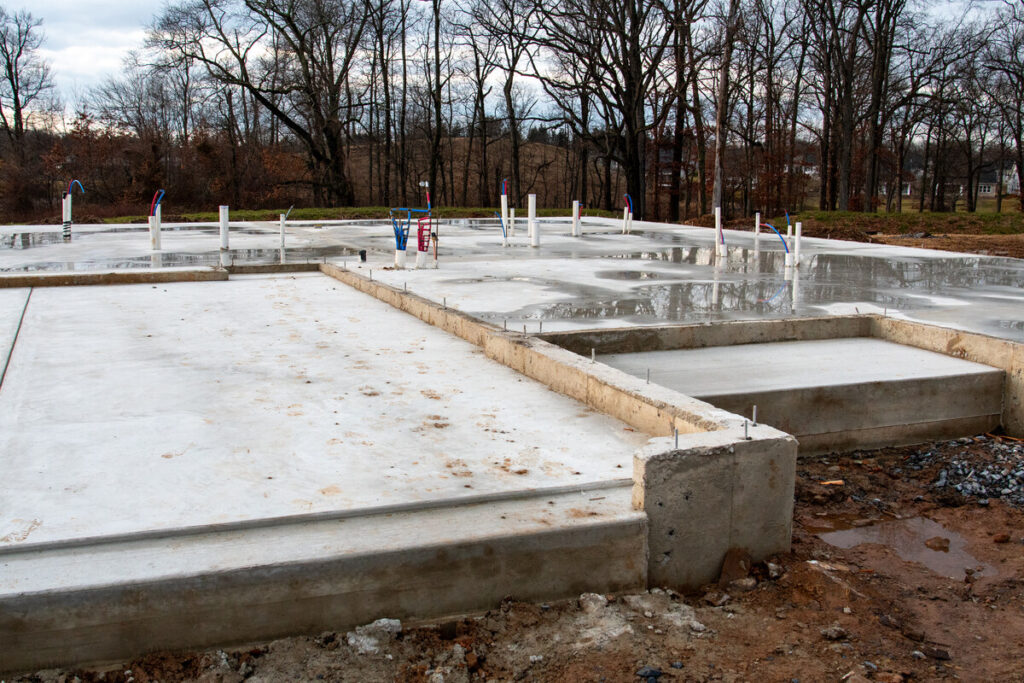
Pouring a slab and not sure how many bags of cement, how much sand, or how much gravel to buy? The good news is that the math behind it is simple once you know the ratio, and you can work it out in a couple of minutes with just a tape measure.
What concrete actually is
Concrete is the most-used material on Earth after water, with roughly 6 billion tons produced every year. It is not the same thing as cement: cement is only one ingredient, a binder that glues together the other two main ingredients, sand and gravel (also called aggregate), once water is added. Cement is never used on its own to build anything.
The formula: mix ratio and volume
Concrete recipes are described as a ratio of cement to sand to gravel. The most common “nominal mixes” are:
- M5 = 1:5:10 (about 5 MPa strength)
- M10 = 1:3:6 (about 10 MPa)
- M15 = 1:2:4 (about 15 MPa, a common choice for slabs and footings)
- M20 = 1:1.5:3 (about 20 MPa, used where more strength is needed)
The first number is always cement, the second sand, the third gravel. To know how much of each you need, you first need the total volume of concrete for your project:
Volume (m³) = length × width × thickness
Once you have that total, split it according to the ratio: divide the total volume by the sum of the ratio parts, then multiply that “one part” value by each ingredient’s number in the ratio.
A real example
Take a small slab measuring 3 m by 3 m (just under 10 ft on each side) and 0.1 m (10 cm) thick. The volume is 3 × 3 × 0.1 = 0.9 m³ of concrete.
Using an M15 mix (1:2:4, which adds up to 7 parts total), one part equals 0.9 ÷ 7 ≈ 0.129 m³. That gives you:
- Cement: about 0.129 m³
- Sand: about 0.257 m³ (2 parts)
- Gravel: about 0.514 m³ (4 parts)
Water is added on top of that, following a water-to-cement ratio that typically falls between 0.30 and 0.45 by weight. That ratio matters more than most people think: adding extra water to make the mix easier to pour feels harmless, but it directly lowers the final strength of the slab.
Mistakes and nuances worth knowing
A few things trip people up almost every time:
Concrete does not “dry”, it cures. Hardening comes from a chemical reaction with water (hydration), not evaporation. That is why keeping a fresh slab damp for the first few days actually helps it get stronger, instead of letting it dry out fast.
Full strength is not reached the day you remove the formwork. More than 90% of the final strength shows up within 4 weeks, but concrete keeps gaining strength slowly for years, sometimes decades, after that.
Trapped air matters too: every 1% of air entrained in the mix can cut compressive strength by roughly 5%, which is one more reason to avoid over-mixing or adding too much water to “help” the pour.
Getting the ratio and the volume right before you order materials is the difference between a slab that cures properly and one that either falls short mid-pour or leaves you with unused bags of cement sitting in the garage.