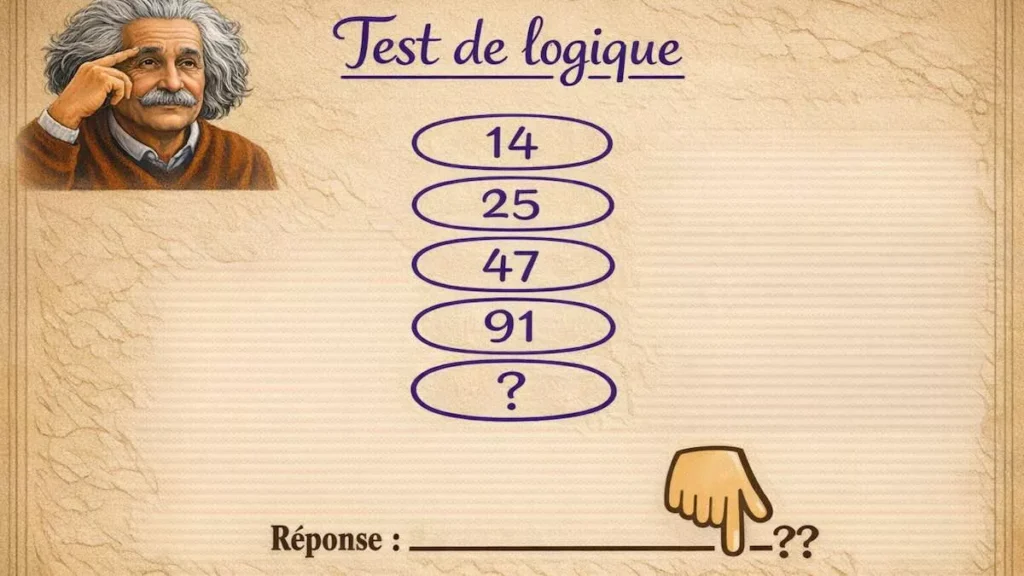
Some sequences may seem immediately accessible. However, behind this apparent simplicity can lie a more subtle logic than it appears. At first glance, it may be tempting to propose a quick answer. Yet, this type of exercise requires one to slow down, analyze each step, and structure their reasoning.
An Approach Inspired by René Descartes
As René Descartes pointed out:
“To reach the truth, one must once in their life rid themselves of all the opinions they have received.”
Applied to this problem, this means avoiding automatic responses. It is not enough to “guess” a logic: it must be demonstrated through concrete observations.
Why This Type of Challenge is Educational
Logical sequences are not just games; they serve as excellent tools for intellectual training. They engage several essential skills:
- Concentration, as every detail can be crucial
- Observation, to spot sometimes subtle regularities
- Rigor, to avoid approximate interpretations
- Method, advancing step by step rather than randomly
- Critical thinking, to verify the coherence of one’s reasoning
This type of exercise highlights an important reality: a problem that appears simple may require deep reflection.
Take the Time to Observe the Following Sequence Carefully:
The Countdown
To add a bit of pressure and test your speed:
35…
30…
20…
10…
5…
3…
2…
1…
Time’s up.
Analysis and Reflection
Before giving your answer, ask yourself the right questions:
-Did you start with the innermost parentheses?
-Did you correctly handle the divisions before the additions?
-Did you account for the exponentiation before multiplication?
Every detail counts, and a single mistake in the order of operations can completely alter the final result.
And You?
What result did you obtain?
Did you find it quickly, or did you have to redo the calculations to check each step?
Regardless of your level, this type of challenge is an excellent way to strengthen your rigor and mathematical logic.
Here is the Solution We Found
Progressive Analysis of the Sequence
To understand the logic, it is often useful to look not directly at the numbers themselves but at the relationships between them.
Let’s calculate the differences between each term:
- 25 – 14 = 11
- 47 – 25 = 22
- 91 – 47 = 44
Here we see a clear evolution: the differences are not constant, but they follow a regular progression.
Indeed:
- 11 × 2 = 22
- 22 × 2 = 44
This logic becomes clearer: each difference doubles compared to the previous one.
Applying the Rule
If this progression continues, the next difference should be:
44 × 2 = 88
We then apply this difference to the last term of the sequence:
91 + 88 = 179
Result
The missing number is therefore: 179
Verification of the Reasoning
A good reflex is always to check the overall coherence:
- 14 → +11 → 25
- 25 → +22 → 47
- 47 → +44 → 91
- 91 → +88 → 179
The logic is respected at each step. The reasoning is therefore valid.
Conclusion
This challenge perfectly illustrates the importance of method in logic. A quick answer can sometimes be incorrect, not due to a lack of ability, but due to a lack of attention.
By taking the time to analyze the relationships between elements rather than the elements themselves, one can more easily access the structure of the problem.
It is precisely this ability to slow down, observe, and structure one’s thinking that makes all the difference in this type of exercise.
And before you get lost in the depths of the web, explore other games and tests by clicking here.