Imagine a young man barely 20 years old who, at the beginning of the 19th century, discovers a new way to understand equations. This young man was Évariste Galois, a French mathematician whose ideas would transform algebra. At a time when many scholars were still searching for general methods to solve certain equations, Galois had a revolutionary idea. Instead of focusing solely on the solutions, one should also study the mathematical relationships and structures that lie behind them.
Despite his tragically short life, his work paved the way for mathematical developments that today play a significant role in number theory, computer science, and communication systems.
This story reminds us that mathematics is not just a collection of numbers and formulas. It is a powerful tool for understanding the world, discovering invisible relationships, and solving problems that once seemed impossible. Thanks to mathematics, we have been able to build airplanes, send probes to explore other planets, develop medical technologies, and design communication systems that connect billions of people.
But their true richness is also found in our daily lives.
Sometimes, simply facing a mathematical puzzle can lead to an astonishing experience. At first, several numbers and letters seem unrelated. Then, by observing the information closely, a first relationship appears, followed by a second, until everything becomes clear.
That feeling of satisfaction when the solution finally reveals itself is one of the great joys of mathematics. And today, it is precisely this experience that I invite you to live!
Quote of the Day
“Mathematics knows no races or geographic boundaries; for mathematics, the cultural world is one country.” David Hilbert
This quote reminds us that mathematics is a universal language. Regardless of our background, age, or language, the rules of mathematics remain the same.
They teach us to reason precisely, to develop our curiosity, and to understand that every problem can become an opportunity for growth.
What This Challenge Allows You to Work On:
- Logical reasoning: understanding the relationships between multiple unknowns.
- Concentration: carefully analyzing the provided information.
- Equation solving: using several equalities to find an unknown value.
- Mastery of powers: understanding how numbers raised to a power function.
- Substitution method: replacing an unknown with its value to simplify calculations.
- Mathematical rigor: checking each step to avoid mistakes.
- Self-confidence: learning to progressively solve a problem that seems complicated.
Challenge of the Day!
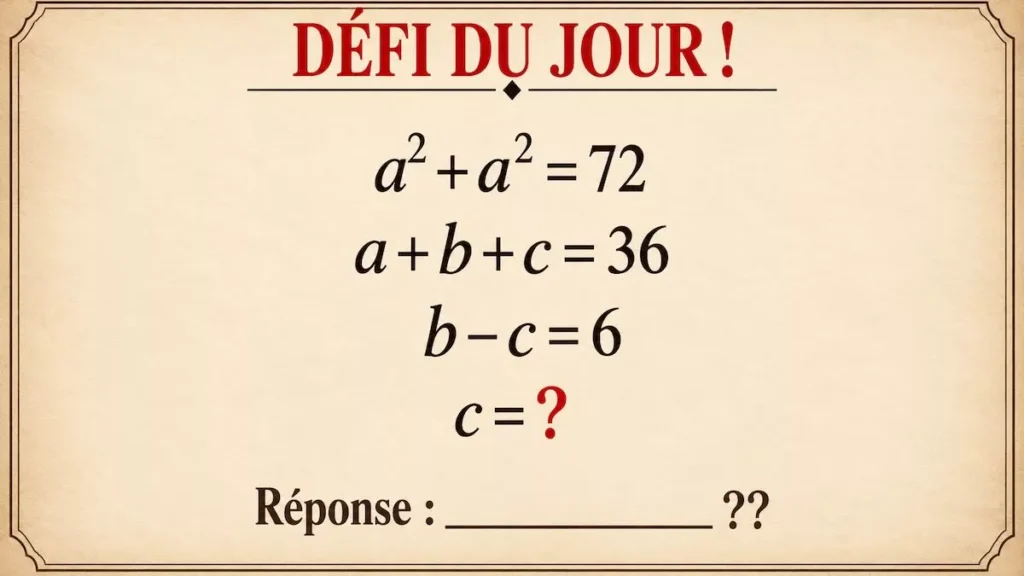
Today, we will test your logic with a small system of equations. Three mysterious letters are hidden behind several mathematical relationships.
Your mission is simple: find the value of c.
Here are the equations:
Pay close attention to the three equations.
Every piece of information is important and can bring you closer to the solution.
But beware! There is a small trap: the first equation can give two possible values for a.
Will you be able to take that into account? You have 30 seconds to find the correct answer.
Focus, think, and dive in!
The Countdown Begins
50…
40…
30…
25…
20…
15…
10…
5…
4…
3…
2…
1…
Time’s up!
What Your Performance Can Reveal
If you found the result quickly and correctly, you have excellent logic and good analytical skills.
If you found the result after some thought, you know how to structure your reasoning and check your steps.
And if your result was incorrect or you didn’t find it, no worries; this type of exercise is perfect for improving your method and precision.
Detailed Solution We Found (Not Necessarily the Only or Even the Correct One)
Let’s now discover how to solve this system of equations.
Step 1: Determine the Value of a
We start with the first equation: a² + a² = 72
Since we are adding the same square twice, we can write:
2a² = 72
Dividing both sides by 2 gives us: a² = 36
We are looking for the numbers whose square equals 36.
We get two possibilities: a = 6 or a = −6
This is an important point: the square of 6 is 36, but so is that of −6. We must therefore examine both possibilities.
Step 2: Use the Second Equation
We know that: a + b + c = 36
Let’s start with the case where a = 6.
Replacing a with 6 gives us:
6 + b + c = 36
Subtracting 6 from both sides:
b + c = 30
We now have a simpler relationship between b and c.
Step 3: Use the Third Equation
The third equation tells us: b − c = 6
Thus, we have two equations:
b + c = 30
b − c = 6
Let’s add them together:
2b = 36
Dividing by 2 gives us:
b = 18
Step 4: Find the Value of c
Returning to: b + c = 30
Replacing b with 18 gives us: 18 + c = 30
Subtracting 18 gives us: c = 30 − 18
We find: c = 12
Step 5: Verify the First Solution
We have found:
a = 6, b = 18, and c = 12
Let’s verify the three equations.
First equation:
6