Imagine a small party where someone decides to tidy up the red cups after the meal. They stack three cups and notice a certain height. Then they add two more and find something amusing: the stack grows, but certainly not to double the height of a cup. Why? Because the cups nest inside one another. This seemingly simple situation hides real mathematics. For a long time, measuring heights, lengths, and volumes has enabled humans to construct buildings, manufacture objects, draw plans, and develop machines. Even today, engineers, architects, and designers use equations to determine dimensions with precision.
Mathematics teaches us to observe everyday situations with greater precision. Behind simple objects like a stack of cups, steps, stacked boxes, or geometric shapes, interesting mathematical relationships may be hidden. What seems obvious to the eye can sometimes require genuine reasoning to be calculated accurately. This is precisely where equations become useful: they allow us to translate a concrete situation into numbers, establish relationships between known information, and gradually determine an unknown value.
“Mathematics is a gymnastic of the mind and a preparation for philosophy.” — Isocrates
This idea aligns well with our challenge: it’s not just about calculating. We need to observe the image, understand what changes between the two stacks, and then use this difference to uncover the hidden information.
What This Challenge Helps Develop:
- Observation and analysis of a figure;
- Translating a situation into equations;
- Logical reasoning;
- Finding an unknown value;
- Subtraction and division;
- Understanding stacking;
- Verifying a result;
- Concentration.
Challenge Of The Day!
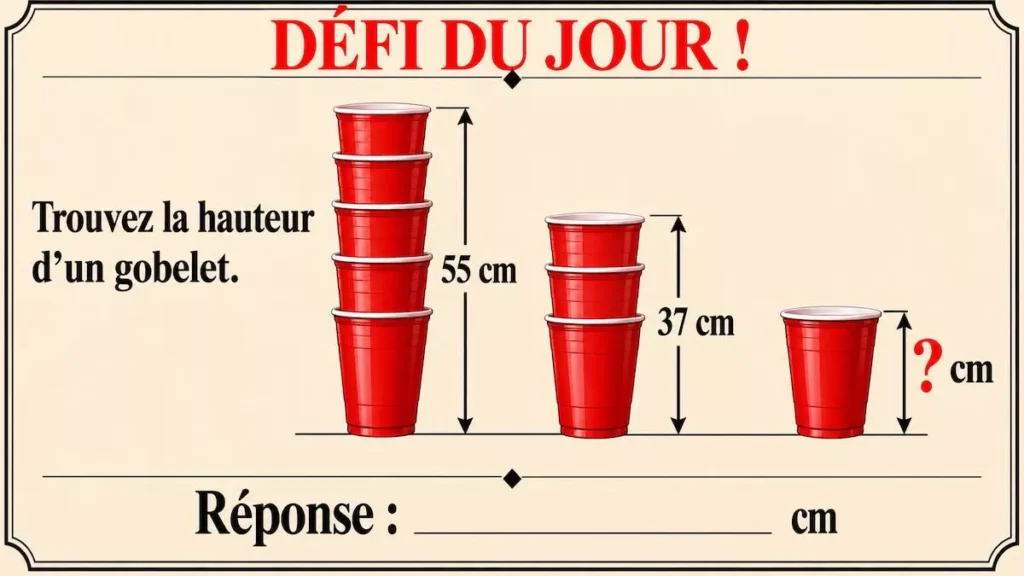
Carefully observe these two stacks of cups.
What is the height of a single cup?
Don’t rush: 55 ÷ 5 is not the correct method, since the cups are partially nested.
Counting Down Begins
50…
40…
30…
25…
20…
15…
10…
5…
4…
3…
2…
1…
Time’s up!
What Your Performance May Reveal
If you quickly and accurately found the answer, you have excellent logic and analytical skills.
If you found the answer after some reflection, you know how to structure your reasoning and verify your steps.
And if your result was incorrect or not found, no worries; this type of exercise is perfect for improving method and precision.
Detailed Solution We Found (Not Necessarily The Only One, Or Even The Correct One)
Let’s first compare the two stacks.
The first contains 5 cups and measures 55 cm.
The second contains 3 cups and measures 37 cm.
This means the first stack has:
5 − 3 = 2 additional cups
And its additional height is:
55 − 37 = 18 cm
This indicates that two additional cups together add 18 cm to the stack.
Thus, each new cup adds:
18 ÷ 2 = 9 cm
Note: 9 cm is not the full height of a cup. It is only the additional visible portion when a cup is added to the stack.
Now, let’s consider the stack of 3 cups.
The first cup contributes its full height, which we will call h.
The other two each add 9 cm.
We thus have the equation:
h + 9 + 9 = 37
Or:
h + 18 = 37
Subtracting 18 gives us:
h = 37 − 18
h = 19 cm
Let’s verify with the 5 cups:
19 + 4 × 9 = 55
19 + 36 = 55
The result is correct.
Answer: 19 cm
Conclusion
This challenge is interesting because it plays with our initial intuition. One might be tempted to directly divide 55 by 5, but that would yield an incorrect answer since the cups are nested.
The key was to compare the two stacks. The 2 additional cups increase the height by 18 cm, so each new cup only adds 9 cm. Once this information was discovered, a simple equation sufficed to find the true height of a cup: 19 cm.
This is exactly what makes mathematics so useful: it teaches us not just to look at numbers, but to understand what they represent and how they are connected.
And before you get lost in the depths of the web, explore other games and tests by clicking here.