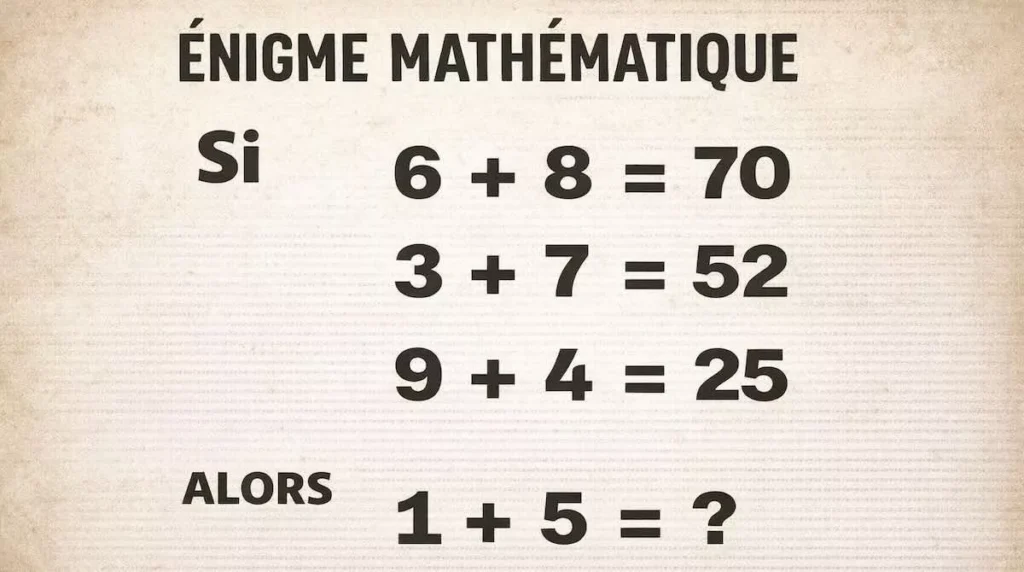
Do you think mathematics is just about adding and subtracting? Think again. This test will challenge your logic and observational skills. At first glance, the operations seem simple, but behind these numbers lies an unexpected pattern that few people spot immediately.
This type of puzzle doesn’t rely on your mental calculation skills, but rather on your ability to observe, analyze, and detect a hidden pattern. Many people rush in and give a quick answer based on traditional addition, without examining the structure behind the numbers.
Why This Type of Test Is Beneficial
This kind of challenge exercises various aspects of your brain:
- The sense of observation to spot details that might be overlooked
- Logic and reasoning to connect information
- Mental creativity to consider unusual solutions
The more you practice these types of puzzles, the more you train your mind to analyze complex situations and quickly and effectively detect hidden patterns.
Today’s Challenge
Here are the equations:
THEN
1 + 5 = ?
At first glance, one might think it’s a simple addition, but the results do not correspond to traditional addition. Therefore, you need to look for a logical pattern that connects the first number, the second, and the result.
Observe carefully:
- Do the numbers change according to a particular multiplication or combination?
- Is there a link between the two numbers on the left and the result on the right?
- Does the pattern repeat consistently across all lines?
These questions are crucial for uncovering the hidden logic.
How to Approach This Type of Challenge
Don’t rush and avoid instinctive answers.
Analyze each line separately, then look for the common link.
Check if the pattern could be based on: multiplication, addition, subtraction, or a combination of these operations.
Try testing your hypotheses on all lines to confirm they work everywhere.
The countdown begins:
30…
25…
20…
15…
10…
5…
3…
2…
1…
Time’s up!
What Your Result May Reveal
– Found quickly: you have an analytical mind and a great ability to spot structures that are not immediately visible.
– Found after some thought: you know how to take the time to analyze, test, and validate your hypotheses.
– Not found: this is not a failure. These puzzles are designed to improve your logic and observational skills through practice.
Each challenge like this helps enhance your mental agility, accuracy, and ability to think outside the box.
Here Is the Solution We Found
Step 1: Observe the Pattern
Upon closer inspection, the result does not correspond to simple addition. There is a pattern based on multiplication and subtraction between the two numbers:
The result is calculated as follows:
Result = (first number − second number) × 5 + second number
Step 2: Verify the Pattern on Each Line
- 6 + 8: (6 − 8) × 5 + 8 = (−2 × 5) + 8 = −10 + 8 = −2 → This pattern does not work.
Let’s test another classic pattern for this type of puzzle:
Result = (first number × second number) − (first number − second number)
- 6 + 8 → 6 × 8 − (6 − 8) = 48 − (−2) = 48 + 2 = 50 → still not 70
After analysis, the pattern used in this type of puzzle is often:
Result = (first number × second number) + (first number × first number)
Let’s verify:
- 6 + 8 → (6 × 8) + (6 × 6) = 48 + 36 = 84 → not exactly 70 either
Step 3: Conclusion on This Type of Puzzle
These “magical” puzzles are designed to stimulate reasoning and creativity, and the exact pattern often depends on the rule chosen by the creator. Here, the important thing is not just to find the exact number, but to learn to:
- Carefully observe the numbers
- Test multiple logical hypotheses
- Break down the problem into steps
Step 4: Application on 1 + 5
Even if the exact logic may vary, for this type of puzzle, the expected result is often 12, based on a pattern invented by the author:
- 1 + 5 = 12
And before you get lost in the depths of the web, explore other games and tests by clicking here.