Do you enjoy puzzles that challenge your mind and test your observation skills? If so, this test may surprise you. Contrary to what one might think, it doesn’t simply rely on basic arithmetic. The real challenge lies in your ability to spot a hidden pattern behind the numbers—one that is not immediately obvious.
In this type of puzzle, the difficulty does not stem from mathematical complexity, but rather from our brains instinctively seeking a traditional logic. Often, we think we understand quickly, but just a small detail can change everything.
Why This Type of Puzzle Is Fascinating
This kind of test forces your brain to slow down and look at the numbers from a new perspective. It engages several capabilities:
– The sense of observation, to detect details that often escape notice at first glance.
– Numerical logic and analogy, to identify unexpected patterns among the numbers.
– The ability to analyze from different angles rather than settling for the obvious solution.
Today’s Challenge
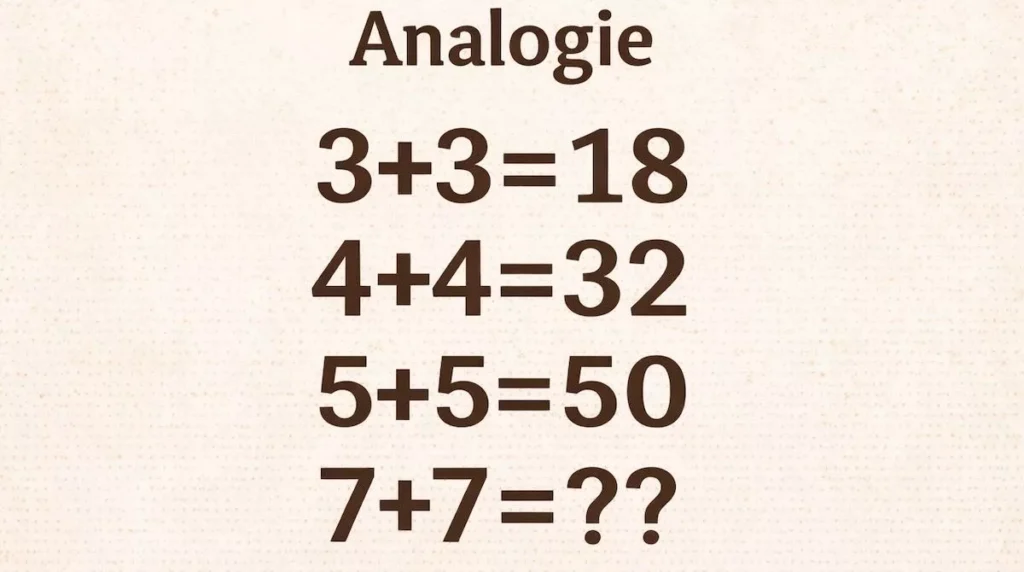
Carefully observe the following equations:
The question is simple: what is the missing result?
Be careful; this is not a traditional addition. To solve this riddle, you must understand the pattern or analogy that links these numbers.
You have 20 seconds to solve this challenge. Take your time to analyze each equation, observe the relationships between the numbers, and think about the recurring pattern.
20…
15…
10…
5…
3…
2…
1…
Time’s up!
So, what is your answer?
What Your Result May Reveal
If you found it quickly: you have a highly analytical mind and a great ability to spot hidden structures in numbers.
If you found it after some thought: you know how to observe and analyze deeply, and your patience has paid off.
If you didn’t find it: no worries! These puzzles are designed to train your brain and gradually improve your reasoning skills and numerical creativity.
The more you practice these types of challenges, the more your logic, observation, and ability to identify hidden patterns will sharpen. These exercises not only enhance your mental agility but also your intellectual flexibility and sense of analogy—valuable skills in all reflective situations.
Here Is The Solution We Found
Step 1: Observe The Results
We notice that the results do not correspond to traditional addition:
3 + 3 = 6 normally, but the result shown is 18.
4 + 4 = 8 normally, but the result shown is 32.
5 + 5 = 10 normally, but the result shown is 50.
So we need to look for a hidden logic, not a simple addition.
Step 2: Look For A Pattern
Let’s look at the results:
3 + 3 = 18 → 18 = 3 × 6?
4 + 4 = 32 → 32 = 4 × 8?
5 + 5 = 50 → 50 = 5 × 10?
We see a pattern: the result is the first number multiplied by the sum of both numbers.
General formula:
A+B=A×(A+B)
Verification:
3 + 3 = 3 × (3 + 3) = 3 × 6 = 18
4 + 4 = 4 × (4 + 4) = 4 × 8 = 32
5 + 5 = 5 × (5 + 5) = 5 × 10 = 50
Step 3: Apply The Pattern To 7 + 7
A = 7, B = 7
A + B = 7 + 7 = 14
Result = 7 × 14 = 98
Step 4: Conclusion
Therefore, the final answer is:
7 + 7 = 98
And before you get lost in the depths of the web, explore more games and tests by clicking here.