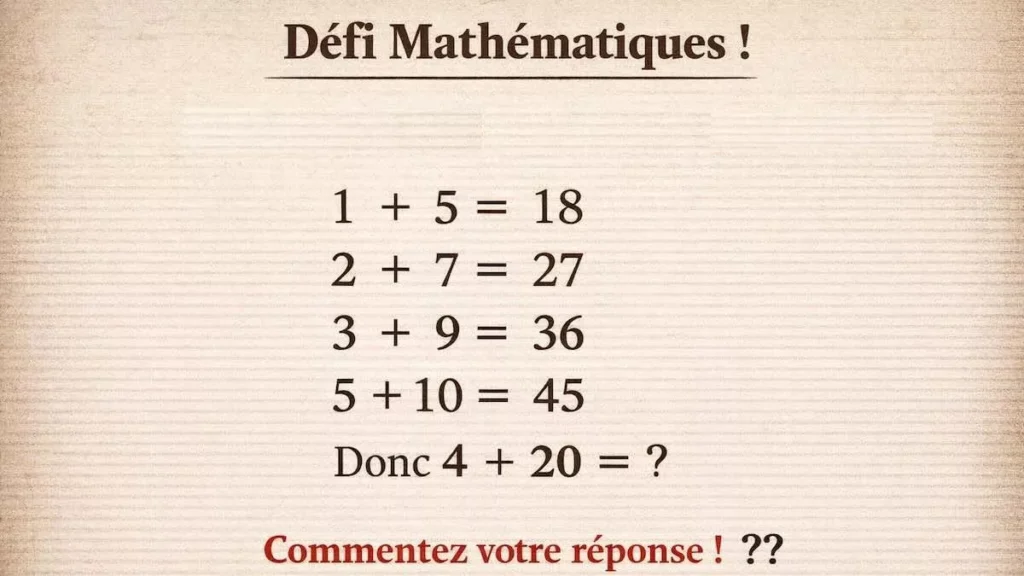
Behind a series of equalities that may seem strange at first glance lies a precise logic. Without careful observation, one might easily think these are calculation errors, when in fact, a hidden rule connects each line.
This type of challenge does not rely on traditional calculations, but rather on the ability to analyze a pattern and understand how the numbers interact with each other. The goal is to find the logic, not to perform an immediate operation.
What This Challenge Helps Develop
- Recognition of numerical patterns
- Logic and pattern analysis
- The ability to go beyond conventional calculations
- Observation of relationships between numbers
- Rigorous reasoning skills
Challenge of the Day
4 + 20 = ?
Answer: ______ ??
Method to Follow
To solve this type of problem, you need to:
- Compare the lines to one another
- Look for a constant relationship
- Test a consistent rule across all examples
- Verify that the logic holds at each step
Take the time to carefully observe the structure before answering.
40…
30…
20…
10…
5…
3…
2…
1…
Time’s up!
So, what is your answer?
What Your Performance Reveals
If you found the answer quickly and correctly, you have excellent logic and strong analytical skills.
If you found the answer after some thought, you know how to structure your reasoning and check your steps.
If your answer was incorrect or you didn’t find it, no problem; this type of exercise is perfect for improving your method and precision.
Detailed Solution We Found
We observe that the results do not correspond to a simple operation but follow a construction based on the two numbers.
Step 1: Look at the Results of Normal Additions
First, we calculate simply:
- 1 + 5 = 6
- 2 + 7 = 9
- 3 + 9 = 12
- 5 + 10 = 15
Step 2: Compare with the Given Results
Now we compare:
- 6 becomes 18
- 9 becomes 27
- 12 becomes 36
- 15 becomes 45
We notice that each time, we multiply by 3:
- 6 × 3 = 18
- 9 × 3 = 27
- 12 × 3 = 36
- 15 × 3 = 45
Step 3: Understand the Rule
The hidden rule is thus:
(first number + second number) × 3
Step 4: Apply to 4 + 20
We add:
4 + 20 = 24
Then we apply the rule:
24 × 3 = 72
Final Answer: 72
Result
Answer: 72
Conclusion
This challenge shows that a sequence of results can conceal mathematical logic rather than just simple calculations. The key is to identify the underlying model behind the examples and reason systematically to find the common rule.
And before you get lost in the depths of the web, explore more games and tests by clicking here.