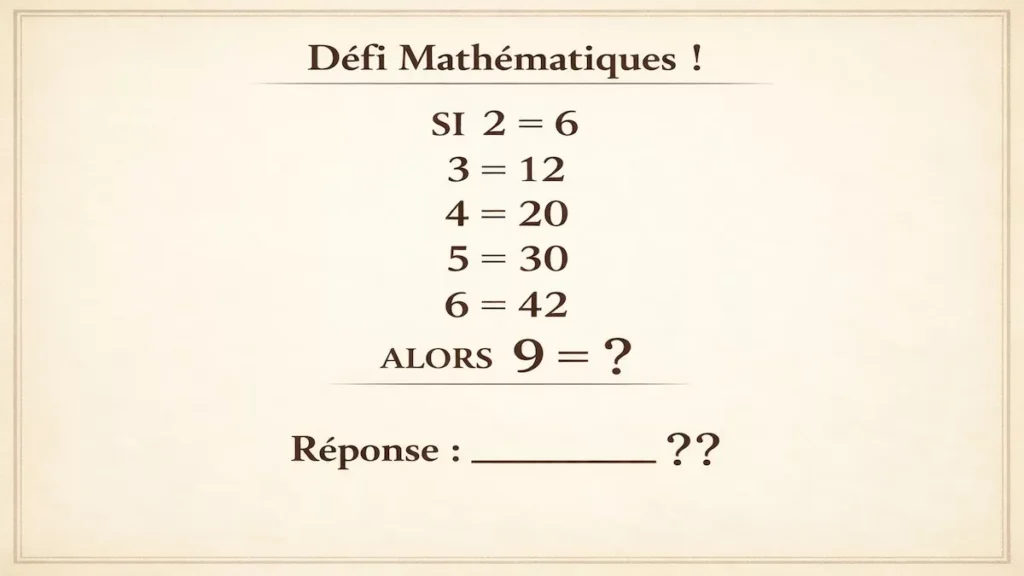
Some number sequences may appear strange due to their structure, but they are actually based on very precise rules. The main trap often lies in a poor identification of the relationships between the numbers and a lack of method in analyzing the progression. This type of challenge tests not only the ability to calculate but also the rigor, observation, and understanding of the reasoning steps.
In France, several international assessments have revealed that the level of mathematics remains a concern. For instance, the results of the PISA survey indicate that French students aged 15 consistently score below the OECD average in mathematics, with a score around 474 points (compared to about 485 on average in OECD countries according to the latest editions).
Furthermore, approximately one in five students still faces significant difficulties with fundamental skills in calculation, logic, and reasoning.
These figures highlight the importance of mastering the basics, and that seemingly simple exercises can indeed help reinforce logic, methodology, and confidence in problem-solving.
As Henri Poincaré said:
“Mathematics is the art of giving the same name to different things.”
This reminds us that each sequence is based on a hidden structure that must be recognized, and no observation should be overlooked.
What This Challenge Helps Develop:
- Respect for numerical regularities
- Understanding of relationships between terms
- Building a logical rule
- Rigor in step-by-step reasoning
- Consistent verification of results
Today’s Challenge
SO: 9 = ?
Answer: ______ ??
Take your time to analyze the sequence carefully before responding.
A single mistake in identifying the rule can completely alter the final result.
The difficulty mainly lies in reading the gaps and searching for the hidden logic in the numbers.
The Countdown Begins:
30…
20…
10…
5…
3…
2…
1…
Time’s up!
So, what is your answer?
What Your Performance Reveals:
A correct and quick answer indicates excellent analytical and deductive abilities.
A correct answer after thoughtful consideration reflects a good mastery of logic and methodology.
An incorrect or unattempted answer is no problem; these exercises are meant to help you improve.
Detailed Solution We Found:
Step 1: Identify the Rule
We notice that each result corresponds to:
n × (n + 1) with a progressive offset, but more simply here:
n × (n + 1) + n
Test:
2 × 3 = 6
3 × 4 = 12
4 × 5 = 20
5 × 6 = 30
6 × 7 = 42
So, the rule is indeed:
n × (n + 1)
Step 2: Calculate 9
9 × 10 = 90
Final Answer:
9 = 90
Conclusion
The rule becomes clear when we compare each step: we are not performing a fixed operation, but rather a progressive adjustment that increases with each line.
And before you get lost in the depths of the web, explore other games and tests by clicking here.