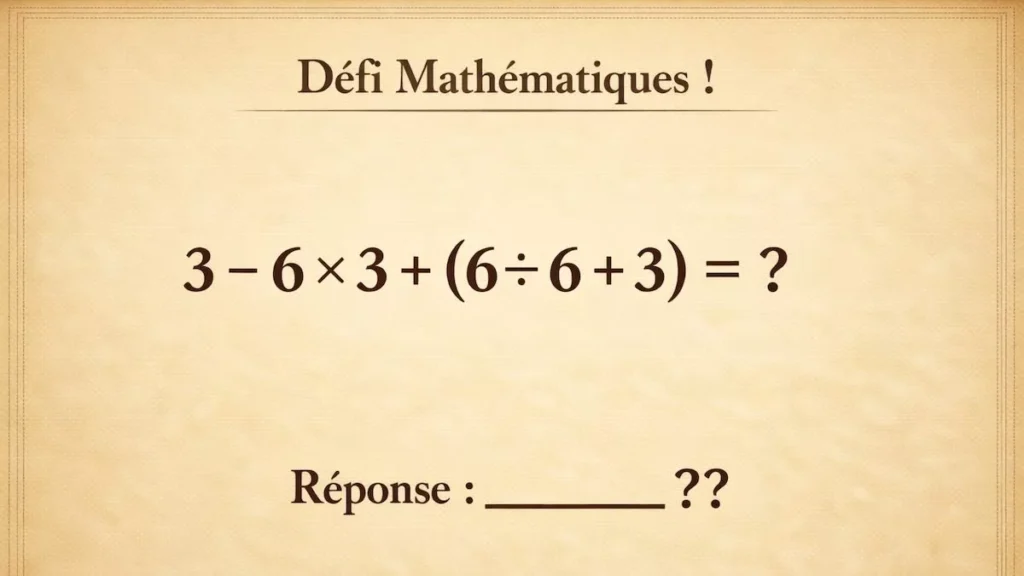
Some equations may seem easy due to their form, but they actually follow well-defined rules. The main challenge often stems from a poor application of order of operations and a lack of methodical calculation. This type of challenge not only assesses the ability to perform operations quickly but, more importantly, evaluates rigor, logic, and understanding of the steps involved.
In France, several international studies have highlighted that mathematics remains a significant issue. For instance, the results of the PISA survey show that French students aged 15 regularly score below the OECD average in mathematics, with a score around 474 points (compared to approximately 485 on average across OECD countries according to the latest editions). Additionally, nearly one in five students faces significant difficulties with fundamental skills in calculation and reasoning.
These data underscore the importance of reinforcing foundational skills, as seemingly simple equations can actually help develop logic, method, and self-confidence in handling calculations.
As Isaac Newton once said:
“What we know is a drop of water; what we do not know is an ocean.”
This reminds us that every result is based on precise logic and that no step should be overlooked.
What This Challenge Allows You to Work On:
- Strict adherence to order of operations
- Management of multiplications within an equation
- Progressive simplification of steps
- Rigor in step-by-step calculations
- Logical verification of the result
Today’s Challenge
Answer: ______ ??
Take the time to carefully analyze this equation before responding.
Even a minor error in the order of operations can completely alter the final result.
The Countdown Begins:
30…
20…
10…
5…
3…
2…
1…
Time’s up!
So, what is your answer?
What Your Performance Reveals:
Correct and quick answer indicates excellent mastery of order of operations.
Correct answer after reflection shows good analytical and reasoning skills.
Incorrect or missing answer? Don’t worry; these exercises are meant for improvement.
Detailed Solution We Found:
To solve this equation correctly, it is necessary to follow a precise method:
– Start with the operations within the parentheses.
– First, perform the multiplications.
– Gradually simplify each step.
– Then address the divisions.
– Finish with additions and subtractions.
– Verify each intermediate result.
1) We Start with the Parentheses
Within the parentheses, we respect the priority of division followed by addition:
6 ÷ 6 = 1
Therefore:
( 1 + 3 ) = 4
The equation becomes:
3 − 6 × 3 + 4
2) We Perform the Multiplication
6 × 3 = 18
The equation becomes:
3 − 18 + 4
3) We Perform Additions and Subtractions from Left to Right
3 − 18 = −15
−15 + 4 = −11
Final Result:
−11
Conclusion
This type of equation shows that apparent complexity can diminish once the calculation rules are followed with rigor. The key is to adhere to a structured method, without rushing, and to verify each step to avoid inattentiveness errors.
And before you get lost in the vastness of the web, explore other games and tests by clicking here.