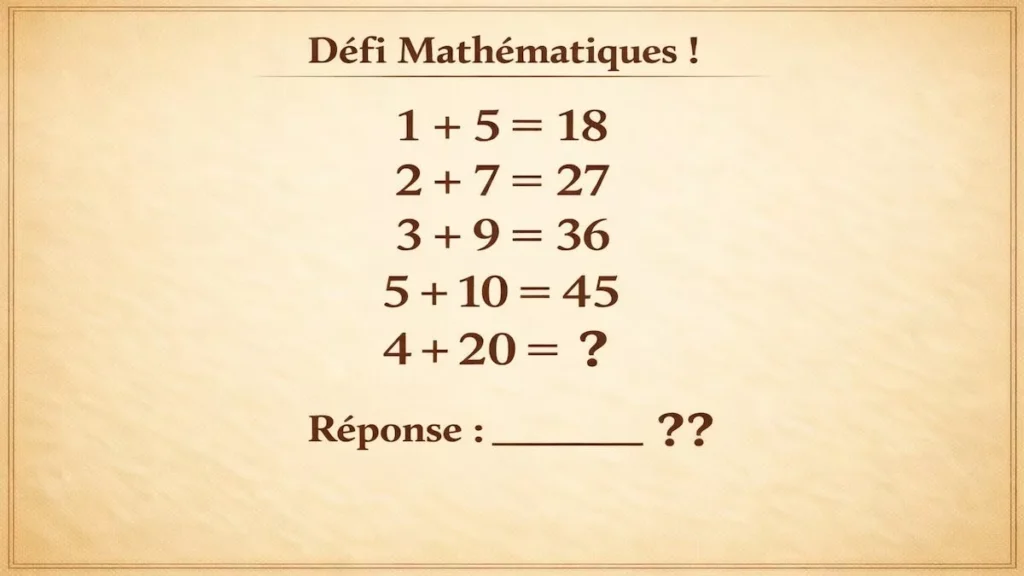
Some sequences of operations may seem unusual at first glance, as they do not follow the classic rules of calculation. In this type of exercise, the main trap lies in the need to first identify the hidden logic before applying a method of resolution. This is not merely a calculation, but rather a task of observation and deduction. In mathematics, the challenge lies not only in the operation itself, but also in the ability to spot a common structure among various results.
Such challenges are useful for developing logic, concentration, and the ability to discover a recurring pattern in a series of equations.
As Henri Poincaré once stated:
“Mathematics is the art of giving the same name to different things.”
In France, mathematics assessments consistently show that success depends as much on the method as on the final result.
Such challenges are therefore beneficial for developing logic, concentration, and the ability to identify a repetitive structure in a series of equations.
This serves as a reminder that behind different equations, there may be a single underlying rule.
What This Challenge Helps to Develop:
- Identifying the rule in a series of equations
- The logic behind constructing a mathematical pattern
- Rigor in step-by-step analysis
- Deductive reasoning skills
- Verifying the consistency of results
Today’s Challenge
Answer: ______ ?
Take a moment to carefully observe the relationships between the numbers before responding.
A hasty reading can easily lead to misinterpretation.
The countdown begins:
30…
20…
10…
5…
3…
2…
1…
Time’s up
So, what is your answer?
What Your Performance Reveals
If you found the answer quickly and correctly, you have excellent logic and strong analytical skills.
If you found the answer after some thought, you know how to structure your reasoning and verify your steps.
And if your answer was incorrect or not found, no problem; this type of exercise is perfect for improving your method and precision.
Detailed Solution We Found (not necessarily the only one, or even the correct one).
Step 1: Observe the Results
Let’s look at the base sums:
- 1 + 5 = 6 → 18
- 2 + 7 = 9 → 27
- 3 + 9 = 12 → 36
- 5 + 10 = 15 → 45
We notice a constant relationship between the sum and the result.
Step 2: Identify the Rule
Each result corresponds to:
(a+b) × 3
Verification:
- 6 × 3 = 18
- 9 × 3 = 27
- 12 × 3 = 36
- 15 × 3 = 45
The rule holds true for all lines.
Step 3: Apply to 4 + 20
- 4 + 20 = 24
- 24 × 3 = 72
Final Answer:
72
Conclusion
The rule becomes clear when comparing each step: we are not performing a fixed operation, but rather a progressive adjustment that increases with each line.
And before you get lost in the depths of the web, explore other games and tests by clicking here.