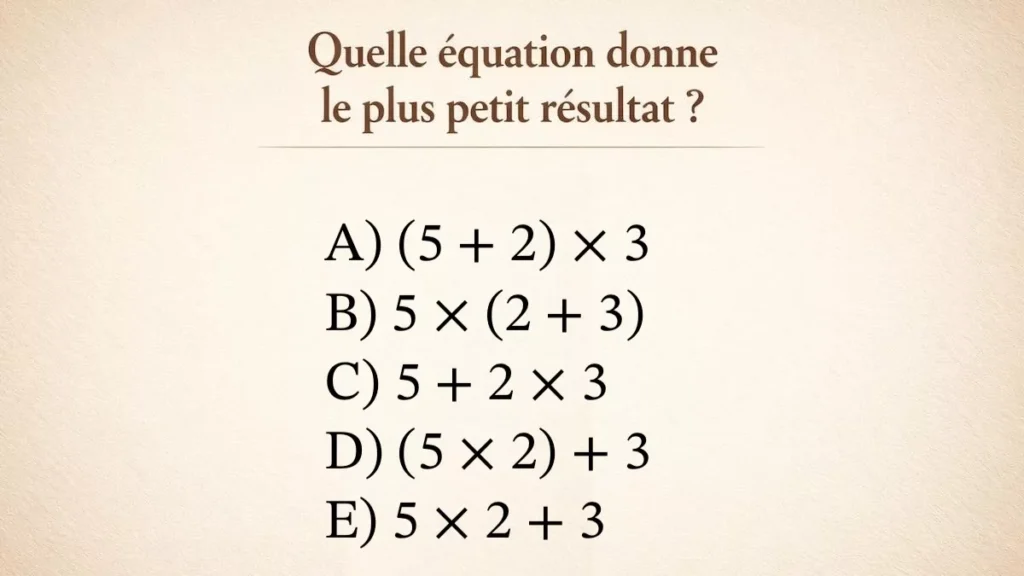
Some equations may appear very similar, but a slight change in the order of operations can completely alter the final result. In this type of challenge, the difficulty lies not in the calculations themselves, but in the ability to correctly analyze each structure before comparing the values. It’s not just about calculating, but also about adhering to the order of operations to avoid any misinterpretation.
In mathematics, the same sequence of numbers can yield vastly different results depending on how it is arranged.
As George Pólya said:
“Understanding a problem is already halfway to solving it.”
This serves as a reminder that observation and reflection are essential before any calculation.
What This Challenge Allows You to Work On:
- Respect for the order of operations
- Comparison of multiple results
- Rigorous calculation
- Analytical logic
- Concentration and attention to detail
The Challenge of the Day
Which equation yields the smallest result?
Answer: ______ ??
Take the time to analyze each equation before responding.
A hasty reading can easily lead to a comparison error.
The countdown begins:
40…
30…
20…
10…
5…
3…
2…
1…
Time’s up!
So, what is your answer?
What Your Performance Reveals
If you found the result quickly and correctly, you have excellent logic and good analytical skills.
If you found the result after some reflection, you know how to structure your reasoning and check your steps.
And if your result was incorrect or you couldn’t find it, no problem; this type of exercise is perfect for improving your method and precision.
Detailed Solution
A)
(5 + 2) × 3 = 7 × 3 = 21
B)
5 × (2 + 3) = 5 × 5 = 25
C)
5 + 2 × 3 = 5 + 6 = 11
D)
(5 × 2) + 3 = 10 + 3 = 13
E)
5 × 2 + 3 = 10 + 3 = 13
Final Comparison
- A = 21
- B = 25
- C = 11
- D = 13
- E = 13
The smallest result is therefore:
Final Answer:
C) 5 + 2 × 3 = 11
Conclusion
This challenge demonstrates that very similar equations can yield different results depending on the order of operations. Careful analysis of each step helps avoid errors and accurately identify the smallest value. Rigorous calculation remains essential for effectively comparing multiple expressions.
And before you get lost in the depths of the web, explore other games and tests by clicking here.