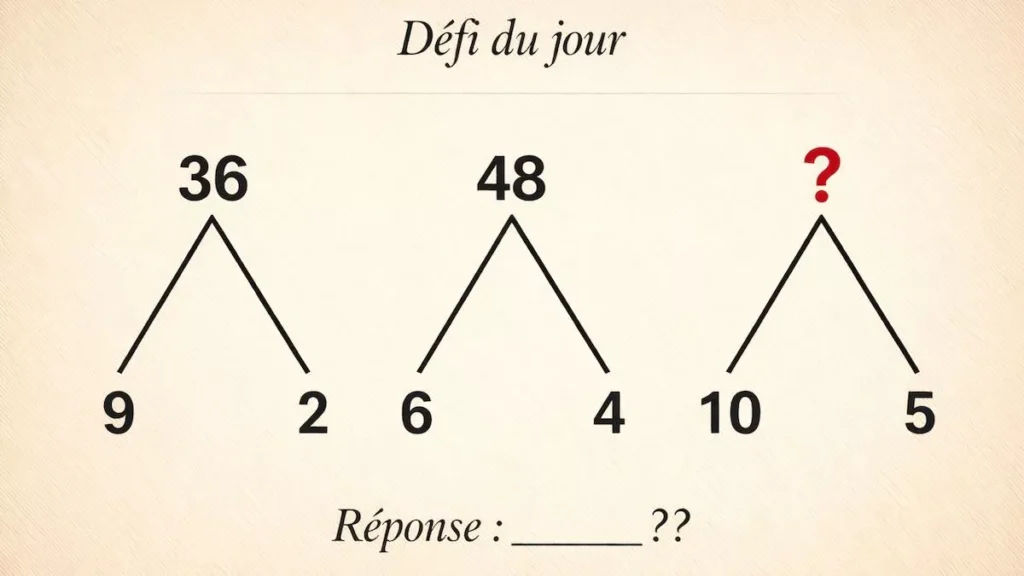
Some challenges may appear simple, very simple… but they actually rely on a hidden logic that must be identified before one can respond. In this type of challenge, the difficulty does not stem from the numbers themselves but from the ability to recognize the connection between each line. Thus, it is less about calculating quickly and more about understanding the rule that links the values together so that it can be accurately reproduced.
Mathematics here becomes an exercise in observation and deduction, where each equation serves as a clue.
As George Pólya said:
“Understanding the problem is half the solution.”
This serves as a reminder that before calculating, one must first analyze the structure of the problem.
What This Challenge Allows You to Work On:
- Searching for regularity
- Logic of decomposition
- Observing relationships
- Deducing
- Verifying consistency
The Challenge of the Day
Answer: ______ ??
Take your time to analyze the relationships between the numbers before responding.
A quick read can easily obscure the logic of the problem.
The countdown begins:
40…
30…
20…
10…
5…
4…
3…
2…
1…
Time’s up!
What Your Performance May Reveal
If you found the answer quickly and correctly, you have excellent logic and good analytical skills.
If you found the answer after some reflection, you know how to structure your reasoning and verify your steps.
If your answer was incorrect or you couldn’t find it, no worries; this type of exercise is perfect for improving your method and precision.
Detailed Solution We Found (Not Necessarily the Only One, Sometimes Even the Right One)
Step 1: Identify the Rule
We observe:
- 36 = 9 × 2 × 2
- 48 = 6 × 4 × 2
Therefore, the starting number is:
(first number × second number × 2)
Step 2: Apply the Inverse Rule
We seek a number such that:
x = 10 × 5 × 2
x = 100
Final Answer:
100
Conclusion
This challenge demonstrates that certain sequences of equations are based on a simple but not immediately obvious multiplicative structure. By carefully observing the relationships between the numbers, it becomes possible to quickly identify the rule and solve the problem methodically.