Mathematics is often likened to a language, as it allows us to express ideas, solve problems, and understand situations with precision. What I enjoy about math challenges is that they require us to slow down, think critically, and search for the hidden logic behind an equation. Sometimes, a formula that appears complicated at first glance becomes quite simple once the right method is applied. Beyond calculations, mathematics fosters numerous useful skills: concentration, organization of ideas, rigor, and confidence in one’s ability to find solutions.
Each equation serves as a small exercise in learning to analyze a problem, make thoughtful choices, and progress step by step.
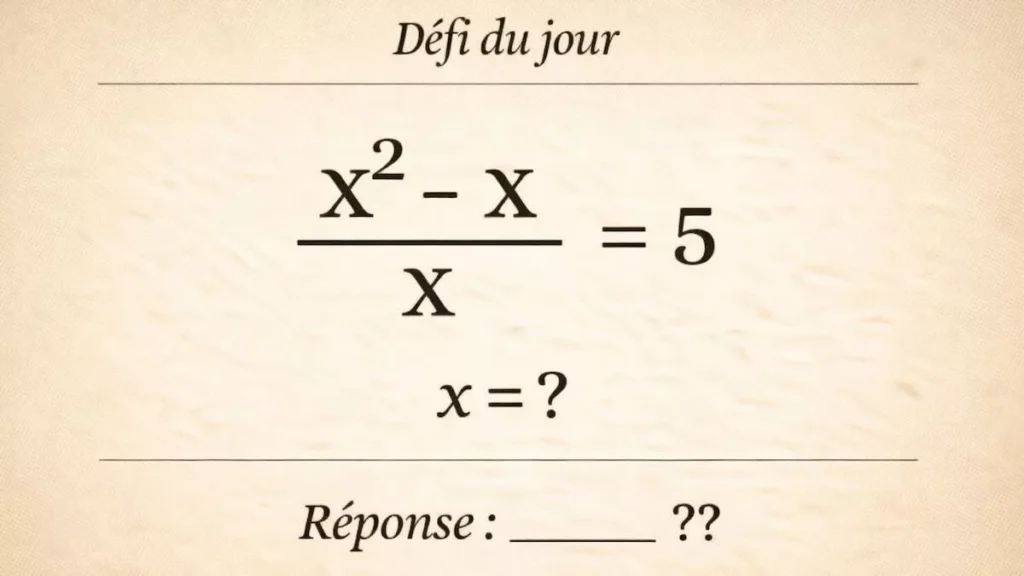
In this challenge, you will need to simplify an equation that includes a squared unknown and a division. The key will be to transform the equation to progressively isolate the value of x.
What This Challenge Helps To Develop:
- Solving equations
- Algebraic simplification
- Using properties of exponents
- Logical reasoning
- Verification of a solution
Today’s Challenge
x = ?
Answer: ______ ??
Take a close look at the equation before responding.
A good strategy often involves simplifying the equation before beginning calculations.
The countdown begins:
40…
30…
20…
10…
5…
4…
3…
2…
1…
Time’s up!
What Your Performance Can Reveal
If you found the answer quickly and correctly, you have excellent logic and analytical skills.
If you found the answer after some thought, you know how to structure your reasoning and check your steps.
And if the result was incorrect or not found, no worries; this type of exercise is perfect for improving method and precision.
Detailed Solution We Found (Not Necessarily the Only One, Sometimes Even the Correct One)
We start with the equation:
(x² − x) / x = 5
We factor the numerator:
x² − x = x(x − 1)
The equation becomes:
x(x − 1) / x = 5
We simplify by x:
x − 1 = 5
We add 1 to both sides:
x = 6
Verification:
(6² − 6) / 6
= (36 − 6) / 6
= 30 / 6
= 5
Final Answer:
x = 6
Conclusion
This challenge illustrates that in mathematics, the solution is not always about doing more calculations, but often about better understanding the structure of the problem. By learning to simplify, organize reasoning, and verify results, we develop a true method of thinking. Mathematics trains us to solve problems with logic and precision.
And before you get lost in the depths of the web, explore other games and tests by clicking here.