I’ve always enjoyed noticing that mathematics can hide challenges in unexpected places. An operation that seems straightforward can sometimes follow a different rule than what we typically use. This is what I love about mathematical puzzles: they force us to step outside our routines, observe details, and seek new logic. For me, math is much more than just calculations; it engages and trains important cognitive functions such as working memory, attention, and logical reasoning. Research shows that success in mathematics is strongly linked to the mental processing abilities required to solve difficult problems. Each mathematical challenge teaches us to analyze a situation, test ideas, and build reasoning step by step.
However, studies primarily indicate a strong relationship between mathematical practice and cognitive abilities, but they do not always prove that doing math directly enhances all general intellectual capacities.
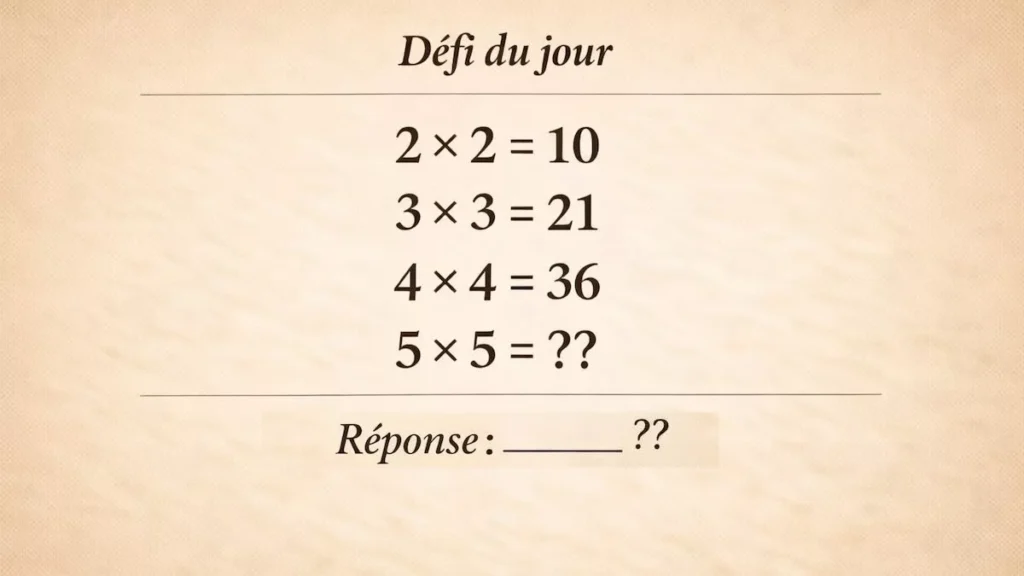
In this challenge, the multiplication symbol does not follow its usual application. You must discover the hidden rule behind the proposed equalities to find the result of the last equation.
What This Challenge Helps To Develop:
- Pattern recognition
- Mathematical logic
- Observation of relationships between numbers
- Deducing reasoning
- Solving an equation
Today’s Challenge

5 × 5 = ??
Answer: ______ ??
Pay close attention to the previous results.
The challenge is not to perform a standard multiplication, but to uncover the hidden rule.
The countdown begins:
40…
30…
20…
10…
5…
4…
3…
2…
1…
Time’s up!
What Your Performance Can Reveal
If you found the result quickly and correctly, you have excellent logic and analytical skills.
If you found the result after some thought, you know how to structure your reasoning and check your steps.
And if your result was incorrect or not found, no worries; this type of exercise is perfect for improving your method and accuracy.
Detailed Solution We Found (Not Necessarily the Only One, or Even the Right One)
The pattern is:
n × n = n × (n + 3)
Verification:
For 2:
2 × (2 + 3)
= 2 × 5
= 10
For 3:
3 × (3 + 4)
= 3 × 7
= 21
For 4:
4 × (4 + 5)
= 4 × 9
= 36
Applying the same rule:
5 × 5
= 5 × (5 + 6)
= 5 × 11
= 55
Final Answer:
55
Conclusion
This challenge demonstrates that mathematics is not just about applying known rules, but also about observing and finding new connections. Logic puzzles develop our creativity, analytical skills, and confidence to solve problems differently. With reflection and a good method, every number can reveal a hidden logic.