Follow us on Google
I am always amazed to see how mathematics has accompanied the greatest discoveries of humanity. Whether it’s building monuments, calculating the orbits of planets, designing airplanes, or developing modern technologies, they are everywhere. What excites me is that with a few simple rules and sound reasoning, they allow us to solve problems that sometimes seem very complex.
Mathematics is much more than a succession of calculations. They teach us to observe with precision, to think methodically, and to never settle for appearances. They develop our logic, critical thinking, concentration, and perseverance. Every challenge is a new opportunity to exercise our brains and progress.
“The book of nature is written in the language of mathematics.” — Galileo
This quote reminds us that mathematics is all around us. They help us understand the world, explain the phenomena around us, and achieve scientific and technical feats.
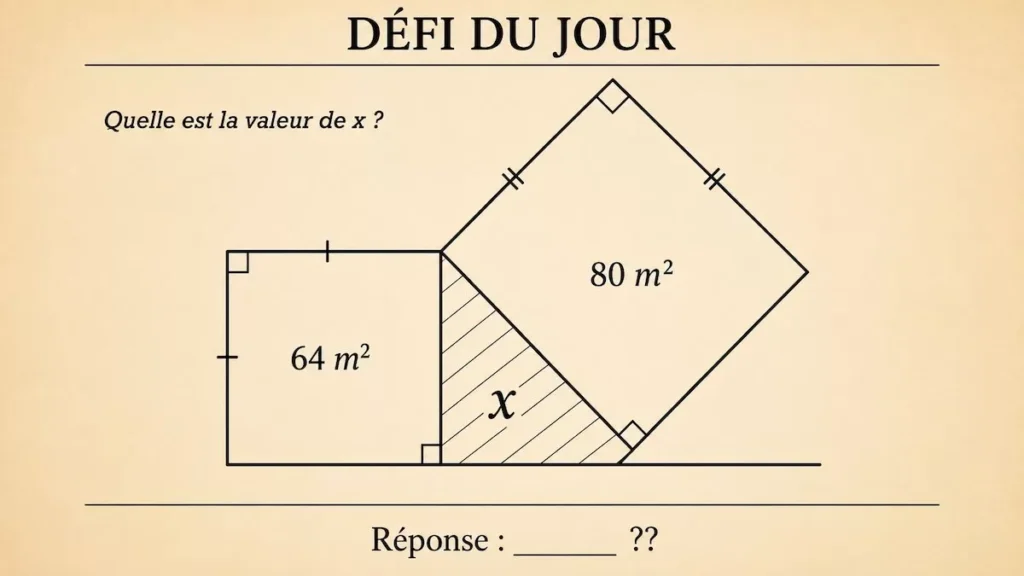
Today, I present you with a new geometry challenge. Can you find the area of the shaded region before the countdown ends?
What This Challenge Helps To Develop:
- Properties of squares
- Pythagorean theorem
- Calculating areas
- Geometric reasoning
- Logic
DAILY CHALLENGE
What is the area of the shaded region?
Answer: ______ ??
Take the time to observe the figure. All the necessary information is present; you just need to connect them with the right geometric properties.
The countdown begins:
40…
30…
20…
10…
5…
4…
3…
2…
1…
Time’s up!
What Your Performance Can Reveal
If you found the answer quickly and correctly, you have excellent logic and good analytical skills.
If you found the result after some thought, you know how to structure your reasoning and check your steps.
And if the result is incorrect or not found, no worries, this type of exercise is perfect for improving method and precision.
Detailed Solution We Found (not necessarily the only one, sometimes even the right one)
The first square has an area of:
64 m²
So its side measures:
√64 = 8 m
The second square has an area of:
80 m²
Its side measures:
√80 = 4√5 m
This side corresponds to the hypotenuse of the shaded triangle.
We then apply the Pythagorean theorem:
Hypotenuse² = base² + height²
80 = base² + 8²
80 = base² + 64
base² = 16
base = 4 m
The area of the shaded triangle is then:
Area = (base × height) ÷ 2
Area = (4 × 8) ÷ 2
Area = 16 m²
Final Answer:
x = 16 m²
Conclusion
This challenge shows that mathematics can transform a seemingly complicated figure into a simple problem when the right properties are applied. By observing the relationships between the squares and the triangle, a few calculations are enough to find the answer. It’s this power of reasoning that makes mathematics an essential tool in architecture, engineering, and the sciences. Each solved challenge is a new opportunity to develop one’s logic, rigor, and observational skills.