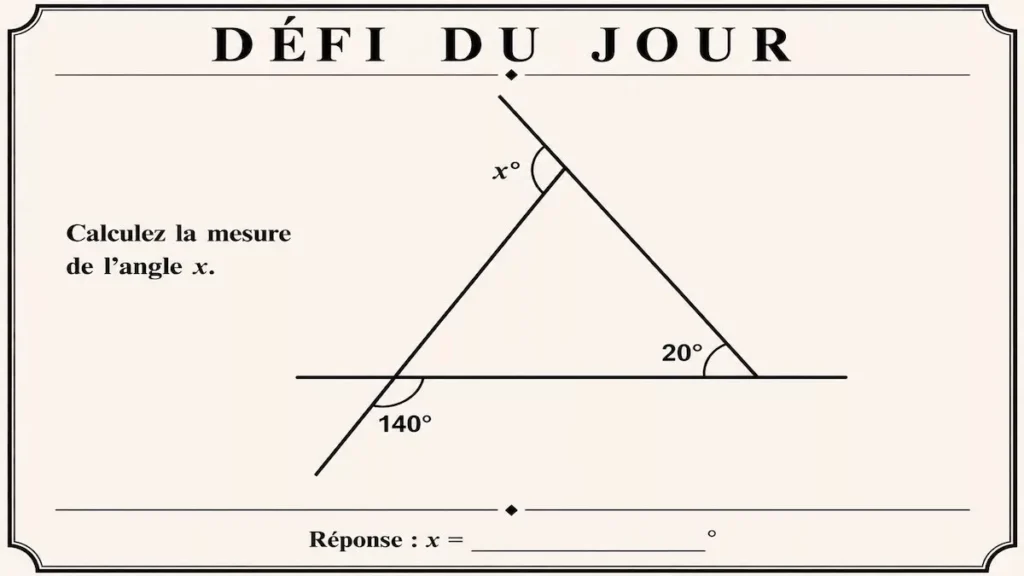

Sometimes, I find myself looking at a geometry problem and immediately searching for the requested angle. However, I have learned that it is often more effective to start with angles that seem secondary. An information point located far from x can ultimately be the key to unlocking the entire figure. This is one of the reasons why I enjoy math; it teaches us to build reasoning, connect information, and not stop at what we see.
The study of angles has accompanied mathematics since ancient times. It allowed astronomers to study the sky, navigators to determine their direction, and builders to design precise constructions. Today, angles remain essential in architecture, engineering, cartography, robotics, and 3D modeling. Thus, behind a simple geometry exercise lies a way of reasoning used in many scientific and technical achievements.
“Mathematics knows no races or geographical boundaries.” — David Hilbert
This quote reminds us that the language of mathematics is universal: the properties of angles remain the same, regardless of where we are.
What This Challenge Allows You to Work On:
- Supplementary angles
- Angles opposite each other at the vertex
- The sum of the angles in a triangle
- Exterior angles
- Equations
- Careful reading of a figure
- Mental calculation
- Logic and concentration
Challenge of the Day
Calculate the measure of angle x.
What is the value of x?
Answer: x = __________ °
Do not rely solely on the position of the numbers. To find x, you must first determine another hidden angle in the figure.
The Countdown Begins
40…
30…
20…
10…
5…
4…
3…
2…
1…
Time’s up!
What Your Performance Can Reveal
If you found the result quickly and correctly, you have excellent logic and strong analytical skills.
If you found the result after some thought, you know how to structure your reasoning and verify your steps.
And if your result is incorrect or not found, no worries; this type of exercise is perfect for improving your method and precision.
Detailed Solution We Found (Not Necessarily the Only One, Sometimes Even the Correct One)
Let’s start with the 140° angle located at the bottom left.
The interior angle of the adjacent triangle forms a straight angle with it.
Let’s call this angle a.
We set up the equation:
a + 140° = 180°
Subtracting 140° gives us:
a = 40°
Thus, the left interior angle of the triangle measures 40°.
Now we know two interior angles of the triangle:
40° and 20°
Let’s call b the interior angle at the top.
The sum of the angles in a triangle is 180°.
We write the equation:
40° + 20° + b = 180°
60° + b = 180°
Thus:
b = 120°
But be careful: on the panel, x corresponds to the exterior angle adjacent to b.
These two angles form a straight angle.
So we set up:
x + 120° = 180°
This gives us:
x = 60°
Final Answer
x = 60°
Verification
To the left:
140° + 40° = 180°
In the triangle:
40° + 20° + 120° = 180°
At the top:
120° + 60° = 180°
The answer is therefore perfectly consistent with the figure.
Conclusion
This challenge shows that in geometry, the answer sometimes builds itself like a small logical chain. The 140° angle first allows us to discover 40°. This new angle, combined with the 20°, leads us to find 120° at the top. Finally, the supplementary angle brings us to x = 60°.
Thus, three simple equations are enough to solve a figure that appears much more complicated at first glance. This is also one of the great interests of mathematics: learning to gradually transform the unknown into something we can understand and demonstrate.
And before you