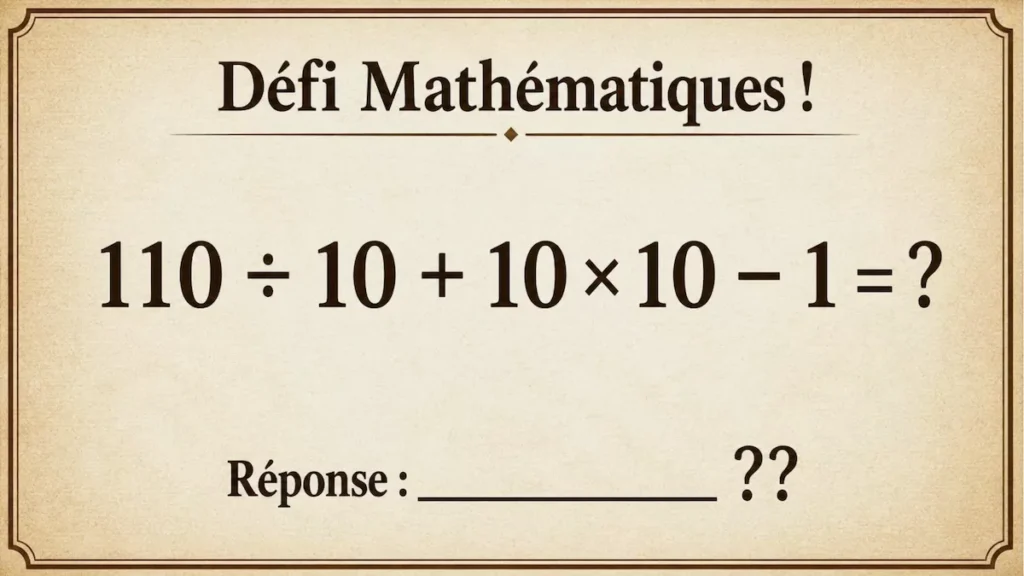
I still find myself looking at a very simple calculation and thinking the answer will come immediately. It’s precisely in these moments that a small operational priority can change everything. Over the years, I’ve learned to be wary of equations that seem too easy. The more obvious they appear, the more I want to check the order of operations before answering. This issue of the order of calculations didn’t arise out of nowhere. As mathematics has developed, establishing common conventions has become essential for everyone to read and solve the same equation in the same way.
These rules now allow scientists, engineers, economists, and computer scientists to manipulate complex calculations without ambiguity.
“Mathematics is the art of giving the same name to different things.” — Henri Poincaré
Today’s challenge may seem elementary. Yet, it serves to reinforce an essential habit: never calculate simply from left to right without considering priorities.
What This Challenge Helps You Practice:
- Operational priorities
- Multiplication and division
- Addition and subtraction
- Mental calculation
- Rigorous reading of an equation
- Order of operations
- Verification of the result
- Mastery of calculation automatisms
Correctly Solve the Following Equation.
Answer: __________
Let the Games Begin!
20…
15…
10…
5…
4…
3…
2…
1…
Time’s up!
What Your Performance May Reveal
If you found the result quickly and correctly, you have excellent logic and good analytical skills.
If you found the result after some thought, you know how to structure your reasoning and verify your steps.
And if the result is incorrect or not found, no worries; this type of exercise is perfect for improving your method and precision.
Detailed Solution We Found (Not Necessarily the Only One, or Even the Right One)
The equation is:
110 ÷ 10 + 10 × 10 − 1 = ?
Multiplication and division take precedence over addition and subtraction.
We start with:
110 ÷ 10 = 11
Next:
10 × 10 = 100
The equation now becomes:
11 + 100 − 1 = ?
We now perform the remaining operations from left to right:
11 + 100 = 111
Then:
111 − 1 = 110
Answer: 110
Conclusion
The trap of this challenge was not the difficulty of the numbers, but the order in which the operations needed to be performed. By respecting the priorities, division gives 11, multiplication gives 100, and then addition and subtraction lead to 110.
This little test serves as a reminder of a fundamental rule: an equation is not necessarily solved in the order that the symbols appear.
In mathematics, it’s not just what we calculate that matters, but also when we calculate it.
And before you get lost in the depths of the web, explore more games and tests by clicking here.