Mathematics has often advanced through a simple idea: instead of performing lengthy calculations, we seek to understand how numbers are constructed and how they can be simplified. Powers and remarkable identities perfectly illustrate this way of thinking. Behind impressive numbers can sometimes lie a very short solution. Thus, the interest of mathematics lies not only in calculation; they teach us to observe, establish connections, and choose efficient methods.
This reasoning ability has led to significant achievements in science, architecture, engineering, computer science, and many other fields.
“The essence of mathematics is freedom.” — Georg Cantor
This quote reminds us that a mathematical problem can often be approached in multiple ways. Finding an elegant method sometimes means realizing that it is not necessary to calculate everything.
I remember certain exercises where I would immediately start calculating. Then, after a moment, I would notice a property that allowed everything to be simplified. That brief moment when a complicated solution suddenly becomes obvious is probably one of the things I appreciate most about mathematical challenges.
What This Challenge Allows You to Work On:
- This challenge allows you to work on powers and the order of operations.
- The difference of two squares.
- Factorization.
- Simplification.
- And above all, the ability to recognize a faster method than direct calculation.
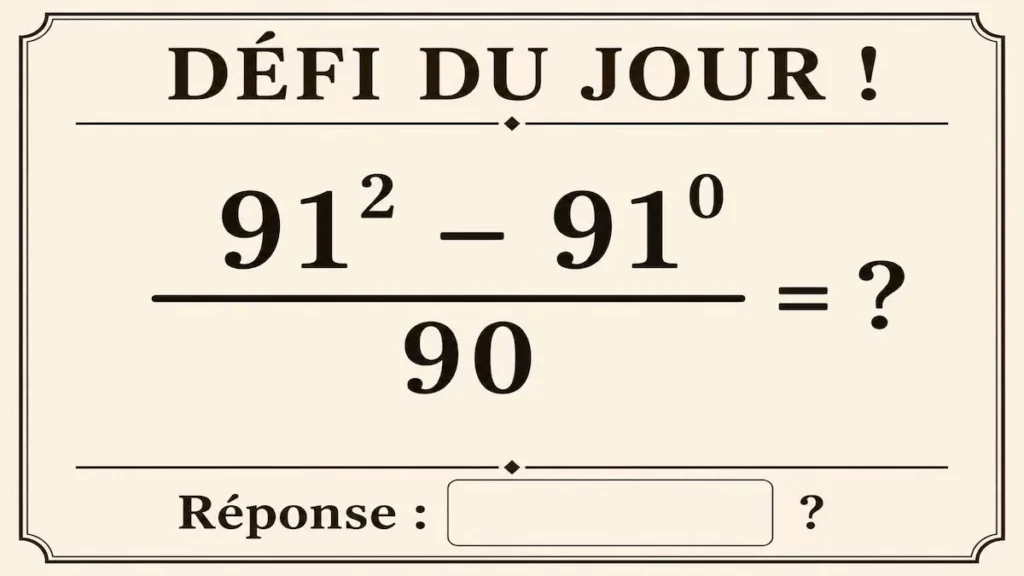
DAILY CHALLENGE
Find the value of:
Take a few seconds to observe the equation before calculating.
There is a particularly quick method.
The Countdown Begins
30…
25…
20…
15…
10…
5…
4…
3…
2…
1…
Time’s Up!
What Your Performance Can Reveal
If you found the result quickly and correctly, you have excellent logic and analytical skills.
If you found the result after some reflection, you know how to structure your reasoning and verify your steps.
And if the result was incorrect or not found, no worries; this type of exercise is perfect for improving method and precision.
Detailed Solution We Found (Not Necessarily the Only One, Sometimes Even the Right One)
First Step:
91⁰ = 1
The equation then becomes:
(91² − 1) ÷ 90
We then recognize a difference of two squares:
91² − 1² = (91 − 1) × (91 + 1)
We obtain:
[(91 − 1) × (91 + 1)] ÷ 90
Now let’s proceed with the calculations:
91 − 1 = 90
91 + 1 = 92
Therefore:
(90 × 92) ÷ 90
The 90 simplifies:
92
Answer: 92
Conclusion
This challenge perfectly illustrates that in mathematics, observing can be more effective than calculating. One could have started by determining 91², but recognizing the difference of two squares allows for a much quicker path to the result.
Thus, the answer is 92. A small challenge that reminds us that a good mathematical property can transform an apparently complicated calculation into just a few simple steps.
And before you get lost in the depths of the web, explore other games and tests by clicking here.