
Almost everyone remembers a time when, while preparing a recipe, they tried to balance a scale with different ingredients. Without even realizing it, we were solving an equation; what we added on one side needed to be compensated on the other. It’s in these very simple situations that I realize how much mathematics is part of our daily lives. They are not just present in textbooks: they allow us to measure, compare, and find unknown information based on what we already know.
Scales have played a significant role in the history of math and commerce. Accurately measuring weights was essential for exchanging goods, preparing materials, or conducting scientific experiments. The principle of balance is also an excellent way to understand equations: both sides must maintain the same value. Today, this reasoning remains crucial in science, engineering, and many everyday situations. It develops our logic, attention, and ability to transform a concrete problem into a calculation.
“Algebra is generous: it often gives more than one asks.” — Jean le Rond d’Alembert
This quote fits well with this challenge: a few objects placed on a scale are enough to create an equation and accurately find a value that is unknown.
What This Challenge Allows You to Work On:
- Setting up equations
- The principle of balance
- Solving for an unknown
- Mental calculation
- Observation
- Logic
- Concentration
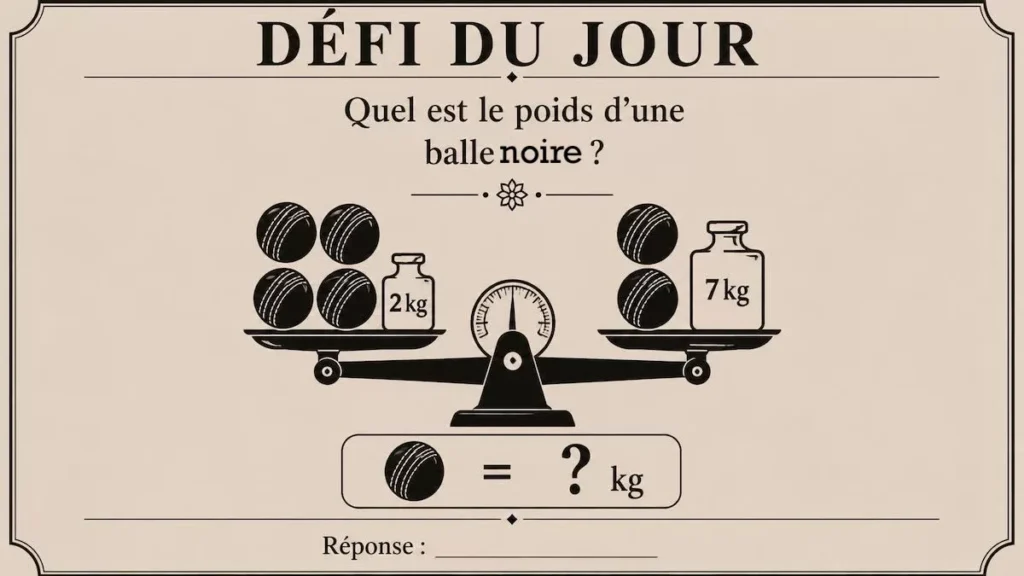
CHALLENGE OF THE DAY
What is the weight of a black ball?
The scale is perfectly balanced.
How much does a black ball weigh?
Answer: __________ kg
Carefully observe both sides of the scale. Since it is balanced, their weights are exactly the same.
The Countdown Begins
30…
20…
10…
5…
4…
3…
2…
1…
Time’s up!
What Your Performance Can Reveal
If you found the answer quickly and correctly, you have excellent logic and analytical skills.
If you found the answer after some thought, you know how to structure your reasoning and check your steps.
And if your answer was incorrect or you couldn’t find it, no worries; this type of exercise is perfect for improving your method and precision.
Detailed Solution We Found (Not Necessarily the Only One, or Even the Correct One)
Let’s call x the weight of a black ball.
The left side contains four balls and a weight of 2 kg.
The right side contains two balls and a weight of 7 kg.
Since the scale is balanced, we can write the equation:
4x + 2 = 2x + 7
We subtract 2x from both sides:
2x + 2 = 7
Next, we subtract 2 from both sides:
2x = 5
We divide both sides by 2:
x = 2.5
Therefore, a black ball weighs:
Final Answer
x = 2.5 kg
Verification
On the left:
4 × 2.5 + 2 = 12 kg
On the right:
2 × 2.5 + 7 = 12 kg
Both sides weigh 12 kg. The scale is therefore perfectly balanced.
Conclusion
This challenge illustrates very concretely what an equation is: an equality that must be maintained throughout the resolution. By removing the same quantity from both sides and progressively isolating the unknown, we discover that each ball weighs 2.5 kg. This is one of the great interests of mathematics: transforming a visual situation into precise reasoning and using a few pieces of information to uncover what was initially unknown.
And before you get lost in the depths of the web, explore more games and tests by clicking here.