
Long before calculators and geometry software, mathematicians learned to understand shapes by observing their properties. A simple triangle could reveal much information without needing to measure every angle. The ancient Greeks notably developed this way of reasoning: starting from a few known properties to demonstrate what, at first glance, remains hidden. Geometry still holds significant interest today. It plays a role in architecture, construction, cartography, engineering, and even digital image creation. Understanding angles and parallel lines is about learning to read a figure as a set of interconnected clues.
I remember some geometry exercises that seemed complicated simply because the figure had many lines. Then, upon identifying a single crucial piece of information — often two parallel lines — everything became much clearer. This challenge works in exactly the same way: the drawing impresses more than the calculations needed to find x.
“Geometry is the art of reasoning rightly about wrong figures.” — Henri Poincaré
What This Challenge Helps To Work On:
- The properties of the isosceles triangle
- The sum of the angles in a triangle
- Parallel lines
- Corresponding angles
- Supplementary angles
- Careful reading of a geometric figure
- Logical reasoning
- Verification of a result
DAILY CHALLENGE
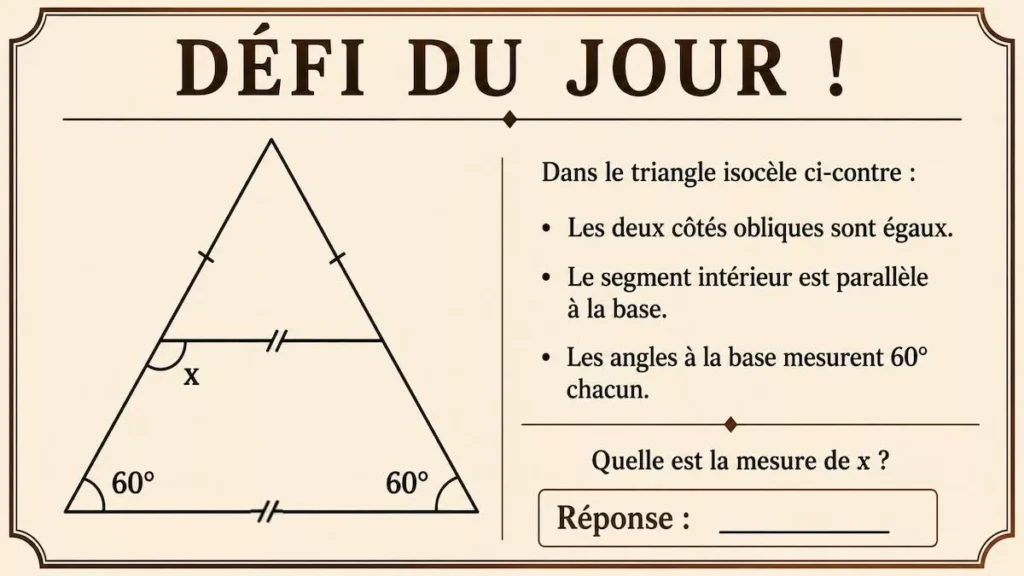
What Is The Measure Of Angle x?
In the presented isosceles triangle:
The two oblique sides are equal.
The inner segment is parallel to the base.
The two base angles measure 60°.
Determine the value of x.
Answer: __________ °
The Countdown Begins
40…
30…
20…
10…
5…
4…
3…
2…
1…
Time’s up!
What Your Performance Can Reveal
If you found the result quickly and correctly, you have excellent logic and good analytical skills.
If you found the result after some thought, you know how to structure your reasoning and verify your steps.
And if your result was incorrect or not found, no worries — this type of exercise is perfect for improving method and precision.
Detailed Solution We Found (Not Necessarily The Only One, Sometimes Even The Correct One)
Since the two base angles measure 60°, let’s first calculate the angle at the apex of the larger triangle.
60° + 60° + apex = 180°
120° + apex = 180°
Apex = 60°
Therefore, the larger triangle has three angles of 60°: it is actually equilateral.
The inner segment being parallel to the base means that the acute angle formed with the left side has the same measure as the 60° angle at the base.
Thus, we have an angle of:
60°
But be careful: in the drawing, x is the angle located on the other side of the inner segment. The two angles are adjacent and together form a straight angle.
So the equation is:
x + 60° = 180°
x = 180° − 60°
x = 120°
Answer: x = 120°
Conclusion
This challenge illustrates why it is important to look closely at which angle is being asked. Seeing two parallel lines allows for immediately identifying a 60° angle, but answering 60° too quickly would be a mistake: x represents the supplementary angle here.
Thus, geometry rewards both observation and calculation. A property of the triangle, a relationship of parallelism, and a very simple equation are ultimately all that is needed to reveal the answer:
x = 120°.
And before you get lost in the depths of the web, explore other games and tests by clicking here.