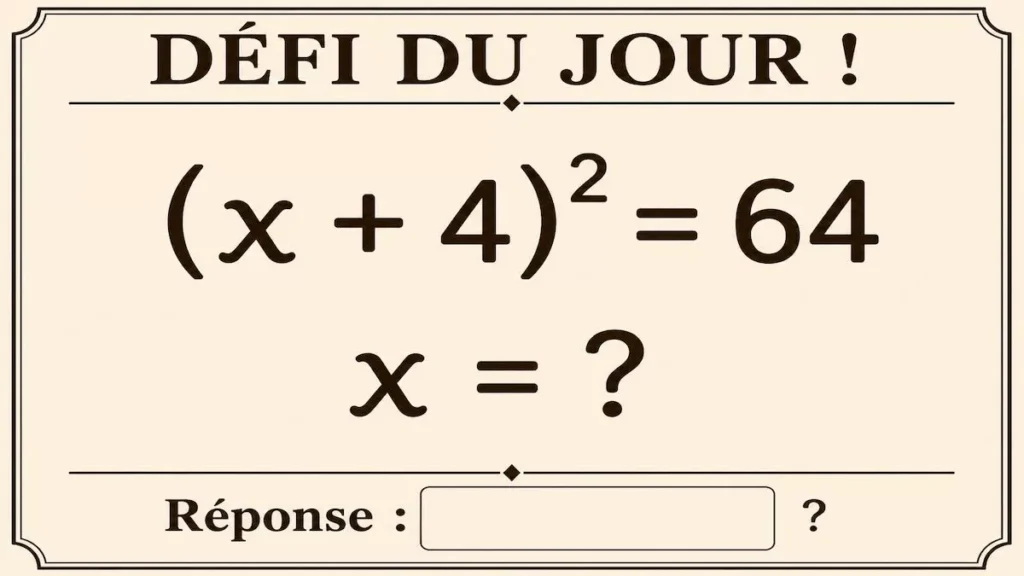
Equations are fascinating because a few symbols can sometimes conceal multiple possible paths. From the earliest works in algebra to the models used today in sciences, architecture, economics, or computer science, solving an equation primarily involves uncovering an unseen piece of information based on what we already know. I particularly enjoy this type of challenge because it appears very straightforward at first glance. One equation, one unknown… one might think the answer will come immediately.
However, a square can hide a subtlety: one must consider all the values that can yield the same result.
“Mathematics knows no races or geographic boundaries; for mathematics, the cultural world is one country.” — David Hilbert
This quote emphasizes the universal nature of mathematics: the rules remain the same, regardless of the location or person seeking the solution. When faced with an equation, it is the logic of reasoning that enables us to arrive at a correct conclusion.
What This Challenge Allows You to Work On:
- Attention to the conditions of the statement
- Solving an equation with a square
- Understanding square roots
- Distinguishing between a positive and a negative root
- Isolating the unknown
- Exploring multiple possible solutions
- Verifying each solution in the original equation
- Mental calculation
- Mathematical rigor
- Concentration
The Challenge
Solve the equation:
What is the value of x?
Take your time to explore all possibilities before looking at the solution.
The Countdown Begins
40…
30…
25…
20…
15…
10…
5…
4…
3…
2…
1…
Time’s up!
What Your Performance Can Reveal
If you found the result quickly and correctly, you have excellent logic and analytical skills.
If you found the result after some thought, you know how to structure your reasoning and verify your steps.
And if your result was incorrect or not found, no worries; this type of exercise is perfect for improving your method and precision.
Detailed Solution We Found (not necessarily the only one, or even the correct one)
We start with the equation:

A number whose square equals 64 can be 8, but also −8.
Thus, we have two possibilities.
First case:
x + 4 = 8
x = 8 − 4
x = 4
Second case:
x + 4 = −8
x = −8 − 4
x = −12
Let’s verify both results.
For x = 4:
(4 + 4)² = 8² = 64
For x = −12:
(−12 + 4)² = (−8)² = 64
Both values satisfy the equation.
Answer
x = 4 or x = −12
Conclusion
This challenge highlights an essential rule: when a square equals a positive number, one must not forget the negative possibility. Here, 8² = 64, but (−8)² = 64 as well. It is precisely this small vigilance that makes the difference between an incomplete answer and a correct resolution.
The prompt asks “x = ?” in the singular, but without additional conditions like x > −4, there are indeed two solutions.
Final count: 1 equation, 2 possibilities, 2 verifications, and 2 solutions: x = 4 or x = −12.
And before you get lost in the depths of the web, explore more games and tests by clicking here.