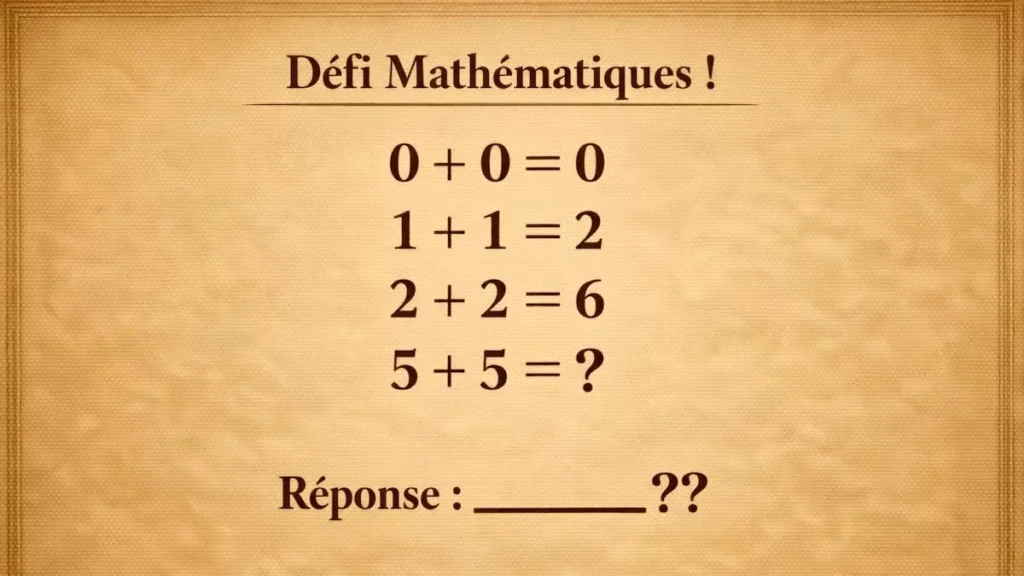
Some logical tests may seem straightforward at first glance, but they actually rely on a hidden mechanism that needs to be identified. The most common mistake is to focus solely on the obvious calculation without trying to understand the logic that connects the different lines, while an evolving rule is often behind the result.
This type of logical test does not just assess calculation, but primarily the ability to observe a sequence and comprehend how the results evolve. It is crucial to analyze the differences between each line instead of limiting oneself to the displayed operation.
“Mathematics is the most powerful instrument that the human mind has created.” — Stefan Banach
This quote reminds us that mathematics is primarily a tool for reflection. It allows us to see relationships that we may not immediately notice.
Today, I present to you a new logical challenge. Can you find the missing value before the countdown ends?
What This Test Helps to Develop
- Detection of hidden rules
- Analysis of numerical sequences
- Logic and observation skills
- Ability to avoid automatic calculation reflexes
- Rigor in reasoning
Today’s Logical Test
Answer: ______ ??
Take your time to carefully observe the logic before responding.
The Countdown Begins
30…
20…
10…
5…
3…
2…
1…
Time’s up!
So, what is your answer?
What Your Performance May Reveal
If you found the answer quickly and correctly, you have a solid grasp of operational priorities.
If you found the answer after some thought, you know how to analyze and structure your reasoning.
If your answer was incorrect or you didn’t find one, no worries; these exercises are designed for improvement.
Detailed Solution We Found:
Method to Follow
To solve this type of test, you need to:
– Compare each line with the previous one
– Observe how the results evolve
– Look for a relationship between the numbers and the result
– Test a consistent rule across all cases
It’s important to note that the result does not correspond to a simple addition.
We observe the following rule:
The trick in this challenge is that the symbol “+” does not correspond to a conventional addition. If it were a normal addition, 2 + 2 would yield 4, while the image indicates 6. Thus, one must discover a different rule that holds for all lines.
We observe:
0 + 0 = 0
1 + 1 = 2
2 + 2 = 6
A working rule is to take the number and then multiply it by the next number.
Thus:
0 → 0 × 1 = 0
1 → 1 × 2 = 2
2 → 2 × 3 = 6
We then notice the progression:
0 × 1 = 0
1 × 2 = 2
2 × 3 = 6
3 × 4 = 12
4 × 5 = 20
5 × 6 = 30
Therefore, for the last line:
5 + 5 = 5 × (5 + 1)
5 + 5 = 5 × 6
5 + 5 = 30
Result
Answer: 30
Conclusion
This test demonstrates that a logical sequence can conceal an evolving rule rather than a simple addition. The key is to identify how the results progress and not to rely solely on the displayed operation.
It’s worth noting that, like many puzzles of this type, multiple mathematical rules could theoretically fit the first three examples. 30 is a valid answer if one chooses this simple and consistent rule.
And before you get lost in the depths of the web, explore more games and tests by clicking here.