Mathematics is not just a series of calculations; it also tells the story of how we understand the world. From the earliest civilizations that used numbers to measure land, organize harvests, and observe the stars, to the scientists who made computers, satellites, and telecommunications possible, mathematics accompanies nearly all significant human advancements.
What I enjoy about small challenges like today’s is their apparent simplicity. I remember problems where I thought I had found the answer in seconds, only to discover that a detail about the order of operations completely changed the result. Since then, I’ve made it a habit to check each step before answering. Often, that little verification makes all the difference.
“Mathematics is the music of reason.” — James Joseph Sylvester
This quote serves as a reminder that mathematics has its own harmony: each number and operation holds a specific place. Therefore, solving a problem involves learning to follow this logical organization without skipping steps.
What This Challenge Allows You to Work On:
- This challenge helps work on algebraic reasoning,
- solving simple equations,
- substituting a value into another equation,
- and especially the order of operations.
It also trains concentration, logic, and vigilance: in the final calculation, multiplication must be performed before addition.
Challenge of the Day
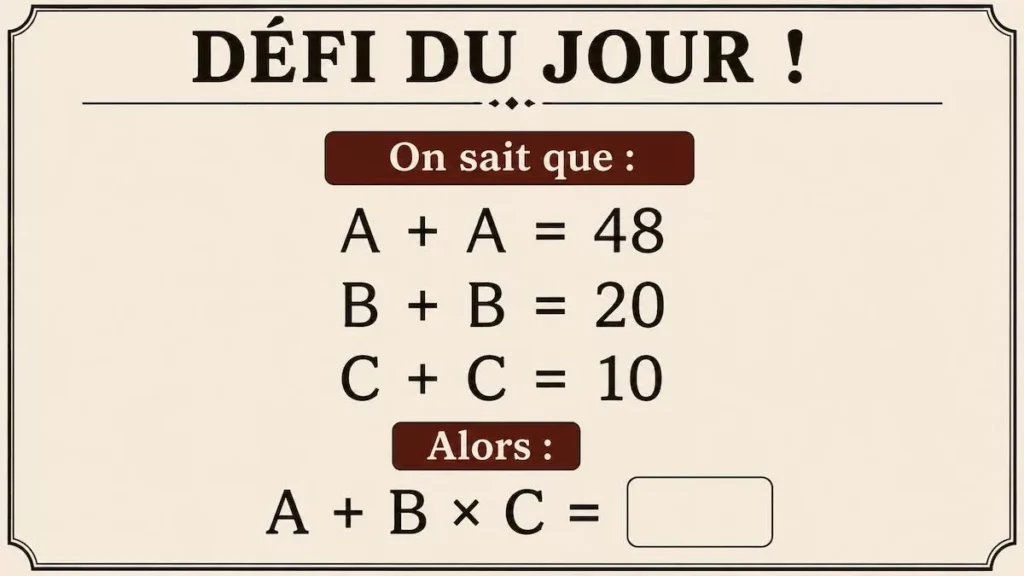
We know that:
Using these three equations, find successively the values of A, B, and C.
Then calculate:
A + B × C = ?
Take your time to think and pay special attention to the order of operations.
The Countdown Begins
30…
25…
20…
15…
10…
5…
4…
3…
2…
1…
Time’s up!
What Your Performance Can Reveal
If you found the result quickly and correctly, you have excellent logic and analytical skills.
If you found the result after some thought, you know how to structure your reasoning and check your steps.
And if the result is incorrect or not found, no worries; this type of exercise is perfect for improving method and precision.
Detailed Solution We Found (Not Necessarily the Only or Even the Correct One)

Let’s start with the first equation:
A + A = 48
Two times A gives 48, so:
2A = 48
A = 24
Now, let’s move on to the second equation:
B + B = 20
So:
2B = 20
B = 10
Finally:
C + C = 10
So:
2C = 10
C = 5
We now have:
A = 24
B = 10
C = 5
Now we just need to substitute these values into the final equation:
A + B × C
Which gives:
24 + 10 × 5
Be careful with the order of operations: multiplication should be done before addition.
So we first calculate:
10 × 5 = 50
Then:
24 + 50 = 74
Final Answer
A + B × C = 74
Thus, the correct answer is 74.
Conclusion
This challenge seems very simple when looking at the first three equations, but its true trap lies in the last line. Someone who adds 24 + 10 before multiplying by 5 would arrive at an incorrect result.
The key was therefore twofold: correctly determining the values of A, B, and C, and then respecting the priority of multiplication over addition.
This is precisely the interest of this type of challenge: it requires not only knowing how to calculate but also knowing in what order to calculate.
And before you get lost in the labyrinth of the web, explore other games and tests by clicking here.