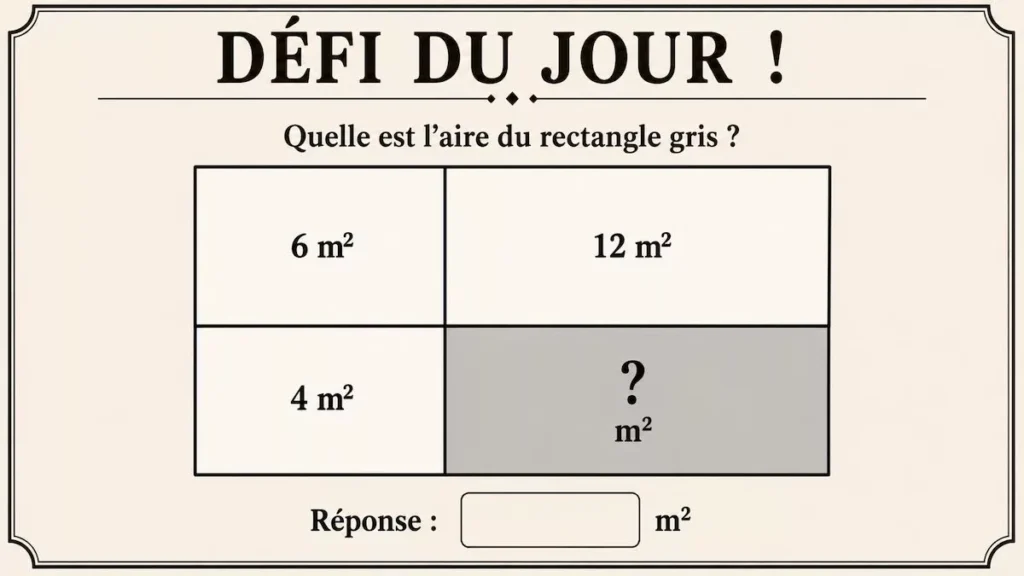
Sometimes, all it takes is four rectangles to tell a beautiful story of mathematics. For centuries, geometers have sought to understand how the dimensions of a figure are interrelated. The earliest methods of calculating areas were used to measure land, organize cities, and construct buildings. Later on, these same principles became essential in architecture, engineering, and many modern technologies. What makes mathematics particularly fascinating is that some information can be uncovered without directly knowing the lengths. Numbers may sometimes seem insufficient, but their relationships already contain the solution.
I remember the first time I encountered a problem of this nature: my initial instinct was to find the length and width of each rectangle. Then I realized there was a much shorter path by simply comparing the areas. Since then, I have particularly enjoyed these challenges where the solution emerges when we stop searching for information that ultimately isn’t necessary.
“Mathematics is about knowing what you are doing and why you are doing it.” — Henri Poincaré
This quote fits our challenge well: the goal is not just to perform calculations but to understand the relationships that exist among the four rectangles. Once this relationship is discovered, the result becomes almost obvious.
What This Challenge Allows You to Work On:
- Calculating areas,
- Understanding proportions between rectangles,
- Formulating a geometric situation mathematically,
- Reasoning based on common dimensions.
It also helps develop observation skills, logical thinking, and the ability to seek an efficient method rather than trying to determine all the dimensions of the figure.
Challenge of the Day
A large rectangle is divided into four smaller rectangles.
The area of the gray rectangle located at the bottom right is unknown.
Your mission is to determine:
What is the area of the gray rectangle?
Note: no lengths or heights are provided. However, the three given areas are sufficient to find the answer.
The Countdown Begins
30…
25…
20…
15…
10…
5…
4…
3…
2…
1…
Time’s up!
What Your Performance Can Reveal
If you found the result quickly and correctly, you have excellent logic and analytical skills.
If you found the result after some thought, you know how to structure your reasoning and check your steps.
And if your result was incorrect or you didn’t find one, no worries; this type of exercise is perfect for improving method and precision.
Detailed Solution We Found (not necessarily the only one, or even the correct one)
Let’s denote the two widths of the columns as a and b, and the two heights of the rows as h and k.
For the rectangle in the top left, we can write the equation:
a × h = 6
For the one in the top right:
b × h = 12
These two rectangles have exactly the same height.
Let’s compare their areas:
12 ÷ 6 = 2
This means the rectangle on the right is twice as wide as the one on the left.
Thus, we have:
b = 2a
Now, let’s look at the two rectangles at the bottom.
They also share the same height k.
The rectangle in the bottom left has an area of:
a × k = 4
Since the gray rectangle is twice as wide, its area will also be twice as large.
Therefore, we get:
2 × 4 = 8
We can also directly present the relationship with the equation:
6 × A = 12 × 4
where A represents the area of the gray rectangle.
Thus:
6A = 48
Then:
A = 48 ÷ 6
A = 8
Final Answer
The area of the gray rectangle is 8 m².
Conclusion
This challenge contains a particularly interesting idea: we did not need to know the exact dimensions of the rectangles.
The ratio between the two rectangles at the top tells us that the width on the right is twice that of the left. Since the rectangles at the bottom use exactly these same widths, the ratio remains the same.
Thus, if the bottom left rectangle has an area of 4 m², the one on the right must necessarily have an area twice as large:
4 × 2 = 8 m²
This challenge reminds us of an important lesson in mathematics: before trying to find all the unknown values, it is often more effective to observe the relationships among the data you already possess.
Answer: 8 m².
And before you lose yourself in the depths of the web, explore other games and tests by clicking here.