For centuries, mathematics has taught us to look beyond what seems obvious. Early civilizations used it to measure land, organize harvests, construct monuments, and observe the sky. Over time, it has become essential in architecture, navigation, computing, medicine, and even space exploration.
What I particularly appreciate about math are those small moments when a hidden rule finally reveals itself. I’ve often found myself staring at a sequence of numbers, pondering complicated calculations, only to discover that the solution was based on a simple computation. It is often in these moments that we realize that, in mathematics, observing well can be just as important as calculating well.
Quote of the Day
“What we know is but a drop, what we ignore is an ocean.” — Pierre-Simon de Laplace
This quote reminds us that every problem is an opportunity for discovery. When faced with a mathematical enigma, not knowing the answer right away is not a hindrance; it is precisely the starting point for reasoning.
What This Challenge Allows You to Work On:
This challenge allows you to work on:
- observing a logical sequence;
- searching for a common rule;
- mental calculations;
- recognizing numerical patterns;
- concentration and attention to detail;
- the ability to test a hypothesis before providing an answer.
Challenge of the Day
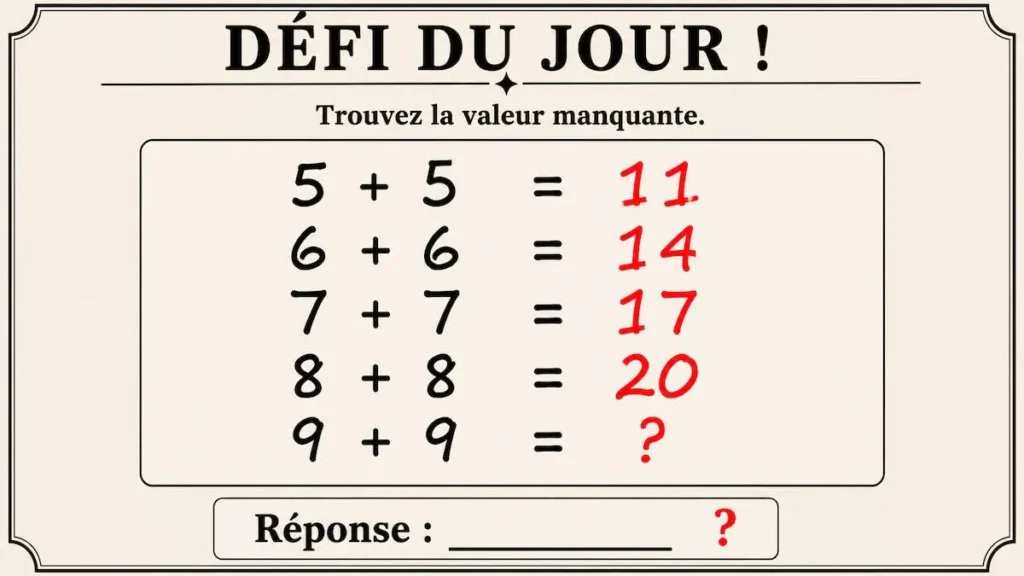
Carefully observe the following equations:
So:
9 + 9 = ?
Note: you should obviously not apply the usual addition.
Your goal is to discover the particular rule used in these equations.
The Countdown Begins
30…
25…
20…
15…
10…
5…
4…
3…
2…
1…
Time’s up!
What Your Performance May Reveal
If you found the result quickly and correctly, you have excellent logic and analytical skills.
If you found the result after some thought, you know how to structure your reasoning and verify your steps.
And if your result was incorrect or not found, no worries; this type of exercise is perfect for improving your methods and precision.
Detailed Solution We Found (Not Necessarily the Only One, or Even the Correct One)
First, let’s observe the results:
11, 14, 17, 20…
What do you notice?
Each result increases by 3:
11 + 3 = 14
14 + 3 = 17
17 + 3 = 20
The logic of the sequence naturally leads us to the next number:
20 + 3 = 23
We can also find a rule that is compatible with all the lines. For a number , the result follows the rule:
3 × n − 4
Let’s verify:
For 5:
3 × 5 − 4 = 15 − 4 = 11
For 6:
3 × 6 − 4 = 18 − 4 = 14
For 7:
3 × 7 − 4 = 21 − 4 = 17
For 8:
3 × 8 − 4 = 24 − 4 = 20
And therefore for 9:
3 × 9 − 4 = 27 − 4 = 23
Final Answer
9 + 9 = 23, according to the challenge’s rule.
The expected answer is therefore:
23
Conclusion
This challenge perfectly illustrates the difference between mechanical calculation and searching for logic. In standard arithmetic, 9 + 9 is obviously 18. However, here, the initial equations impose a different rule, and one must discover it before answering.
This is the essence of such tests; they train the brain to detect a pattern, formulate a hypothesis, and verify it across multiple examples. When a single rule works for all lines, we can continue the sequence and obtain 23.
And before you get lost in the depths of the web, explore other games and tests by clicking here.