For centuries, geometry has helped humans understand and organize the space around them. Ancient builders used it to map out roads, construct monuments, and measure land. Later, it became essential for architecture, navigation, and astronomy, and even today, it plays a crucial role in engineering and modern technologies. What I particularly enjoy about angle problems is that a figure may seem complicated at first glance, yet often just a few properties can unlock everything.
I’ve often found myself searching for a complicated calculation only to notice a simple right angle or two parallel lines. It’s precisely this kind of detail that can sometimes change the entire problem.
“Mathematics is the poetry of logical science.” — Albert Einstein
This quote highlights a beautiful aspect of mathematics: behind very precise rules lies true elegance. Finding a solution often means discovering how several simple properties fit together perfectly.
What This Challenge Allows You to Work On:
This challenge allows you to work on angles formed by parallel lines, corresponding angles, right angles, angles around a point, and the ability to combine multiple geometric pieces of information.
It also trains observation, concentration, logical reasoning, and especially the ability not to rely on the appearance of a figure when it is specified that it is not to scale.
CHALLENGE OF THE DAY
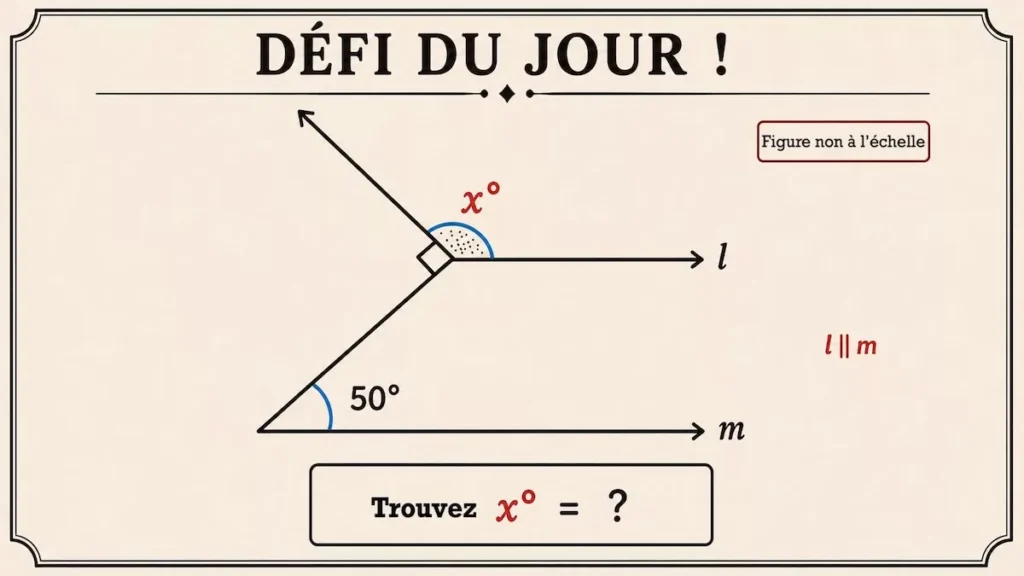
Observe the figure carefully.
The lines l and m are parallel:
l ∥ m
An oblique line intersects these two parallels.
The question is simple:
What is the measure of angle x?
Note: the figure is not to scale. Therefore, reasoning must be based solely on geometric properties.
Countdown Begins
40…
30…
25…
20…
15…
10…
5…
4…
3…
2…
1…
Time’s up!
What Your Performance Can Reveal
If you found the result quickly and correctly, you have excellent logic and good analytical skills.
If you found the result after some thought, you know how to structure your reasoning and verify your steps.
And if your result was incorrect or not found, no worries; this type of exercise is perfect for improving your method and precision.
Detailed Solution We Found (Not Necessarily the Only One, or Even the Right One)
Let’s start with the essential information:
l ∥ m
The oblique line rising from the left intersects the two parallel lines.
The angle it forms with line m measures 50°.
Using the properties of angles formed by a transversal with two parallel lines, this same inclination is found at line l.
Therefore, we have an angle of:
50°
This indicates that the two oblique lines are perpendicular.
We know that lines l and m are parallel.
The lower oblique line forms a 50° angle with line m. Since l and m are parallel, it also forms a 50° angle with a horizontal line parallel to l.
The small square at the top indicates that the two oblique lines are perpendicular. Therefore, the angle between them measures exactly 90°.
The upper oblique line then forms an acute angle with the horizontal of:
90° − 50° = 40°
But be careful: the angle x shown in the figure is not this acute angle of 40°. It is the obtuse angle on the other side.
These two angles are supplementary, so their sum equals 180°:
x + 40° = 180°
Thus:
x = 180° − 40°
x = 140°
Conclusion: x = 140°.
Final Answer
x = 140°.
Conclusion
This challenge perfectly illustrates the importance of connecting multiple geometric properties rather than relying solely on the drawing.
The parallel lines first allow us to transfer the angle of 50°. The symbol for the right angle then gives us 90°. Finally, the equation for angles forming a straight line provides us with:
50° + 90° + 40° = 180°
Thus, the sought measure is:
x = 40°
This is an excellent exercise for learning how to spot decisive information in a figure: sometimes, a few small symbols are enough to reveal the entire solution.
And before you get lost in the depths of the web, explore other games and tests by clicking here.