Mathematics often began with very concrete questions: measuring land, dividing a plot, calculating the height of a building, or determining the amount of materials needed for construction. Long before calculators, ancient civilizations were already using geometry to solve everyday problems. Even today, these same principles are present in architecture, engineering, mapping, and road design. What is fascinating is that a figure containing only a few measurements can sometimes reveal much more information than it appears to show at first glance.
I remember encountering a problem where I immediately sought the area of a triangle. I circled around the formula without making progress, until I realized that I needed to forget about the triangle and start with the rectangle instead. Once I found its height, almost everything else became obvious. Since then, when faced with a geometric figure, I always try to ask myself: what information can I determine first with certainty?
Quote of the Day
“The essence of mathematics is freedom.” — Georg Cantor
This quote reminds us that mathematics is not just about mechanically applying formulas. It also gives us the freedom to explore multiple paths and choose the most effective reasoning to reach a solution.
What This Challenge Allows You to Work On:
- Careful reading of a geometric figure,
- Calculating the area of a rectangle and a triangle,
- Finding an unknown length from a known area,
- Interpreting equality marks,
- Decomposing a total length,
- And above all, the ability to organize reasoning in several steps.
It also helps develop concentration, logic, and the reflex to verify each piece of data before starting calculations.
Challenge of the Day
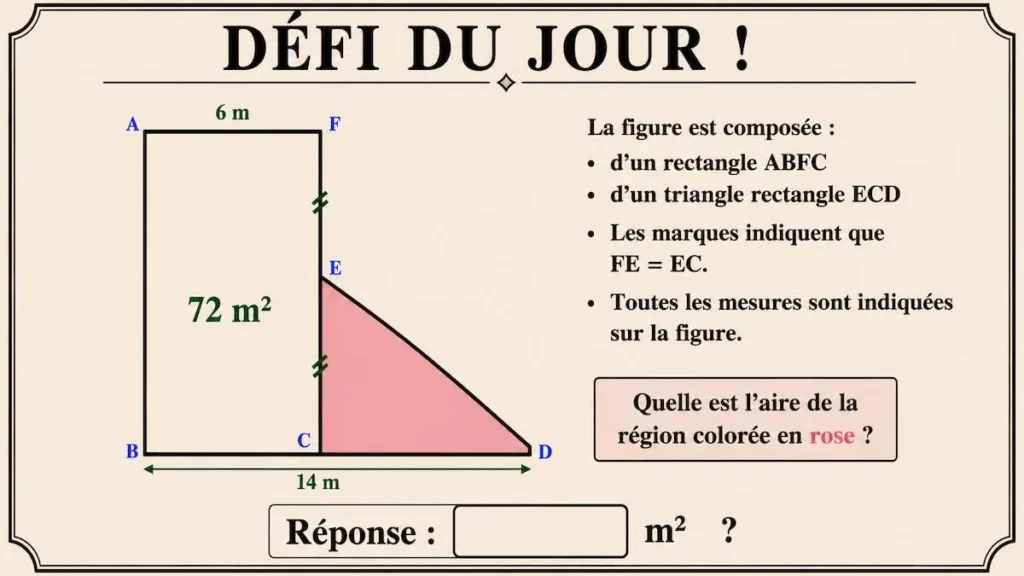
The figure consists of a rectangle ABFC and a right triangle ECD.
Your mission is to determine:
What is the area of the pink-colored region?
Take the time to observe the figure. Several lengths are not indicated directly, but they can all be found using the available information.
The Countdown Begins
60…
50…
40…
30…
25…
20…
15…
10…
5…
4…
3…
2…
1…
Time’s up!
What Your Performance Can Reveal
If you found the result quickly and correctly, you have excellent logic and analytical skills.
If you found the result after some reflection, you know how to structure your reasoning and verify your steps.
And if the result was incorrect or not found, no worries; this type of exercise is perfect for improving method and accuracy.
Detailed Solution We Found (Not Necessarily the Only One, or Even the Correct One)

Let’s start with the rectangle ABFC. We know its area:
72 m² and its width: AF = 6 m
Let’s call h its height.
The equation to calculate the area of the rectangle is:
6 × h = 72
Therefore:
h = 72 ÷ 6
h = 12 m
The height of the rectangle is thus: FC = 12 m
Now, let’s look at the marks placed on segment FC.
They indicate that: FE = EC
Point E divides side FC into two equal parts.
We then have:
EC = 12 ÷ 2
EC = 6 m
We now know the height of the pink triangle. We still need to find its base CD. The total length from B to D is:
BD = 14 m
Now, the width of the rectangle is: BC = AF = 6 m
We can therefore write the equation: BC + CD = BD
That is: 6 + CD = 14
Thus:
CD = 14 − 6
CD = 8 m
The pink right triangle therefore has: a base CD = 8 m and a height EC = 6 m.
We can now calculate its area. The equation for the area of a triangle is:
A = (base × height) ÷ 2
So:
A = (8 × 6) ÷ 2
A = 48 ÷ 2
A = 24 m²
Final Answer
The area of the pink-colored region is 24 m².
Conclusion
This challenge perfectly illustrates why it is important to not immediately seek the final answer. None of the two dimensions of the pink triangle were given directly, yet all the necessary information was present. The area of 72 m² first allowed us to find the height of the rectangle, which is 12 m. The equality marks then gave us EC = 6 m, while the total length of 14 m