For a long time, mathematics has served as a means to seek order in what seemed complicated. Early mathematicians observed numbers, shapes, and movements to uncover hidden relationships. Gradually, this reasoning led to the development of geometry, algebra, astronomy, and many other fields. Even today, the ability to recognize a pattern remains essential. Mathematics enables the construction of bridges and buildings, computer programming, satellite launches into space, securing our communications, and analyzing vast amounts of data. Moreover, it fosters something much more everyday: our ability to observe before drawing conclusions.
I recall a small challenge where I was desperately searching for a complicated rule because the equations seemed incorrect. After several attempts, I realized that the symbol “+” was merely a visual trap, and I needed to look for another relationship between the two numbers. Since then, when faced with such challenges, I always start by testing the simplest rule on all the lines.
Quote of the Day
“Mathematics is the music of reason.” — James Joseph Sylvester
This quote reminds us that mathematics has a certain harmony: when the correct rule is discovered, results that seemed strange suddenly become perfectly coherent.
What This Challenge Helps Improve:
This challenge helps improve:
- observation;
- logic;
- searching for a common rule;
- mental calculation;
- multiplication and addition;
- verifying a hypothesis;
- recognizing patterns;
- concentration;
- speed of reasoning.
Challenge of the Day
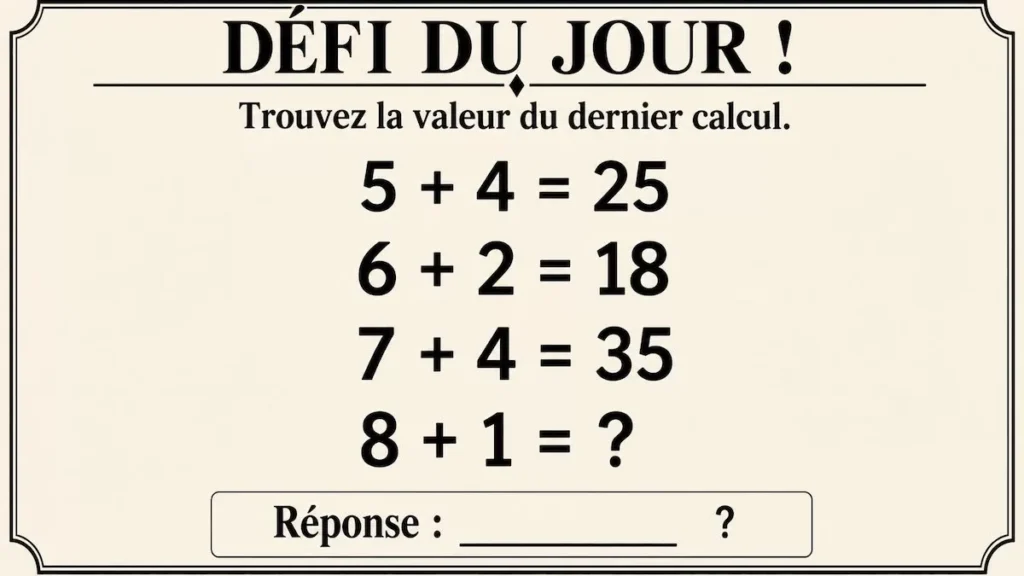
Observe these particular equations carefully:
And now:
8 + 1 = ?
Be careful: with a standard addition, the first three equations would obviously be incorrect.
Thus, there exists another rule.
Your task is to discover it and determine the value of the last calculation.
The Countdown Begins
30…
25…
20…
15…
10…
5…
4…
3…
2…
1…
Time’s Up!
What Your Performance Can Reveal
If you found the result quickly and correctly, you possess excellent logic and analytical skills.
If you found the result after some thought, you know how to structure your reasoning and verify your steps.
And if the result was incorrect or not found, no worries—this type of exercise is perfect for improving method and precision.
Detailed Solution We Found (Not Necessarily the Only One, or Even the Correct One)
Let’s look for a rule that works the same way for the first three lines.
Starting with: 5 + 4 = 25
If we first add the two numbers: 5 + 4 = 9
Then we add this result to the product of the two numbers: 5 × 4 = 20
We get: 20 + 5 = 25
However, this approach does not yield the same rule for the other lines. Let’s look for a much simpler relationship.
For the first line:
5 × (4 + 1) = 5 × 5 = 25
Let’s verify with the second line:
6 × (2 + 1) = 6 × 3 = 18
That works.
Now let’s check the third line:
7 × (4 + 1) = 7 × 5 = 35
The same rule still applies.
We can thus write the general rule:
a + b → a × (b + 1)
Now we just need to apply it to the last calculation:
8 + 1
First, we increase the second number by 1:
1 + 1 = 2
Then:
8 × 2 = 16
Answer: 16
Verification
The rule works well for all lines:
5 × 5 = 25
6 × 3 = 18
7 × 5 = 35
8 × 2 = 16
Thus, the consistency is maintained.
Conclusion
This challenge is interesting because it plays with our automatic responses. Upon seeing the symbol “+,” our brains immediately want to perform a standard addition. However, the results indicate that we must abandon this first interpretation and search for a hidden rule. This is one of the great interests of mathematics: learning not to accept a hypothesis just because it seems obvious. We observe, test, compare, and verify.
And if you found 16 before the countdown ended, congratulations: you quickly identified the hidden logic of the challenge!
Before getting lost in the depths of the web, explore more games and tests by clicking here.