Centuries ago, measuring the height of a tower, a mountain, or the distance to an inaccessible object posed a significant challenge. However, mathematicians discovered that it wasn’t always necessary to reach the object to measure it. A few angles, a known distance, and some geometric reasoning could suffice. This idea profoundly influenced the history of mathematics. Trigonometry, in particular, has assisted astronomers in observing the sky, navigators in finding their way, surveyors in measuring land, and later engineers in designing bridges, buildings, and large infrastructures.
Even today, similar principles are applied in topography, cartography, and many measurement technologies.
I recall a problem where I had to determine the height of an object without knowing the distance to it. At first, it seemed impossible: how could I find a height with so little information? Then I realized that angles themselves provided information about distances. This is precisely what makes this challenge intriguing.
Quote of the Day
“Geometry is the art of reasoning correctly about incorrect figures.” — Henri Poincaré
In other words, a drawing does not need to be perfectly to scale. It is the geometric properties, angles, and equations that yield the result.
What This Challenge Allows You to Work On:
This challenge allows you to work on:
- Trigonometry;
- The tangent of an angle;
- Right triangles;
- Angles of elevation and depression;
- Transforming a geometric situation into equations;
- Calculating with √3;
- Observing a figure;
- Multi-step reasoning;
- Concentration and result verification.
Challenge of the Day
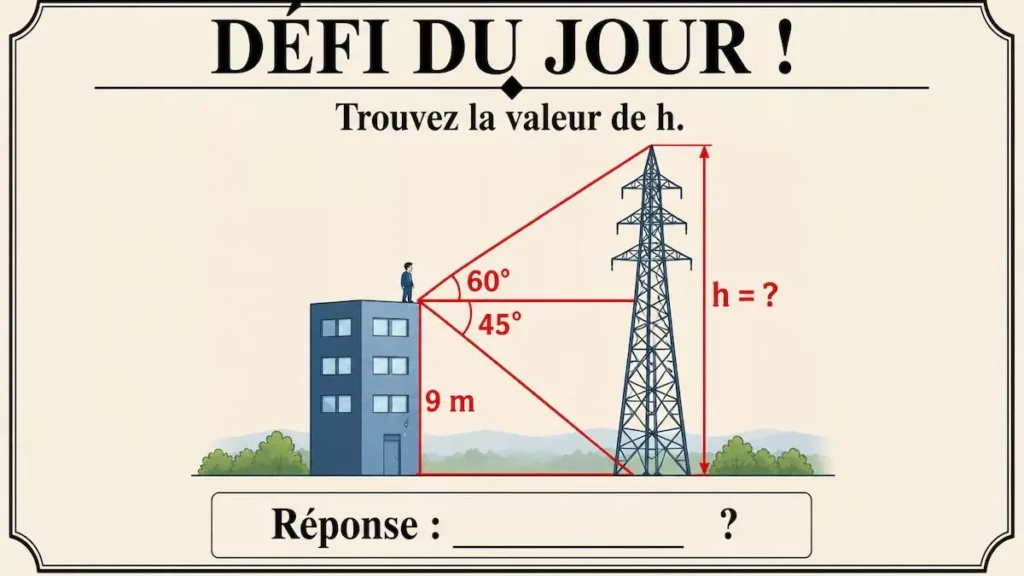
A person is standing on top of a building that is 9 m high.
Your mission is to determine the total height h of the pylon.
Note: The height of 9 m from the building will play a crucial role.
What is the value of h?
The Countdown Begins
90…
80…
70…
60…
50…
40…
30…
20…
10…
5…
4…
3…
2…
1…
Time’s up!
What Your Performance Can Reveal
If you found the result quickly and correctly, you have excellent logic and analytical skills.
If you found the result after some thought, you know how to structure your reasoning and check your steps.
And if your result was incorrect or not found, no worries; this type of exercise is perfect for improving your method and precision.
Detailed Solution We Found (Not Necessarily the Only One, Sometimes Even the Right One)
Let’s start by determining the horizontal distance between the building and the pylon. The person is 9 m off the ground and looks at the base of the pylon with an angle of depression of 45°. This creates a right triangle.
Using the tangent:
tan(45°) = 9 ÷ d
Now:
tan(45°) = 1
Therefore:
1 = 9 ÷ d
Thus:
d = 9 m
The horizontal distance between the building and the pylon is 9 meters.
Now, let’s consider the top of the pylon.
The angle of elevation is 60°. Let’s call H the height between the observer’s level and the top of the pylon.
We can write the equation:
tan(60°) = H ÷ 9
Now:
tan(60°) = √3
Therefore:
√3 = H ÷ 9
Thus:
H = 9√3
Which gives approximately:
H ≈ 15.59 m
But beware of the trap!
These 15.59 m represent only the height above the observer’s level.
The observer is already 9 m off the ground.
Therefore, the total height of the pylon is:
h = 9 + 9√3
So:
h ≈ 9 + 15.59
h ≈ 24.59 m
Answer: h = 9 + 9√3 ≈ 24.59 m
Conclusion
This challenge perfectly illustrates why trigonometry is so powerful: we determined the height of a pylon without ever needing to measure it directly. The first angle of 45° allowed us to find the horizontal distance of 9 m. Next, the angle of 60° enabled us to calculate the part of the pylon above the observer. Finally, we had to remember to add the 9 m corresponding to the height of the building. This was, after all, the main trap in the challenge: responding with 15.59 m would have meant forgetting that the observer was not at ground level.
Thus, the sought height is indeed approximately 24.59 meters.
And before you get lost in the depths of the web, explore other games and tests by clicking here.