
Since the dawn of civilization, mathematics has enabled humans to measure what they could not directly ascertain. The Egyptians used it to measure land, builders employed it to organize their constructions, and astronomers relied on it to study distances in the sky. Over time, geometry evolved into a powerful tool for understanding and organizing space. Even today, the same principles are applied in architecture, engineering, road design, building construction, and even computer modeling. While calculating an area may seem basic, this concept encompasses a vital skill: deducing an unknown measurement from known information.
I recall a geometry problem where I was trying to find the desired area directly. It was impossible to find it. Then I realized that I needed to determine a height first, then a width, and only then could I calculate the area I was looking for. This is precisely the trap in today’s challenge: the answer isn’t readily accessible; you must reconstruct the missing dimensions.
Quote of the Day
“Geometry is the art of reasoning correctly about incorrect figures.” — Henri Poincaré
This quote serves as a reminder that a drawing doesn’t need to be perfectly to scale. It’s the measurements and mathematical relationships that yield the exact result.
What This Challenge Allows You to Work On:
- Calculating the area of a rectangle;
- Finding an unknown length;
- Finding an unknown height;
- Using multiple successive pieces of information;
- Simple equations;
- Geometric reasoning;
- Observation and logic;
- Mental calculation and concentration.
Today’s Challenge!
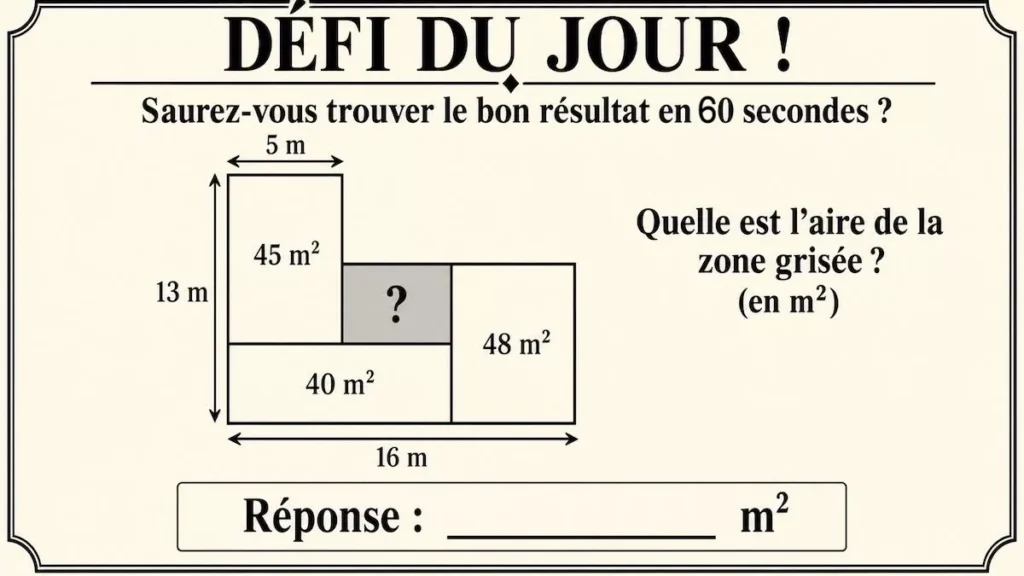
The figure consists of several rectangles.
We know that:
Question:
What is the area of the shaded zone?
Note: No lengths of the shaded zone are provided directly.
You will need to find them using the other rectangles.
The Countdown Begins
60…
50…
40…
30…
20…
10…
5…
4…
3…
2…
1…
Time’s Up!
What Your Performance May Reveal
If you found the result quickly and correctly, you possess excellent logic and analytical skills.
If you found the result after some thought, you know how to structure your reasoning and check your steps.
And if the result was incorrect or not found, no worries; this type of exercise is perfect for improving method and precision.
Detailed Solution We Found (not necessarily the only or correct one)
Let’s start with the rectangle of 45 m².
Its width is 5 m.
The equation for its area is:
5 × height = 45
Therefore:
height = 45 ÷ 5 = 9 m
The total height on the left is 13 m.
Thus, the height of the lower rectangle is: 13 − 9 = 4 m
Now we know the area of the lower rectangle: 40 m².
Its equation is: width × 4 = 40
So its width is: 40 ÷ 4 = 10 m
This width corresponds to the distance from the left edge up to the rectangle of 48 m².
The total width being 16 m, the width of the right rectangle is:
16 − 10 = 6 m
Its area is 48 m².
We can thus find its height: 6 × height = 48
So: height = 8 m
This height of 8 m corresponds to the height of the lower rectangle and the shaded zone combined.
The lower rectangle already measures 4 m in height.
Thus, the height of the shaded zone is: 8 − 4 = 4 m
Now we need to find its width.
The lower rectangle measures 10 m in width, while the rectangle of 45 m² measures 5 m in width.
Therefore: 10 − 5 = 5 m
Thus, the shaded zone measures 5 m in width and 4 m in height.
Its area is then: 5 × 4 = 20 m²
Answer: 20 m²
Conclusion
This challenge was intriguing because the shaded area could not be calculated immediately. The solution needed to be constructed like a puzzle: first find a height, then another width, use the rectangle of 48 m², and finally piece together the dimensions of the area sought.
This is one of the great strengths of mathematics: one piece of information can reveal another, which leads to the discovery of a third, until the answer emerges.
If you found 20 m² before the 30 seconds were up, you demonstrated excellent speed. For this challenge, 30 seconds represent a rather tough level; a timeframe of