There is something fascinating about the history of mathematics: the letters we use today in equations did not always exist. For a long time, problems were described entirely in words. The gradual emergence of algebraic writing allowed lengthy reasoning to be condensed into just a few symbols. This evolution has profoundly transformed the sciences. With equations, it became possible to model the movement of planets, calculate trajectories, design machines, develop computing, and analyze complex phenomena. An equation may seem very simple on paper, but the reasoning developed through it is applied in countless scientific and technological fields.
I remember my first exercises involving squares. When I encountered the same term multiple times, I tended to perform each calculation separately. Then I realized that it was much more efficient to start by grouping identical terms. This small change in method often makes an equation much easier to solve.
Quote of the Day
“Mathematics is the door and key to the sciences.” — Roger Bacon
This quote reminds us that mathematics is not only about performing calculations. It primarily provides methods to organize reasoning, understand relationships, and solve problems with precision.
What This Challenge Allows You to Work On:
This challenge allows you to work on:
- solving equations;
- grouping identical terms;
- squares and square roots;
- finding unknowns;
- substitution;
- mental calculation;
- verifying solutions;
- rigor in the face of multiple possible solutions;
- concentration and logical reasoning.
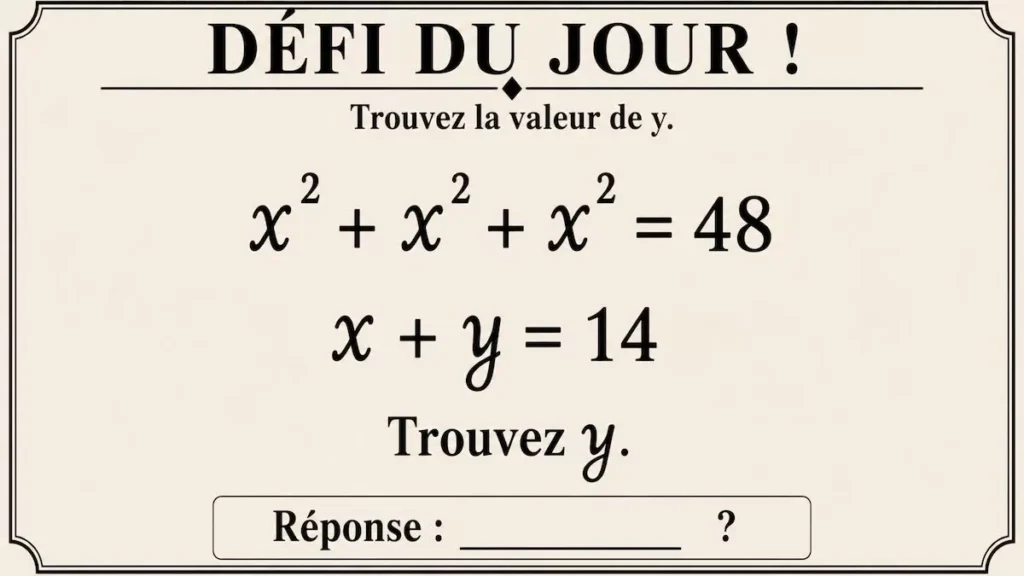
Challenge of the Day (y is positive)
Here are the two equations:
Your goal is to determine the value of y which is positive.
Take a close look at the first equation before you begin. The three terms are identical, allowing for a quick simplification of the calculation.
But be careful: there is a small mathematical trap that you will need to spot.
The Countdown Begins
50…
40…
30…
25…
20…
15…
10…
5…
4…
3…
2…
1…
Time’s up!
What Your Performance Can Reveal
If you found the result quickly and correctly, you have excellent logic and analytical skills.
If you found the result after some thought, you know how to structure your reasoning and check your steps.
And if the result is incorrect or not found, no worries; this type of exercise is perfect for improving method and accuracy.
Detailed Solution We Found (not necessarily the only one, or even the correct one)
Let’s start with the first equation:
x² + x² + x² = 48
Since the three terms are identical, we can group them: 3x² = 48
Dividing both sides by 3 gives us: x² = 16
This is where we need to be careful.
If:
x² = 16
Then two values are mathematically possible:
x = 4
or
x = −4
First Case: x = 4
Let’s use the second equation: x + y = 14
By substituting x with 4: 4 + y = 14
Thus:
y = 10
Second Case: x = −4
We get:
−4 + y = 14
Therefore:
y = 18
Final Answer
With the equations as written, there are two possible solutions:
y = 10
or
y = 18
However, since it is stated that y is positive, the expected answer is:
y = 10
Conclusion
This challenge may seem very simple at first glance, but it contains an important subtlety. When we obtain x² = 16, we must not automatically conclude that x = 4: x = −4 also works, since the square of −4 also equals 16.
This is precisely what makes this type of challenge interesting. It does not only test calculation speed but also the precision and rigor of reasoning.
For the challenge to have a single answer and for that answer to be 10, it would be necessary to specify in the statement that x is positive or that x and y are positive numbers.
And before you get lost in the depths of the web, explore other games and tests by clicking here.