For centuries, mathematics has taught humans to transform the unknown into something understandable. Ancient mathematicians already employed methods to find unknown quantities long before modern symbols such as , , , or appeared in equations. Over time, algebra has become an essential tool. It is now involved in engineering, computer science, economics, architecture, physics, and even in technologies that allow satellites to calculate their trajectories. Thus, solving an equation is not merely about finding a number: it’s about learning to reason step by step from known information.
I remember my first challenges involving multiple letters; initially, three unknowns made the problem seem complicated. However, as soon as I started with the simplest equation, a value emerged, followed by another, and the entire problem started to unfold. This very strategy will be useful today.
Quote of the Day
“Nature is written in the language of mathematics.” — Galileo
This quote reminds us that mathematics constitutes a language capable of representing relationships between different quantities. In this challenge, the letters may seem mysterious at first, but the equations provide precisely the information needed to discover their values.
What This Challenge Helps To Develop:
This challenge helps to develop:
- solving simple equations;
- logical reasoning;
- substituting a value into another equation;
- order of operations;
- mental calculation;
- concentration;
- the ability to organize resolution in multiple steps.
Challenge of the Day
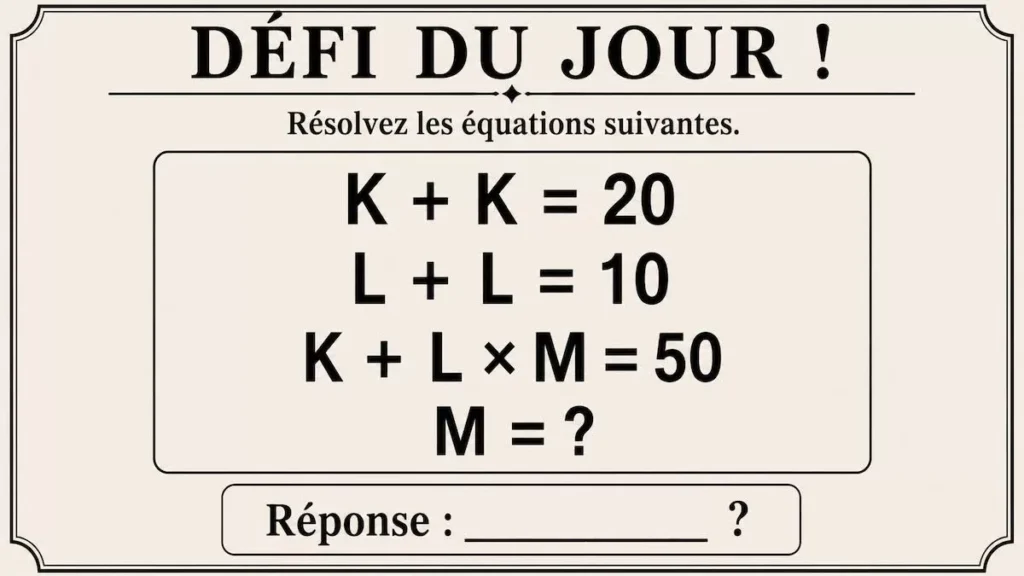
We have the following equations:
Your goal is to determine:
M = ?
Pay attention to an essential detail: in the last equation, multiplication must be performed before addition.
Try to find the value of M before the countdown ends.
The Countdown Begins
30…
25…
20…
15…
10…
5…
4…
3…
2…
1…
Time’s up!
What Your Performance Can Reveal
If you found the result quickly and correctly, you have excellent logic and good analytical skills.
If you found the result after some thought, you know how to structure your reasoning and check your steps.
If the result was incorrect or not found, no worries; this type of exercise is perfect for improving your method and precision.
Detailed Solution We Found (Not Necessarily the Only One, Sometimes Even the Correct One)
Let’s start with the first equation:
K + K = 20
Two times K gives 20, so: 2K = 20
Thus:
K = 10
Now let’s move on to the second equation:
L + L = 10
Therefore:
2L = 10
Which gives: L = 5
We now know the values of K and L.
Let’s revisit the third equation: K + L × M = 50
Substituting K with 10 and L with 5: 10 + 5 × M = 50
We must respect the order of operations. So, we first look for the value of 5 × M.
Subtracting 10 from both sides gives: 5M = 40
Next, we divide by 5: M = 8
Let’s verify:
10 + 5 × 8
Multiplication first:
5 × 8 = 40
Then: 10 + 40 = 50
The equation holds true.
Final Answer
M = 8
Conclusion
This challenge demonstrates that a problem with multiple unknowns is not necessarily difficult. The right strategy is to start with the simplest equations, progressively determine each value, and then use those results in the next equation.
It also reminds us of a fundamental rule: multiplication takes precedence over addition. Here, after finding K = 10 and L = 5, just a few steps were needed to obtain M = 8. Therefore, the answer to the challenge is indeed: 8.
And before you get lost in the depths of the web, explore other games and tests by clicking here.