There is something fascinating about the history of mathematics: many significant advancements originated from problems that initially seemed almost trivial. Finding an unknown quantity, measuring an inaccessible distance, or understanding the relationship between several numbers gradually led mathematicians to develop algebra. Today, these methods are everywhere. They allow engineers to design buildings, scientists to model phenomena, computer scientists to create algorithms, and astronomers to study objects located at unimaginable distances. Thus, behind a small equation like the one in our challenge lies a way of reasoning that has accompanied some of humanity’s greatest achievements.
I remember an exercise where a very short equation caused me to hesitate simply because of the parentheses. I was looking for a complicated method when it only required moving forward calmly, operation by operation. Since then, when faced with an equation, I always try to ask myself: what is the simplest operation I can perform first?
Quote of the Day
“The essence of mathematics lies in its freedom.” — Georg Cantor
A beautiful way to remind us that mathematics is not just about applying rules: it also teaches us to explore different methods to reach a logical conclusion.
What This Challenge Allows You to Work On:
This challenge allows you to work on:
- solving a simple equation;
- understanding parentheses;
- inverse operations;
- division and subtraction;
- mental calculation;
- logic and concentration;
- verifying a result;
- the ability to solve a problem step by step.
Challenge of the Day
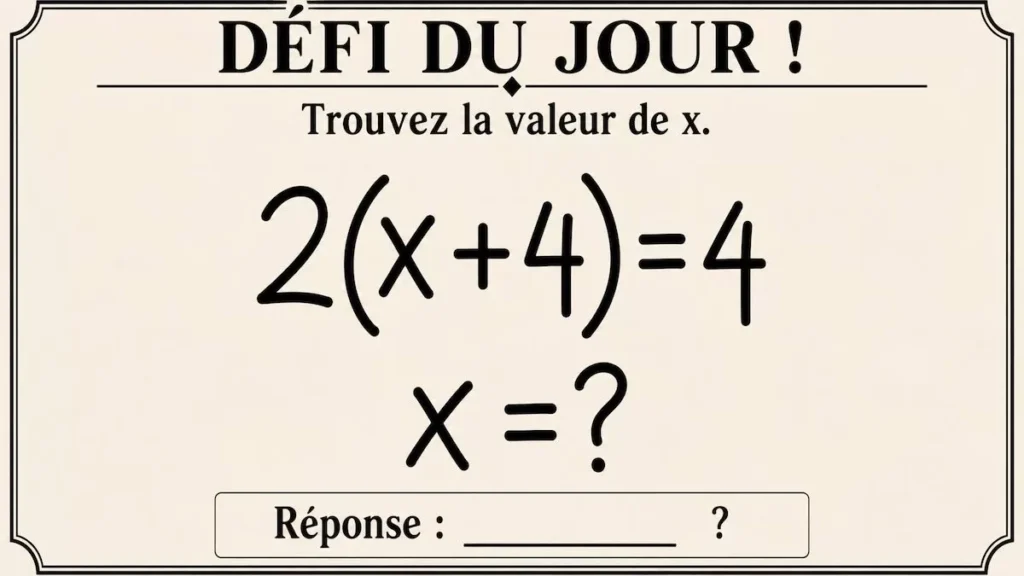
Today, we need to find the value of x in the equation:
It seems very simple, but try to solve it mentally before looking at the solution.
What is the value of x?
Countdown Begins
30…
25…
20…
15…
10…
5…
4…
3…
2…
1…
Time’s up!
What Your Performance Can Reveal
If you found the result quickly and correctly, you have excellent logic and analytical skills.
If you found the result after some thought, you know how to structure your reasoning and verify your steps.
And if the result was incorrect or not found, no worries, this type of exercise is perfect for improving your method and accuracy.
Detailed Solution We Found (Not Necessarily the Only One, Sometimes Even the Correct One)
We start from the equation:
2(x + 4) = 4
A particularly quick method is to start by dividing both sides of the equation by 2.
We obtain:
x + 4 = 2
Now, we need to isolate x.
So we subtract 4 from both sides:
x = 2 − 4
Which gives:
x = −2
Let’s Verify Our Answer
Let’s replace x with −2 in the original equation:
2(−2 + 4) = 4
Inside the parentheses:
−2 + 4 = 2
Thus:
2 × 2 = 4
We indeed get 4.
Therefore, the solution is correct.
Answer: x = −2
Conclusion
This challenge perfectly demonstrates that a short equation can be an excellent exercise in reasoning. The important point was not to calculate quickly, but to understand how to gradually isolate the unknown while maintaining equality. With practice, this type of reasoning becomes almost automatic: we observe, choose the appropriate inverse operation, simplify, and verify.
And above all, remember this: a negative answer is not a bad answer simply because it is negative! Here, −2 is exactly the sought value.
And before you get lost in the web’s meanderings, explore more games and tests by clicking here.