For centuries, mathematics has evolved because humans needed to count, measure, build, and communicate their discoveries unambiguously. From the earliest calculation methods to modern algebraic rules, each advancement has made reasoning more precise. Today, these same principles are found everywhere: in software, navigation systems, engineering, architecture, and even space technology. Behind extremely complex achievements often lie basic rules that simply need to be applied in the correct order.
I remember an exercise that was quite similar to today’s. The numbers seemed easy, and I was convinced that I could solve it in just a few seconds. However, the real trap wasn’t the calculation. It was the order of operations. Since then, whenever I encounter a short equation, I always try to examine its structure before touching the numbers.
Quote of the Day
“The essence of mathematics is freedom.” — Georg Cantor
A beautiful reminder that mathematics is not just about performing calculations: it also invites us to explore, test ideas, and understand why a method works.
What This Challenge Allows You to Work On:
- Understanding the order of operations;
- The role of parentheses;
- Multiplication and division;
- Mental calculation;
- Attention to mathematical notation;
- Logic and concentration;
- The ability to justify your result.
Challenge of the Day!
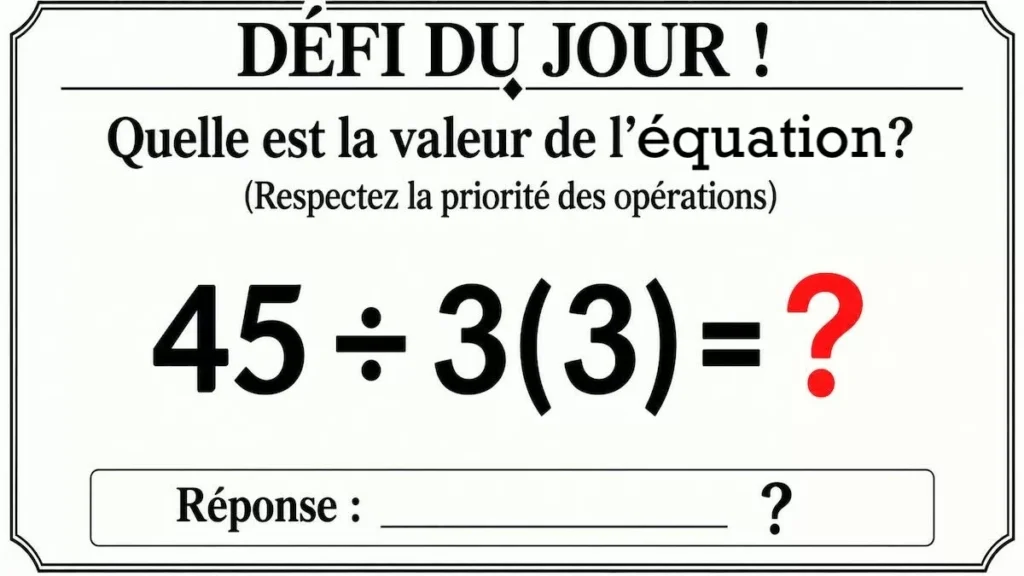
Carefully observe this equation:
Your task is to find the result while respecting the priority and order of operations.
Be careful, this equation is interesting because its notation can easily lead to hesitation.
You have 30 seconds.
The Countdown Begins
10…
9…
8…
7…
6…
5…
4…
3…
2…
1…
Time’s up!
What Your Performance Can Reveal
If you found the result quickly and correctly, you have excellent logic and strong analytical skills.
If you found the result after some reflection, you know how to structure your reasoning and check your steps.
And if your result was incorrect or you couldn’t find it, no worries; this type of exercise is perfect for improving your methods and accuracy.
Detailed Solution We Found (not necessarily the only or even the correct one)
Let’s start with the parentheses.
We simply have:
(3) = 3
The equation then becomes:
45 ÷ 3 × 3
Now, we must remember an important rule: multiplication and division have the same level of priority.
When they occur sequentially, we perform them from left to right.
So, we start with:
45 ÷ 3 = 15
Then:
15 × 3 = 45
Answer: 45
But why do some people answer 5?
Because they spontaneously interpret 3(3) as a single block and calculate:
3 × 3 = 9
Then:
45 ÷ 9 = 5
This is precisely what makes this challenge interesting. The notation 45 ÷ 3(3) is susceptible to different interpretations based on the typographical conventions used. For an exercise that should have an unequivocal answer, it would be preferable to explicitly write either (45 ÷ 3) × 3 or 45 ÷ (3 × 3).
With the school convention where multiplication and division have the same priority and are performed from left to right after parentheses are removed, we obtain 45.
Conclusion
This challenge demonstrates that in mathematics, notation matters as much as calculation. The numbers are simple, but a compact notation can transform a basic operation into a true test of attention.
If you obtained 45, you applied the left-to-right reading for operations of the same priority. And if you found 5, your reasoning highlights why an equation must be written unambiguously.
Good mathematical reasoning is not just about finding a number: it is also about precisely understanding what you are calculating.
And before you get lost in the depths of the web, explore other games and tests by clicking here.