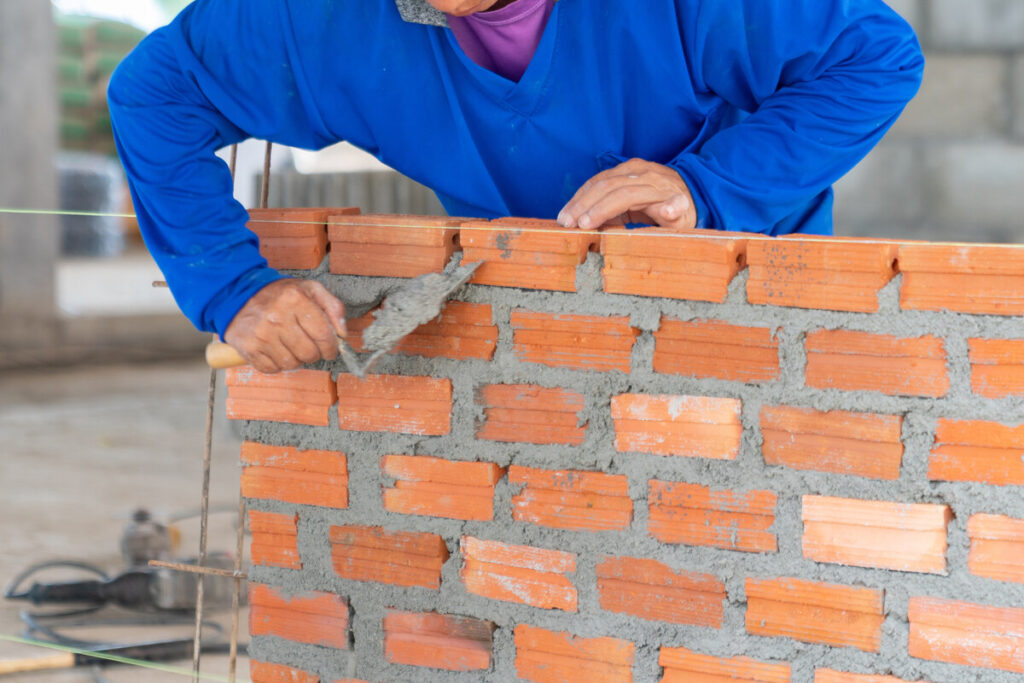
If you are planning a brick wall and just want a number, here is the short version: the formula is wall area divided by the area of one brick face, using nominal size, not the size a brick actually measures with a ruler. Get that one distinction wrong and every estimate that follows is off, sometimes by a lot.
What nominal size actually means
The real, physical dimensions of a brick are almost never the number builders use for estimating. A standard modern UK brick measures 215 x 102.5 x 65 mm on its own. But bricks are never laid touching each other, there is always a mortar joint between them, typically 10 mm in the UK or 3/8 inch in the US. Add that joint thickness to the actual size and the result is the nominal size, 225 x 112.5 x 75 mm for a UK brick, and that is the figure that belongs in any quantity calculation.
Skip that step and use the real size instead, and the math will systematically undercount how many bricks a wall actually needs, because it ignores the space every mortar joint takes up across the whole surface.
The formula for estimating how many bricks you need
Once the nominal size is right, the formula itself is simple:
Number of bricks = wall area divided by the area of one brick exposed face (nominal length x nominal height)
For a wall laid in the common stretcher pattern, the exposed face of each brick is its nominal length by its nominal height, not its full nominal volume. So the first job is just multiplying those two nominal numbers together to get the area one brick covers, then dividing the total wall area by that figure.
A real example: bricking a 10 square meter wall
Take a 10 square meter wall built with standard UK bricks. The exposed face, using nominal dimensions, is 225 mm x 75 mm, which works out to 0.016875 square meters per brick.
Divide the wall area by that: 10 divided by 0.016875 is approximately 593 bricks. That is the theoretical count with zero waste. In practice, cutting bricks to fit corners, openings and edges always wastes some material, so contractors commonly add a 5 to 10 percent allowance, which puts the real order closer to 620 to 650 bricks for this wall.
If the numbers for a different wall size or brick type feel like too much manual arithmetic, the TheCalcMaster brick calculator runs the same formula automatically.
Common mistakes that throw the count off
Beyond the nominal versus actual size mix-up, two other assumptions trip people up regularly:
Assuming every brick in the world is the same size. It is not even close. A US modular brick measures roughly 194 x 92 x 57 mm actual, an Australian brick runs 230 x 110 x 76 mm, a German brick 240 x 115 x 71 mm, and a Chinese brick 240 x 155 x 53 mm. Plugging one country dimensions into a wall built with another country bricks will produce a confidently wrong number.
Assuming all bricks perform the same too. Compressive strength varies enormously, from as low as 7 MPa up to over 100 MPa depending on the type and where it was made, though a typical house brick usually sits somewhere between 20 and 40 MPa. That number matters for structural decisions, even though it does not change how many bricks fit in a wall.