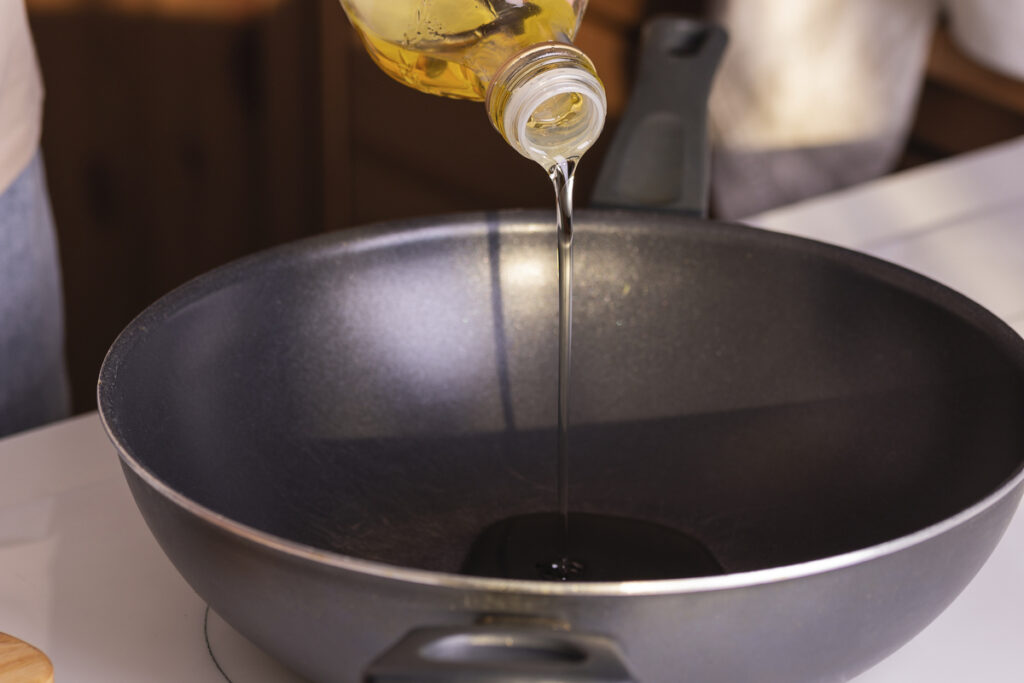
A tablespoon of oil looks tiny, but fat is the most calorie-dense thing on your plate. Here is how to turn “a little oil” into grams and calories, and check it against a daily budget.
Why oil adds up so fast
Each gram of fat releases about 9 kcal, while a gram of carbohydrate gives about 4 kcal. Fat therefore carries more than twice the energy of carbohydrates, weight for weight. That is why a splash of oil in the pan can matter more than the vegetables sitting in it.
The simple method
You only need two steps:
- Convert the oil to grams (a tablespoon is roughly 14 g, a typical label figure, so treat it as an approximation).
- Multiply the grams by 9 to get calories.
A worked example: cooking for a day
Say you use 1 tablespoon of oil for the morning sabzi, 1 for lunch and a little extra for frying in the evening, about 30 g in total (roughly 2 tablespoons).
- 30 g of oil × 9 kcal = 270 kcal
- On a 2,000 kcal day, that is 270 ÷ 2,000 = 13.5% of your calories, before counting the fat in milk, nuts, paneer or the rest of the meal (my own calculation, based on an illustrative amount).
How much fat is a reasonable budget?
The US FDA recommends getting “15-30% of total calories from all fat”, with less than 10% of calories from saturated fat. On a 2,000 kcal day, here is what that means in grams:
- 15% of 2,000 = 300 kcal ÷ 9 = about 33 g of fat
- 30% of 2,000 = 600 kcal ÷ 9 = about 67 g of fat
- 10% of 2,000 = 200 kcal ÷ 9 = about 22 g of saturated fat
Our 30 g of cooking oil uses 270 of the 600 kcal at the top of that range, so almost half of the maximum fat budget is gone before you count anything else you eat. These are US guidelines, so treat them as a reference point rather than a personal prescription.
Common mistakes
- Measuring “by eye”. Pouring straight from the bottle makes it easy to double the amount. A measuring spoon takes five seconds.
- Thinking healthy oil means low calorie. Olive oil is about 75% monounsaturated fat and often seen as a good choice, but it still has 9 kcal per gram like every other fat.
- Cutting fat to zero. Fats are a main nutrient group, and vitamins A, D, E and K are fat-soluble, so they need some fat to be absorbed. The aim is a sensible amount, not none.
- Ignoring the type. Studies have found that replacing saturated fats with unsaturated ones lowers the risk of cardiovascular disease, so what the fat is matters as well as how much.
Where to go next
If you want to see how the weight of food changes its calories, our guide on calories in cooked rice uses the same weight-first thinking, and the formula behind the calorie count on a food label covers how food energy is counted in the first place.