The calculation rules we use today are the result of centuries of evolution in mathematics. As calculations became more complex, it was necessary to establish common conventions so that the same equation would yield the same result, regardless of who solves it. This is how the order of operations became a fundamental aspect of mathematical language.
In everyday life as well as in the sciences, knowing how to organize a calculation is just as important as knowing how to add, multiply, or divide. Fields like computer science, engineering, economics, or physics rely on calculations where each operation must be performed at the right moment. A simple change in order can lead to a completely different result.
“The essence of mathematics lies in its freedom.” — Georg Cantor
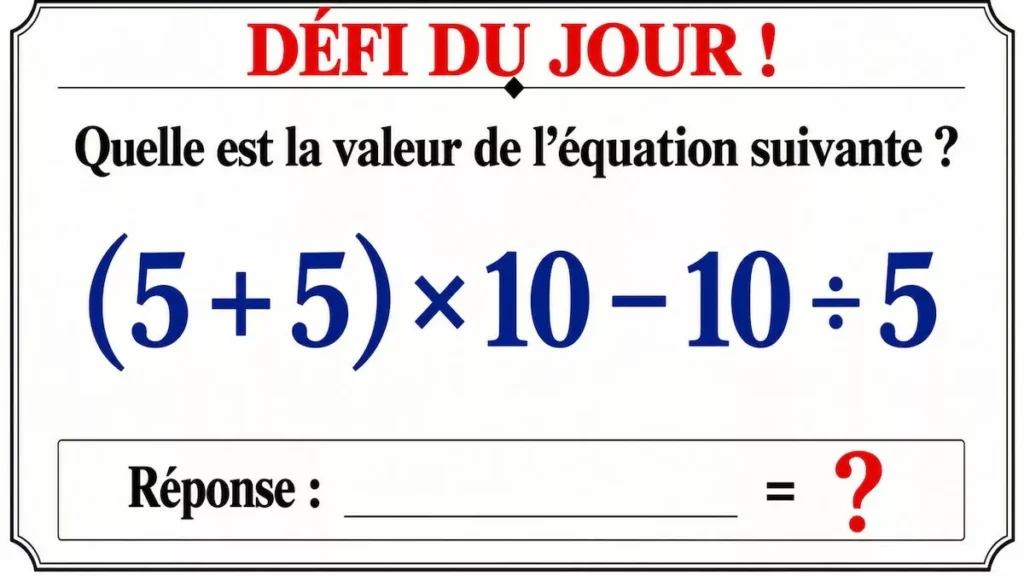
This challenge perfectly illustrates an essential idea: when faced with multiple operations, it is not necessary to calculate everything you see from left to right. Parentheses and priorities indicate the path to follow.
It often happens that we look at a relatively short equation and instantly think we know the result. Yet, it is precisely in these seemingly simple calculations that we can rush too quickly. Taking a few seconds to identify the parentheses, and then the multiplications and divisions, usually helps avoid mistakes.
What this challenge helps to practice:
- careful reading of an equation;
- operational priorities;
- the role of parentheses;
- multiplication and division;
- mental calculation;
- verification of a result;
- concentration and speed.
DAILY CHALLENGE!
Can you find the value of the following equation?
Attention: the order of operations is essential.
You have 10 seconds.
The countdown begins
10…
9…
8…
7…
6…
5…
4…
3…
2…
1…
Time’s up!
Let’s solve it
We start with the parentheses:
5 + 5 = 10
The equation becomes:
10 × 10 − 10 ÷ 5
Now we must perform the multiplication and division before the subtraction.
Let’s calculate the multiplication:
10 × 10 = 100
Then the division:
10 ÷ 5 = 2
Thus, the equation becomes:
100 − 2 = 98
Answer: 98
Conclusion
This challenge demonstrates that a very short equation can still require vigilance. The trap lies in wanting to perform operations simply in the order they appear.
We had to first calculate the parentheses, then perform the multiplication and division, before finishing with the subtraction.
If you found 98 before the countdown ended, well done! But the key takeaway is the method: in mathematics, respecting the order of operations ensures you arrive at the correct result without being misled by appearances.
And before you get lost in the depths of the web, explore other games and tests by clicking here.