Long before calculators and geometry software, mathematicians were already studying shapes by drawing lines, triangles, and figures in the sand, on tablets, or on papyrus. Among all these shapes, the triangle, seemingly simple, has always held a prominent place. It has allowed for the development of a significant part of geometry and for understanding distances, angles, and constructions. Even today, mathematics and geometry are all around us. Triangles play a role in architecture, bridges, frameworks, cartography, engineering, and even digital images. Their structure enables the construction of solid assemblies and facilitates numerous measurement calculations.
“Geometry is the art of reasoning correctly from incorrect figures.” — Henri Poincaré
This quote is particularly fitting for today’s challenge: it’s not enough to take a quick glance at the figure. You must observe it, break it down, and methodically check what you count.
I find this type of challenge especially interesting because it often elicits the same reaction.
What This Challenge Helps You Work On:
- Geometric observation;
- Recognition of triangles;
- Decomposition of a figure;
- Identification of small and large shapes;
- Methodical counting;
- Spatial visualization;
- Concentration and speed.
CHALLENGE OF THE DAY!
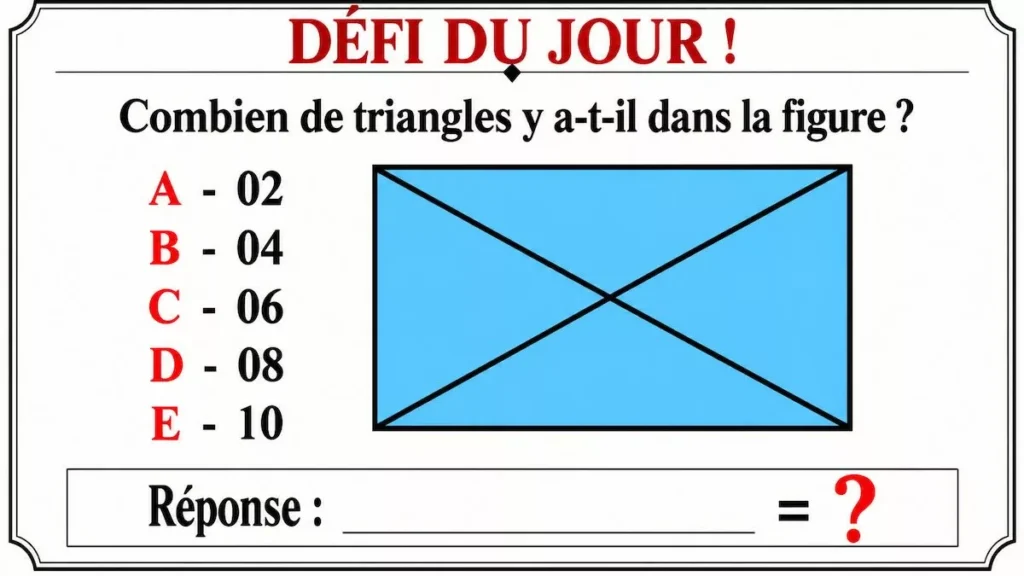
How many triangles can you find in this figure?
A rectangle is crossed by its two diagonals.
The possible answers are:
A: 2
B: 4
C: 6
D: 8
E: 10
Be careful: don’t just count the smallest triangles!
You have 10 seconds.
The Countdown Begins
10…
9…
8…
7…
6…
5…
4…
3…
2…
1…
Time’s up!
What Your Performance May Reveal
If you found the result quickly and correctly, you have excellent logic and good analytical skills.
If you found the result after some reflection, you know how to structure your reasoning and check your steps.
And if your result was incorrect or you didn’t find it, no worries, this type of exercise is perfect for improving your method and precision.
Detailed Solution We Found (Not Necessarily the Only One, Sometimes Even the Correct One)
To avoid missing any, let’s proceed methodically.
The two diagonals intersect at the center of the rectangle. They first create 4 small triangles: one at the top, one at the bottom, one on the left, and one on the right.
But that’s not all.
The complete diagonals also allow for the formation of larger triangles using three vertices of the rectangle.
We can identify 4:
One large triangle using the top side,
One using the bottom side,
One using the left side,
And one using the right side.
So we have:
4 small triangles + 4 large triangles = 8 triangles
Answer: D — 8 Triangles
Conclusion
This challenge reminds us that in geometry, seeing a figure does not mean you have fully analyzed it. The four small triangles are immediately visible, but the four large triangles are easier to overlook because they consist of multiple regions.
The best method is to count the figures by size: first the smallest, then the largest. This organization prevents omissions and double counting.
If you found 8 triangles before the countdown ended, congratulations! And if you stopped at 4, you fell into the main trap of the challenge: some shapes only become visible after looking at the whole figure.
And before you get lost in the depths of the web, explore other games and tests by clicking here.