The calculation rules we use today are the result of centuries of evolution in mathematics. As trade, astronomy, navigation, and the sciences developed, it became essential to have common methods to perform calculations without ambiguity. Mathematics has thus enabled us to build, measure, predict, and today, to operate a significant portion of the technologies that surround us.
However, their value lies not only in major discoveries. A calculation involving a few numbers can already develop a fundamental skill: knowing how to organize one’s reasoning before seeking the answer.
“Mathematics is the door and key to the sciences.” — Roger Bacon
In such challenges, many people instinctively start calculating from left to right without considering the entire equation. This is a common reaction: the numbers seem simple and give the impression that the answer will be immediate. However, taking a few seconds to identify the priority operations often suffices to avoid errors.
What This Challenge Allows You to Work On:
- Order of operations;
- Multiplication and division;
- Addition and subtraction;
- Mental calculation;
- Careful reading of an equation;
- Speed of reasoning;
- Verification of results.
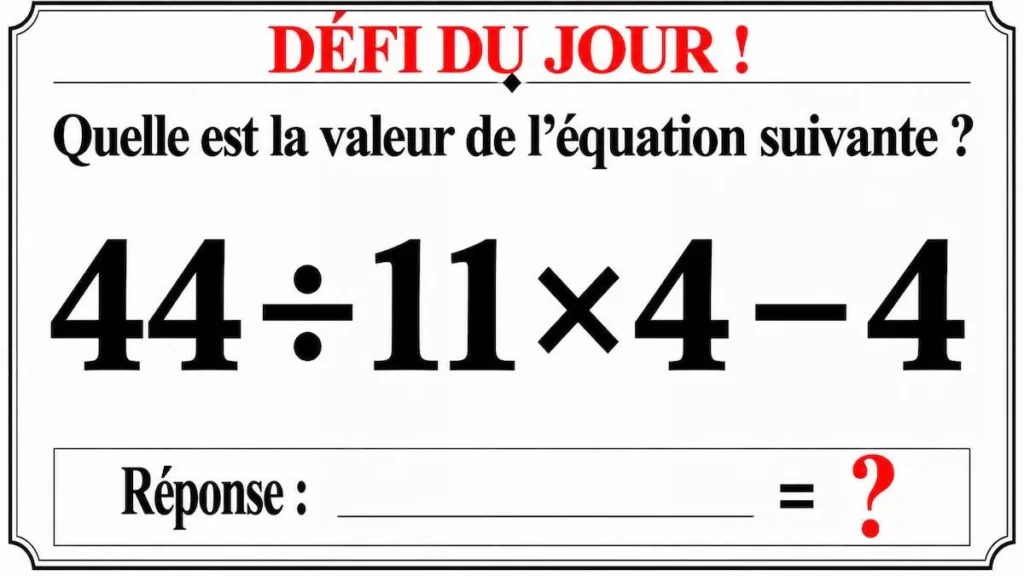
CHALLENGE OF THE DAY!
What is the value of the following equation?
You have 10 seconds to find the correct answer.
The Countdown Begins
10…
9…
8…
7…
6…
5…
4…
3…
2…
1…
Time’s up!
What Your Performance Can Reveal
If you found the result quickly and correctly, you have excellent logic and analytical skills.
If you found the result after some thought, you know how to structure your reasoning and check your steps.
And if the result is incorrect or not found, no worries; this type of exercise is perfect for improving method and accuracy.
Detailed Solution We Found (Not Necessarily the Only One, and Sometimes Not Even the Right One)
In this equation, division and multiplication take precedence over subtraction.
But it’s also important to remember a key rule: multiplication and division have the same priority. When they occur sequentially, they are performed from left to right.
So we start with:
44 ÷ 11 = 4
The equation now becomes:
4 × 4 − 4
Next:
4 × 4 = 16
Now we have:
16 − 4 = 12
Answer: 12
Conclusion
This challenge may seem extremely simple because it contains only four numbers. However, it allows us to verify a fundamental rule: we do not choose the order of calculations based on their appearance.
Division and multiplication are performed before subtraction, and since they have the same level of priority, they are processed from left to right.
Thus, the correct answer is 12.
Ultimately, this little test reminds us of something essential in mathematics: speed is useful, but a correct method is even more important.
And before you get lost in the depths of the web, explore other games and tests by clicking here.