Long before calculators arrived, mathematicians understood that calculations couldn’t be performed randomly. Common rules had to be established so that the same sequence of numbers would always yield the same result. This organization of calculations became essential with the development of sciences, astronomy, engineering, and later, computer science. Even today, the relevance of these rules extends far beyond school exercises.
They teach us to organize a sequence of steps, identify what needs to be addressed first, and avoid hasty conclusions.
“Mathematics knows no races or geographic boundaries; for mathematics, the cultural world is a single country.” — David Hilbert
It often happens that a calculation consisting solely of divisions seems obvious. However, as soon as a parenthesis appears next to a number, a quick reading can lead to misinterpretation. In such cases, the best method is to observe the entire equation before performing the first operation.
What This Challenge Allows You to Work On:
- the role of parentheses;
- the order of operations;
- division;
- implicit multiplication;
- mental calculation;
- rigorous reading of an equation;
- verification of the result.
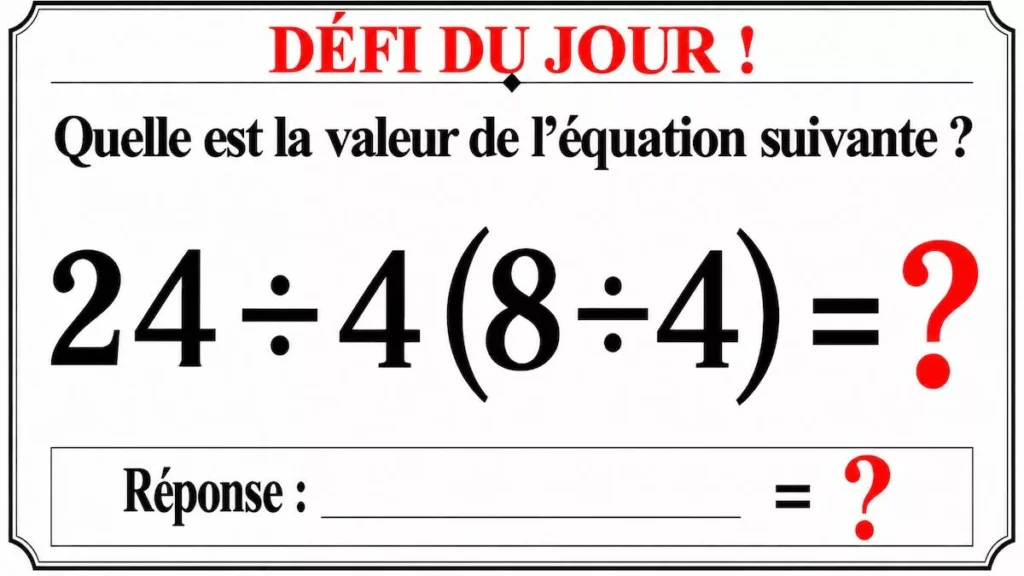
CHALLENGE OF THE DAY!
What is the value of the following equation?
You have 20 seconds to find the correct answer.
The Countdown Begins
10…
9…
8…
7…
6…
5…
4…
3…
2…
1…
Time’s up!
What Your Performance Can Reveal
If you found the result quickly and correctly, you possess excellent logic and analytical skills.
If you found the result after some thought, you know how to structure your reasoning and check your steps.
And if your result was incorrect or you didn’t find one, don’t worry; this type of exercise is perfect for improving method and precision.
Detailed Solution We Found (Not Necessarily the Only One, or Even the Correct One)
We start with what’s inside the parentheses:
8 ÷ 4 = 2
The equation then becomes:
24 ÷ 4 × 2
The fact that the 4 is placed directly in front of the parentheses indicates multiplication: 4(2) = 4 × 2.
Once the parentheses are calculated, multiplication and division have the same priority. Therefore, we perform them from left to right.
First:
24 ÷ 4 = 6
Then:
6 × 2 = 12
Answer: 12
Conclusion
This challenge is interesting because the numbers used are extremely simple. The real difficulty lies in reading the equation.
After calculating the parentheses, we obtain 24 ÷ 4 × 2. Since division and multiplication have the same priority, the calculation continues from left to right.
Thus, the answer is 12.
This little test reminds us of an essential rule: in mathematics, carefully reading an equation is already part of solving it.
And before you get lost in the depths of the web, explore other games and tests by clicking here