Mathematics is not just a series of calculations; it is also a way to organize thought. Since ancient times, mathematicians have sought to establish rules that allow everyone to understand reasoning and achieve the same result. These rules have accompanied great achievements, from architecture to modern sciences, including astronomy, engineering, and computer science.
In everyday calculations, this rigor remains essential. An equation may seem very simple at first glance, but a parenthesis or the order of operations can completely change the answer.
“Mathematics is the art of giving the same name to different things.” — Henri Poincaré
We have all encountered a calculation that seemed obvious before realizing that a small detail had been overlooked. Often, the error does not stem from a difficult multiplication or division, but simply from starting at the wrong place. Taking a few seconds to observe the equation before calculating can make all the difference.
What This Challenge Helps To Work On:
- The respect of operational priorities;
- The role of parentheses;
- Multiplication and division;
- Mental calculation;
- Observation before calculation;
- Speed of reasoning;
- Verification of results.
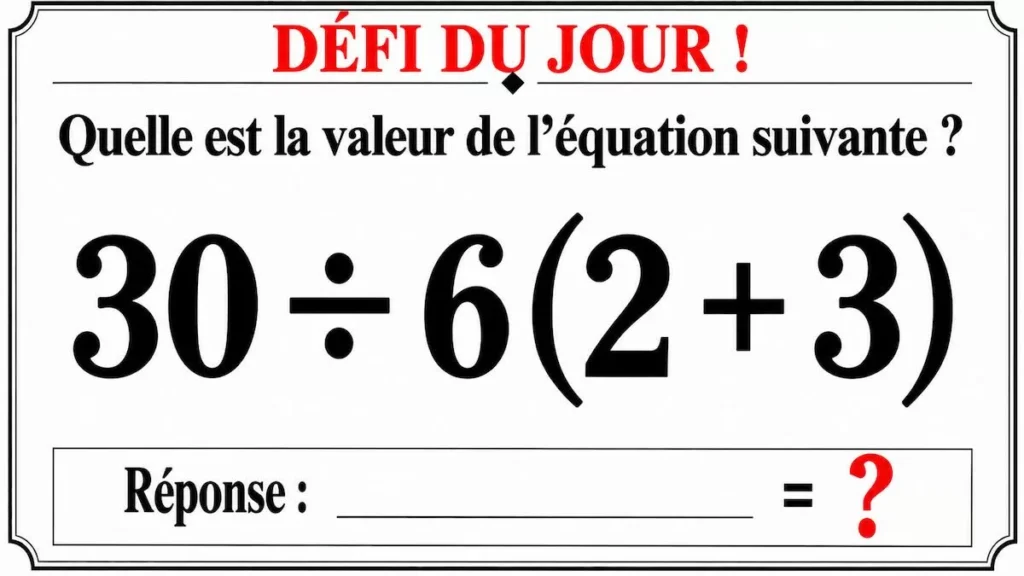
CHALLENGE OF THE DAY!
What is the value of the following equation?
You have 30 seconds to find the result.
The Countdown Begins
20…
15…
10…
5…
4…
3…
2…
1…
Time’s up!
What Your Performance Can Reveal
If you found the result quickly and correctly, you have excellent logic and good analytical skills.
If you found the result after some thought, you know how to structure your reasoning and check your steps.
And if the result was incorrect or not found, no worries; this type of exercise is perfect for improving method and precision.
Detailed Solution We Found (Not Necessarily The Only One, Sometimes Even The Correct One)
We must start with the parentheses:
2 + 3 = 5
The equation becomes:
30 ÷ 6 × 5
Multiplication and division have the same priority. When they follow each other, they are performed from left to right.
So we start with:
30 ÷ 6 = 5
Then:
5 × 5 = 25
Answer: 25
Conclusion
This challenge perfectly illustrates why it is essential to distinguish between the priority of operations and the order of reading. Parentheses come first, but once they are calculated, multiplication and division are on the same level of priority and are processed from left to right.
The equation may seem short, but it requires a precise understanding of mathematical conventions. This is precisely the point of such challenges: it’s not the difficulty of the numbers that matters, but the quality of reasoning.
Thus, the answer is 25.
And before you get lost in the depths of the web, explore other games and tests by clicking here.